Health = Looks Review: 7,571 Members, $39/mo
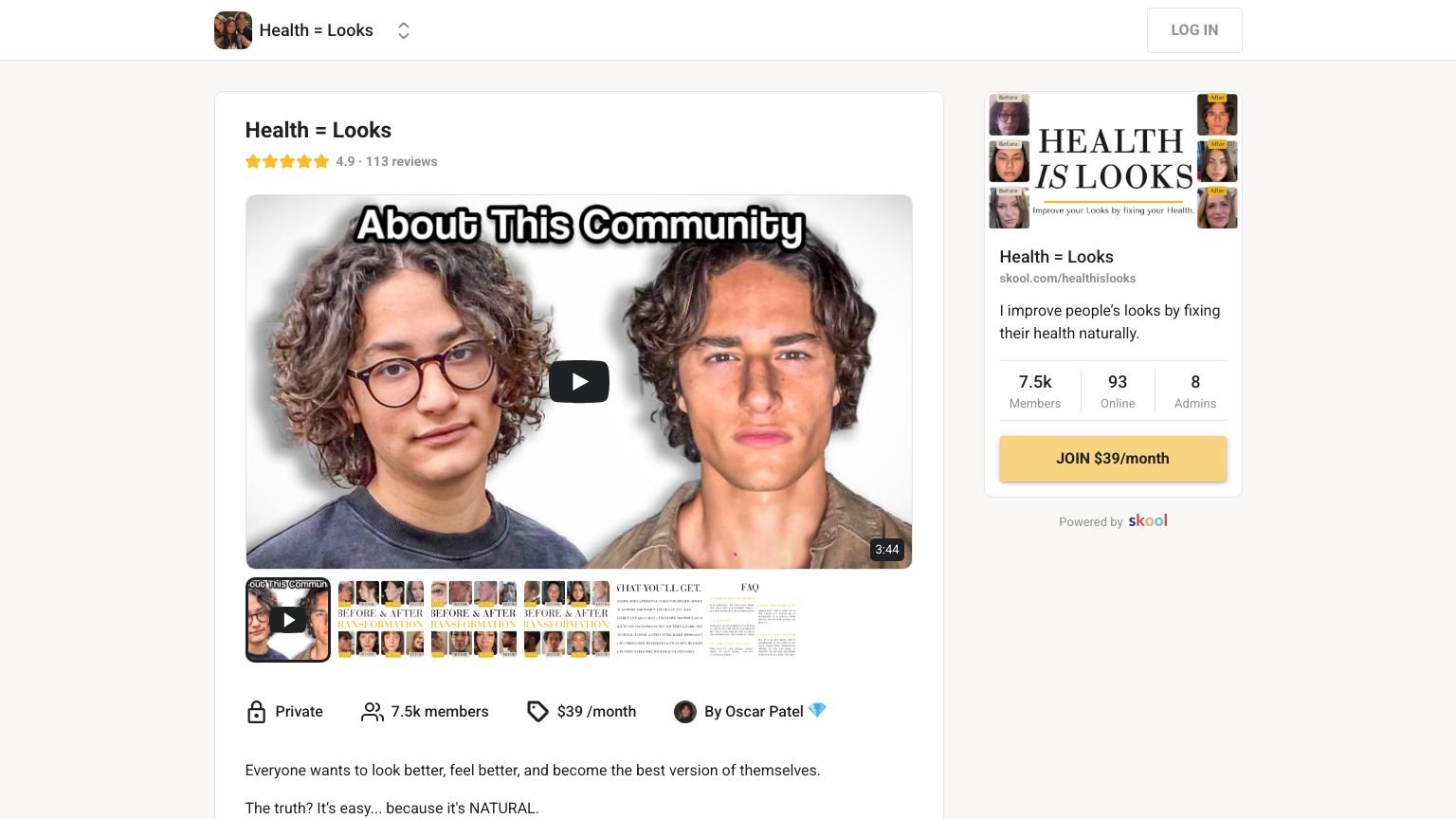
Health = Looks costs $39 a month for 477 modules and 7,571 members. The founder's profile carries no links at all. What that means for you.
 By Ray Okafor ·

No score: research review
We only score what we used. The verdict below is built from public sources. Price at review: $39/month.
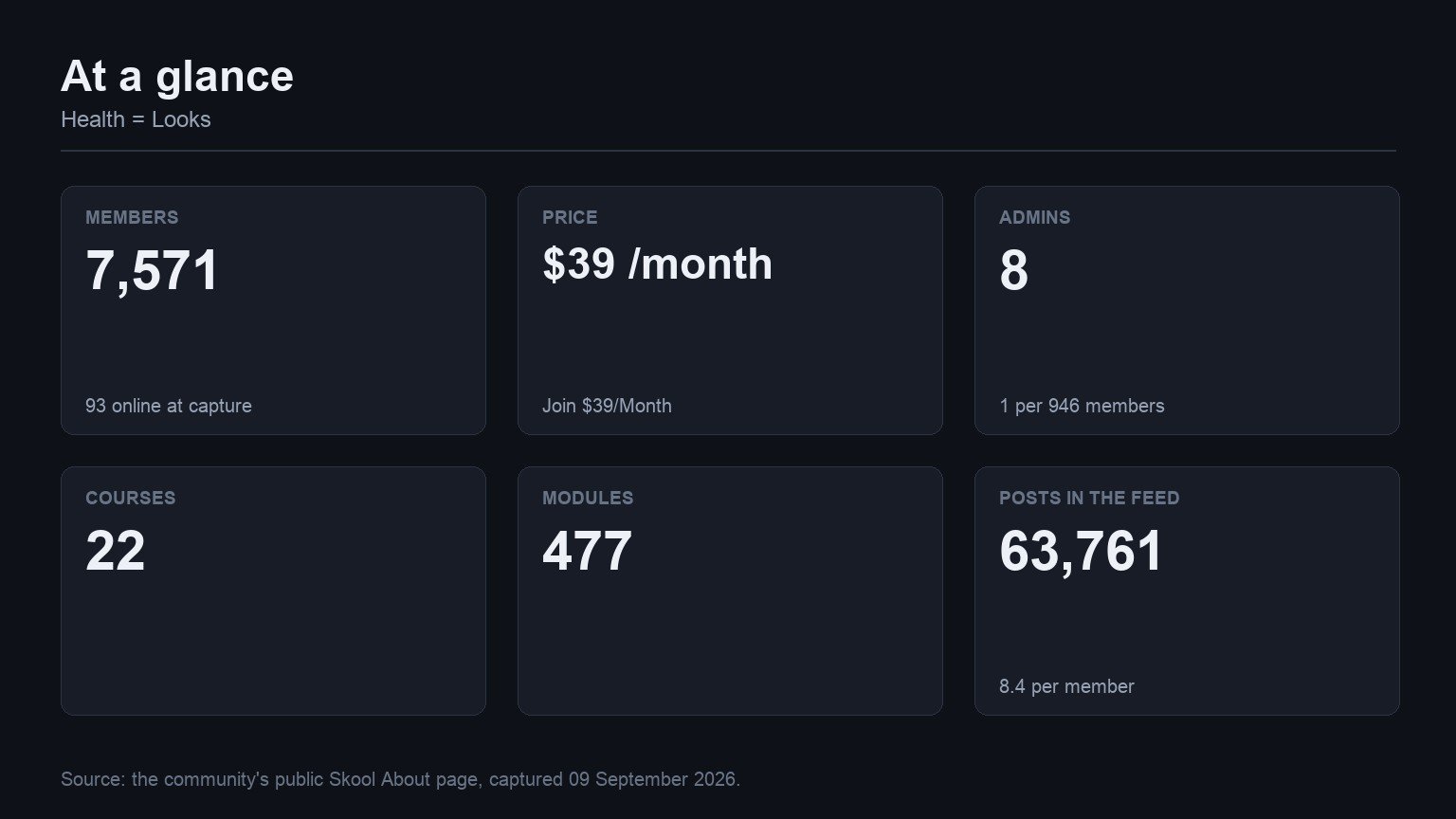
$39 a month for 477 modules across 22 courses, the cheapest entry in Skool's top five
The founder's profile carries no links, no location and no stated qualifications
Source: Skool public About page, captured September 9, 2026
Seven thousand, five hundred and seventy-one members. Sixty-three thousand posts. Thirty-nine dollars a month.
And a founder profile with nothing on it. No website, no social link, no location, no qualification. One sentence of biography.
That combination is what this review is about.
How this was written: I have not joined Health = Looks and have paid Oscar Patel nothing. Everything here comes from the public Skool About page, the member reviews Skool restricts to paying members, and whatever public record the founder has attached to his profile, captured on 9 September 2026. Claims taken from the sales copy are named as the seller’s, not repeated as fact.
Quick Decision
Worth $39 a month if you are curious about breathing, posture and facial development, you want a large peer community to compare notes with, and you will treat everything inside as a starting point rather than instruction. The library is big and the price is low enough that the risk is one month of money.
Do not join if you are looking for clinical guidance, if you have an actual diagnosed condition, or if you need to know who is teaching you before you take advice about your body. On that last point the listing gives you nothing to work with.
The current terms sit on the Health = Looks listing if you want to read the page yourself.
Oscar Patel, And A Profile With Nothing On It
The founder section is normally where a review finds its reassurance. Here it is where the problem lives.
Oscar Patel has run the community since August 2024. His biography is one line: he improves people’s looks by fixing their health. His location field is blank. His links object is empty.
No website. No YouTube. No Instagram. No LinkedIn. Nothing.
One member review mentions following him on YouTube before joining, so an audience clearly exists somewhere. It is simply not connected to the page asking for your money.
Why this matters more here than elsewhere
Every founder gap is a gap. This one is larger because of the subject.
A community teaching Facebook ads can be judged on results you can measure in a month. A community discussing breathing mechanics, palate width, posture and fascia is discussing your body, and the reasonable question is what qualifies the person teaching it. The listing does not name a qualification, a training background, a clinical partner or a single source.
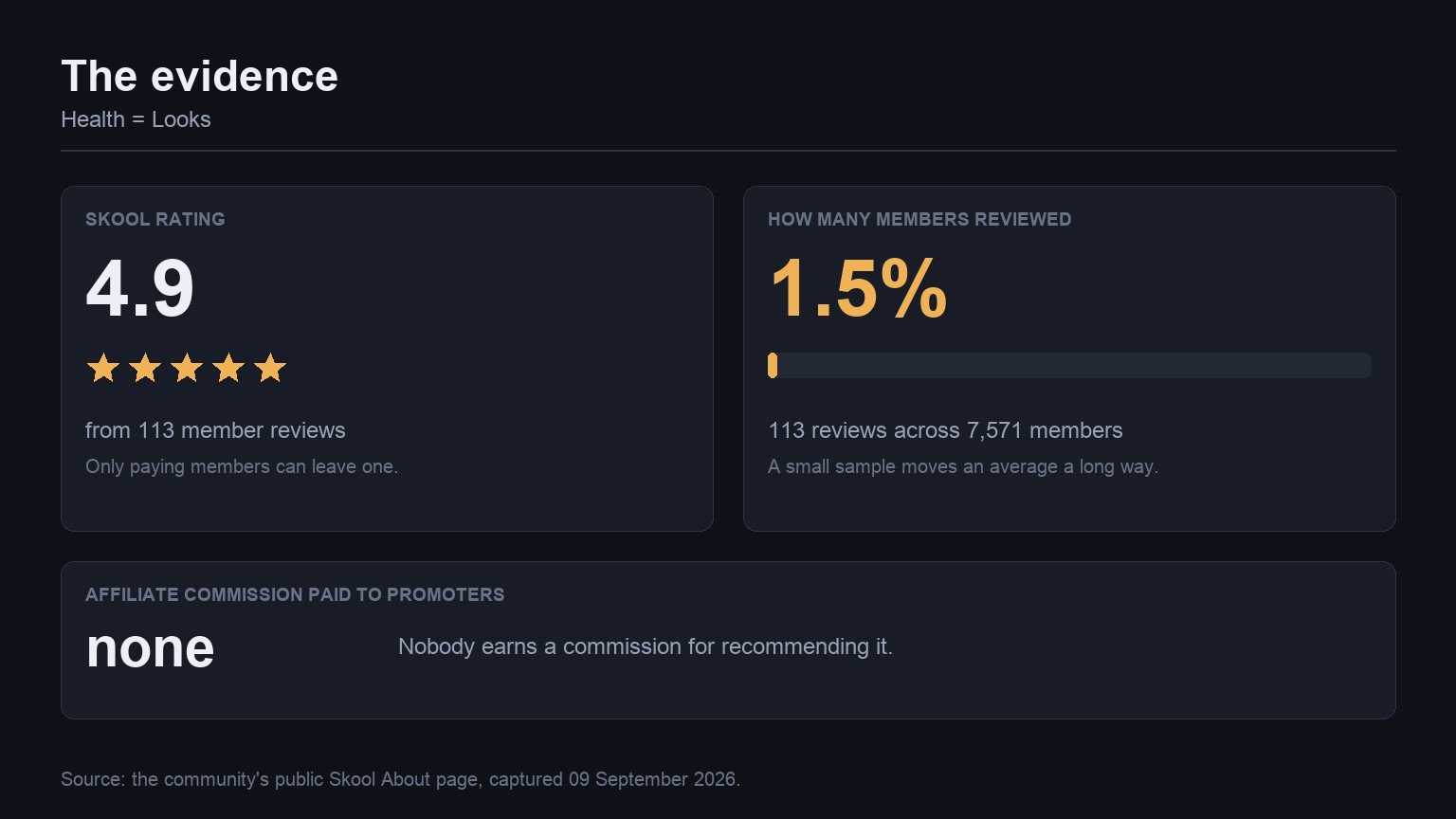
That does not make him wrong. Plenty of useful practical knowledge sits outside formal credentials, and 113 members who paid rated the experience 4.9. But you are being asked to take physical advice from someone the page will not let you research, and you should know that before you pay rather than after.
What you can do about it
Find his free material and spend an evening with it. If the reasoning is careful and he tells you what he does not know, that is a real signal. If every claim arrives with certainty and no source, that is a signal too.
Thirty-nine dollars is a low enough price that testing costs little. The judgement still has to be yours, because nobody on the page has made it for you.
What $39 A Month Gets You
Thirty-nine dollars, monthly. That is the cheapest entry in Skool’s top five by revenue, and by a wide margin.
The listing holds no structured price record. The button is the only place the number appears, which is worth a screenshot on the day you join.
No annual plan is offered. No trial, no free tier and no refund window are published anywhere on the page.
The price is the strongest argument here
At $39 a month, 477 modules across 22 courses is a lot of material per dollar. A month of testing costs less than dinner out, and cancelling a Skool membership does not require a phone call.
That changes how you should think about the transparency problem. At $1,700 a month, a founder with no public record would be disqualifying. At $39 it is a reason for caution and a reason to verify anything before acting on it, rather than a reason to walk away entirely.
Set your own limit. If a month inside teaches you nothing you can check independently, leave.
Seven Thousand Members, Ninety-Three Online
| What | Count |
|---|---|
| Members | 7,571 |
| Members online at capture | 93 |
| Admins | 8 |
| Courses | 22 |
| Modules | 477 |
| Posts in the feed | 63,761 |
Sixty-three thousand, seven hundred and sixty-one posts across 7,571 members is 8.4 posts each. That is a working community with years of accumulated discussion, not a landing page with a chat box.
Twenty-two courses holding 477 modules is a broad rather than deep library, averaging about 22 modules per course. That shape usually means many separate topics covered at moderate length, which fits a subject spanning sleep, breathing, diet, posture and facial development.
Eight admins across 7,571 members is one per 946. Thin in absolute terms, generous for $39 a month, and better than at least one community in the top five charging nearly five times more.
The one number that deflates
Ninety-three members online at capture, out of 7,571. That is 1.2 percent.
Membership counts on Skool are cumulative and include people who joined once and never returned. The live presence figure is the more honest measure of how busy the room feels on a Tuesday afternoon, and 93 is modest for a community this size.
The Argument The Page Is Making
The sales copy sets out a clear thesis, and it is worth reading as an argument rather than as a feature list.
It claims that what we call attractive is simply health, that humans are biologically wired to select the healthiest mate, and that we were designed to look a certain way but drift from it through environment and habit. It states that fascia can always be adapted, so correction is always possible. It ends with a claim about breathing: a wider palate and more efficient breathing will gain you years.
That is the whole pitch. It is coherent, it is confident, and it carries no source at all.
Where the argument gets ahead of itself
Some of this has mainstream support. Sleep quality, nasal breathing and posture do affect how people look and feel, and that is not controversial.
The step that needs evidence is the claim of permanent structural change through habit, and the further claim that it adds years to your life. Those are physiological claims with a measurable answer, and the page presents them without a study, a practitioner or a number.
Skool’s data verifies none of it. What Skool verifies is 7,571 members, 22 courses, 477 modules and 113 reviews averaging 4.9. Everything about the body is the seller talking.
The Review That Needs A Doctor, Not A Community
One member review describes real physical change: better sleep, a less puffy face, and a deviated septum that is now almost gone with a straighter nose (a member review on Skool, September 2026).
I want to handle this carefully, because it is the most persuasive thing on the page and also the most concerning.
It is a genuine member’s genuine experience as they describe it. It is also an unverified self-report about a structural nasal condition, written by someone with no stated way of measuring the change. Nobody examined them before, nobody examined them after, and no clinician is quoted.
If you have a diagnosed condition, that review is not a reason to join a $39 community instead of seeing a doctor. Read it as one person’s account, treat the community as somewhere to discuss habits, and keep medical questions with medical people.
The community itself did not write that review, and it is not responsible for how a member describes their own body. The responsibility that does sit with the page is the absence of any note telling readers where the line is.
Why 4.9 Is The Most Reassuring Number Here
One hundred and thirteen reviews at 4.9 out of 5.
Every other community in Skool’s top five sits at a flat 5.0. Across dozens or hundreds of reviewers, a perfect average is statistically strange, and it usually means either a very small sample or a community that manages its review requests closely.
Health = Looks is the only one of the five where somebody rated it below five stars, and I trust the room more for it.
The catch is that the dissenting reviews are not among those captured, so what went wrong for that member is not visible. Skool restricts reviewing to paying members, which means the 113 are all real payers, and it also means people who quit tend to leave without writing anything. Any Skool review panel is a record of the people who stayed.
Inside The Written Feedback
Two more worth reading.
One member says the community has changed their life, and reports feeling stronger, healthier, more confident and more capable (a member review on Skool, September 2026). Another praises the founder’s dedication and describes seeing improvements in health and appearance they had not thought possible (a member review on Skool, September 2026).
The pattern in the language
Read enough of these and the shape is consistent. Members describe how they feel, how confident they are, and how supportive the room is.
What almost nobody provides is a measurement. No before and after numbers, no sleep study, no timeframe, no photographs described with any specificity. The praise is real and it is subjective.
In a health community that is expected, and it is not evidence of anything wrong. It does mean the review panel cannot tell you whether the method works in the way the page claims. It tells you people enjoy being there and believe they improved.
No Commission, No Promoters
The listing shows an affiliate rate of zero.
Nobody earns money for recommending Health = Looks. In the health and appearance niche, where paid promotion is the default, that is genuinely unusual and it removes a whole category of doubt about the reviews you find.
It has a cost as well. Communities that pay nothing get written about far less, so there is very little independent coverage to read before you decide. Most of what exists online comes from the founder’s own audience, which is not the same as scrutiny.
Don’t Join If
- You have a diagnosed medical condition. A $39 community is not a substitute for a clinician.
- You need to know who is teaching you. The founder’s profile carries no links and no qualifications.
- You want sourced claims. Nothing on the page cites a study, a practitioner or a measurement.
- You expect constant live activity. Only 93 of 7,571 members were online at capture.
My Verdict
The value is real at the price. Four hundred and seventy-seven modules across 22 courses for $39 a month is the most material per dollar in Skool’s top five, the feed holds 63,761 posts from a 7,571-member base, and 8 admins is respectable staffing for a community this cheap. A zero percent affiliate rate means nobody is paid to like it, and a 4.9 average across 113 verified payers is more credible than the perfect fives sitting above it in the rankings.
The weak points are about who is behind it and what backs it up. An empty links object, a blank location and a one-line biography give you no way to evaluate the person teaching you about your own body. Every physiological claim on the page arrives without a source. And the most compelling member review makes a medical claim that no clinician checked.
Watch the founder’s free material first, join for one month if it holds up, and take nothing about a diagnosed condition from a community feed. For a comparison on how a low price and a large library can work in a different niche, our Maker School review covers a $184 community with 745 modules, and the La Tribu Divisual review looks at how a founder’s public record changes what a community is worth.
Full pros & cons
- $39 a month for 477 modules across 22 courses, the cheapest entry in Skool's top five
- 63,761 posts from 7,571 members, about 8 posts each, so the feed carries real discussion
- 113 reviews at 4.9, the only community in the top five that is not a suspiciously perfect 5.0
- No affiliate programme, so nobody earns a commission for recommending it
- 8 admins on 7,571 members, better staffing than several communities charging five times more
- The founder's profile carries no links, no location and no stated qualifications
- The page makes physical health claims with no clinician, study or source attached
- One member review describes a deviated septum improving, which is a medical claim nobody verified
- The listing holds no price record, only a button reading $39 a month
- Only 93 of 7,571 members were online at capture, about 1.2 percent
Try it yourself
Ready to put it to the test?
We may earn a commission at no extra cost to you. Affiliate disclosure.
Frequently Asked Questions
How much does Health = Looks cost?
Who is Oscar Patel?
Are the health claims verified?
Why is the rating 4.9 and not 5.0?
Is Health = Looks active?
Does Health = Looks pay affiliates?
Reader feedback
Was this review helpful?
Your feedback helps us write better reviews.
Thanks for your feedback.
Ray Okafor is the analyst behind AI Insider Edge, covering AI tools, online courses, and paid communities in the make-money-online space. Hands-on reviews say so and state what was actually paid for access. Research reviews say that too, and are built from the seller’s own public pages, verified member reviews, and the founder’s public record. Either way the aim is a buyer’s-eye read, not a press release. Reviews are independent and may contain affiliate links, at no extra cost to you.
More reviews: Health, self-improvement and lifestyle

The Holistic Gut Reset Skool Review (2026)
The Holistic Gut Reset lists $59/month while its own copy says $99. 858 members, 15 five-star reviews, and no medical disclaimer on the page.

Dor Eckstein: The Closed Community Skool Review (2026)
Dor Eckstein's closed community charges $144/mo. It is Hebrew-only, promises pain relief from written body codes, and shows zero written reviews.

4biddenknowledge Academy Review: 1,458 Members, $55/mo
4biddenknowledge Academy runs at $55/month for 1,458 members and 68,821 posts. The founder's credential claims carry no source on the listing.

Ilana's Method Review: 945 Members, $4,999/yr
Ilana's Method charges $4,999 a year for 945 members, 751 modules and 6 admins. 34 reviews average 5.0, and no clinical credential is published.

Is Headman Nation Worth $49/mo?
Headman Nation lists $49/month for 1,229 members, 1,042 modules and 2 admins. Only 7 reviews exist, and Skool holds no structured price record.

Library of Adonis Skool Review (2026)
Library of Adonis costs $37/month for 2,620 members, 340 modules and 4 admins. All 344 reviews average 5.0, and the visible ones say almost nothing.
The Edge Briefing
One honest review, every Sunday.
One email a week: which AI tools, courses & communities passed the rubric — and which to skip. Built for people funding their own stack.