Monetise Discount & Coupon Codes: The Honest Answer (2026)
There is no published Monetise discount. What the $1,995 price has actually been, why coupon sites show fake codes, and the one legitimate way to pay less.

We bought this. We paid $1,995 for Monetise on September 7, 2026 and we publish the receipt on our full Monetise review. We have not finished the course, so nothing below is a verdict on the teaching.
Short answer: there is no Monetise discount code. The program has never sold through coupons, and every “Monetise promo code” page we checked is a template site farming clicks. Here’s the full picture so you don’t waste an evening hunting.
What the price has actually been
Monetise has had exactly two prices in its life. Monetise 1.0 was $999 for a twelve-month software subscription, and it stopped being the product in September 2025. Monetise 2.0 is $1,995, one-time, and that’s what sells at the Side Hustle Summit in September. The full version history, with sources, is on our Monetise pricing page.
Neither version ever had a public coupon. The cart isn’t open continuously either: Monetise sells in launch windows, and between them the site takes waitlist signups only. A product that spends most of the year not for sale has no reason to discount the weeks it is.
What the checkout looks like, since we bought it
The cart opened on 7 September 2026 during the summit’s second session, and we paid $1,995. Two things on that page settle this question.
There is an “Add promo code” field. Whop hosts the checkout and that field appears on every Whop product. A field is not a code. Nothing in the presentation, the confirmation email or the welcome email contained one, and the total due was the full $1,995.00.
There is a payment plan. Splitit is offered at checkout alongside card, PayPal, ACH, bank wire and crypto, and Gadzhi quoted it live at from $166 a month, subject to region and approval. Twelve months at $166 is $1,992, so it spreads the cost rather than cutting it. Check Splitit’s own terms before using it, and remember a financed purchase still has to be refunded inside the same 7 days.
The number that shrinks while you watch
Worth knowing before the pitch reaches you. During the offer presentation on 7 September, one bundle graphic carried a “Total value” box that read $10,000, then $5,000 a few moments later, then relabelled itself Investment: $1,995. Same slide, same items, nothing added or removed. Spoken, the sequence ran $19,458, then “you won’t pay $10,000”, then “$5,000 would be justified”, then $1,995.
$1,995 has been the price since September 2025. Arriving at it from above is presentation, not a discount.
Why coupon sites show codes anyway
Type any paid program into a coupon aggregator and it will “find” codes, because those pages are generated from the search demand, not from the merchant. The codes fail at checkout, the page still earned its ad impression. If a Monetise code somewhere claims 20% off, ask where a working screenshot of it is. There won’t be one.
The one legitimate way to pay less
Attend the summit before deciding, and be early. The event is free, the $1,995 pitch runs during it, and the launch does bundle its best terms for live attendees. The first 777 buyers on 7 September got a four-day bootcamp with Russell Brunson on 5 to 8 October that is otherwise reserved for $25,000 clients. That is not a discount, but it is the only version of “paying less for Monetise” that exists: the same price with more attached to it. Registration details are on the free ticket page, and what we hand attendees who register through this site is on the bonus page.
The closest thing to a discount actually happened, and it wasn’t a code
On 8 September, in the summit’s third session, Gadzhi added two bonuses to the offer and left the price alone. ListKit, an automated creator-outreach tool he quoted at $7,164 a year, and Ask Iman AI at $1,495. The stated stack value went from $15,293 to $19,458. The number you pay stayed at $1,995.
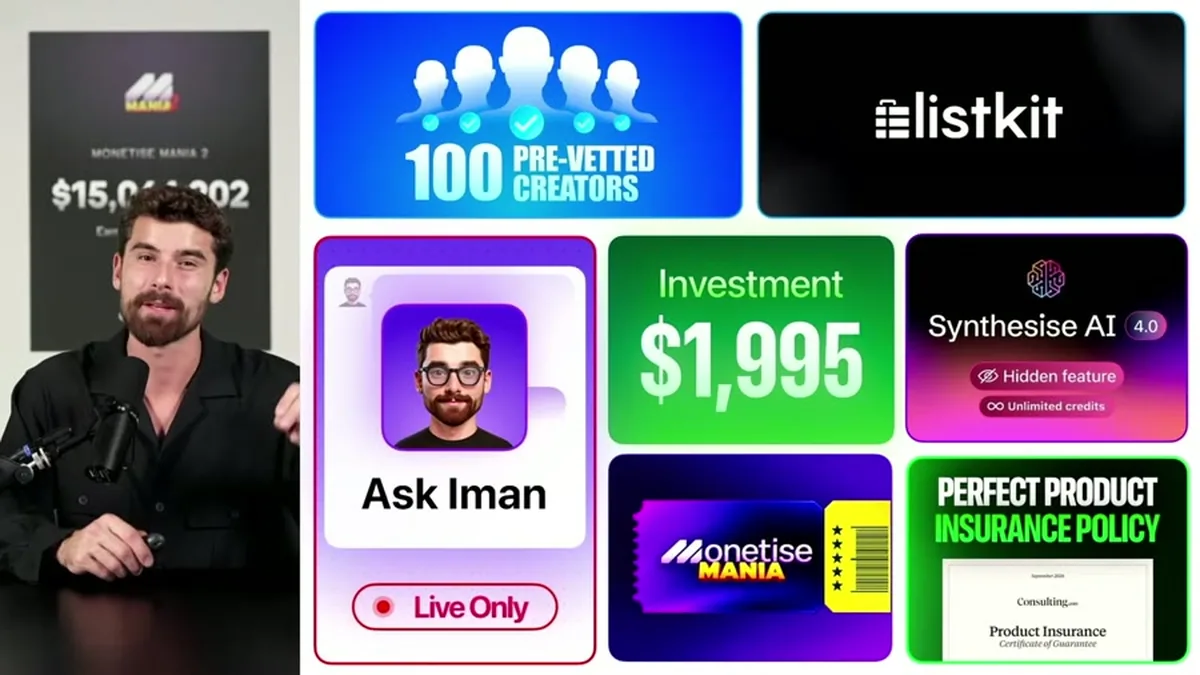
That is the only mechanism by which anyone paid less per unit of stuff during this launch, and it is worth being precise about what it is and is not. It is not a discount. Nobody’s card was charged a smaller number. Buyers from 7 September were told the new bonuses were added to their accounts retroactively, so early buyers were not penalised either.
One asterisk that matters more than the value figures. Ask Iman was sold as live-only, gone when the stream ended. So the $19,458 stack and the $1,995 price were never available at the same time to anyone watching a replay. If a page quotes you that stack today, it is quoting a bundle you cannot buy.
If $1,995 is the sticking point
Then the honest move is not a coupon hunt, it’s reading what’s inside Monetise and the refund terms and deciding whether the course, the four AI tools and the community clear that bar for you. A price you need a discount to justify is usually a price you shouldn’t pay.
Try it yourself
Ready to put it to the test?
We may earn a commission at no extra cost to you. Affiliate disclosure.
Reader feedback
Was this review helpful?
Your feedback helps us write better reviews.
Thanks for your feedback.

Ray Okafor is the analyst behind AI Insider Edge, covering AI tools, online courses, and paid communities in the make-money-online space. Hands-on reviews say so and state what was actually paid for access. Research reviews say that too, and are built from the seller’s own public pages, verified member reviews, and the founder’s public record. Either way the aim is a buyer’s-eye read, not a press release. Reviews are independent and may contain affiliate links, at no extra cost to you.
More reviews: Online business and community building

Monetise Bonus (2026): What's Real and What's Recycled
What bonuses actually come with Monetise at the Side Hustle Summit, how to judge affiliate bonus stacks, and the four things we hand out ourselves.

Monetise Refund Policy: The 7-Day Window, Explained (2026)
Monetise 2.0 carries a 7-day no-questions refund window per partner documentation. What that covers, what it doesn't, and what to verify at checkout.

Monetise vs Skool (2026): One's a Course, One's a Platform
Monetise is Iman Gadzhi's $1,995 program for building digital products. Skool is a $99/month community platform. Which you need depends on what you're missing.

Pay It Forward Learning Center Review: 2,665 Members, $25/mo
Pay It Forward Learning Center gives 1,627 modules for $25/mo. But the owner record carries no human name, no location and no links. The numbers.

WAH Vault Review: 5,466 Members, $12/mo
WAH Vault charges $12 a month for curated remote job leads. The seller states she is not an employer, guarantees no placement and gives no refunds.

Lifestyle Founders Skool Review (2026)
Lifestyle Founders charges $1,500 a month for a room of 84 members and 3 admins. Eight reviews exist, and entry runs through a phone application.
The Edge Briefing
One honest review, every Sunday.
One email a week: which AI tools, courses & communities passed the rubric — and which to skip. Built for people funding their own stack.