Plan de estudios Di Fiore Review: 1,782 Members, $127/mo
Plan de estudios Di Fiore charges $127/mo for 21 modules across 2 courses. Every word of it is in Spanish. The numbers, read honestly.
 By Ray Okafor ·
A 5.0 average across 25 reviews, with no rating below five stars anywhere in the record
Every course, post and review is in Spanish, and no English track is offered anywhere on the listing
Source: Skool public About page, captured September 9, 2026
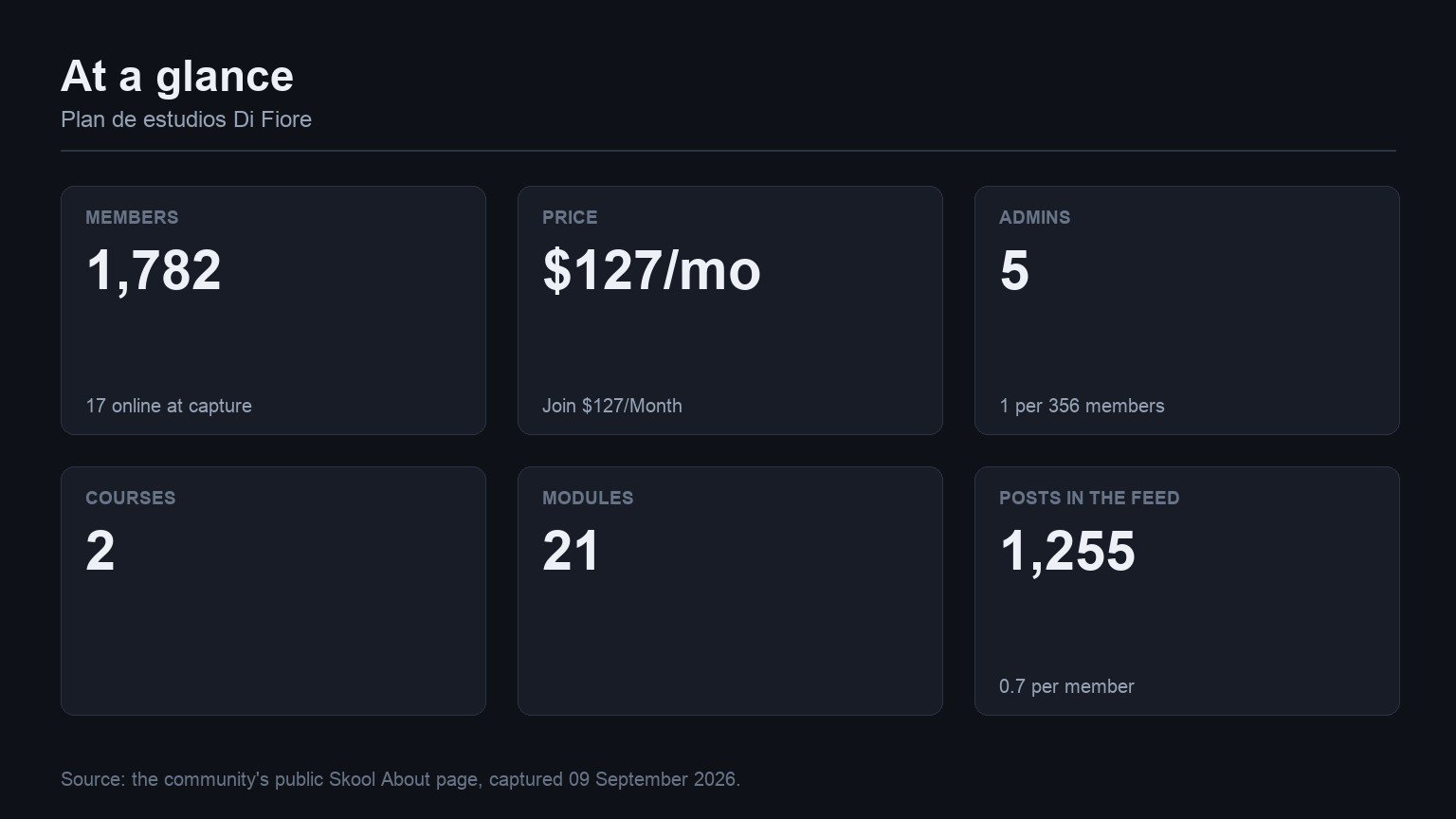
One thousand, seven hundred and eighty-two members. Twenty-one modules.
That ratio is the first thing to understand about Plan de estudios Di Fiore, and the second is that every word of it is in Spanish.
A disclosure before the detail. I am not a member here and no money has gone to Braian Di Fiore or anyone connected to him. What follows was built from the community’s public Skool About page, the written reviews Skool shows only to paying members, and the founder’s own public social accounts, captured on 9 September 2026. Where a claim comes from the seller’s own marketing rather than Skool’s records, I say so.
Quick Decision
Join if you are a Spanish-speaking mechanic who wants structured training in automotive electronics, you can read technical Spanish comfortably, and $127 a month is small against what a diagnostic repair bills in your market. The subject matter is a real trade skill with a real job market, which separates this from most communities at this price.
Hold off if you do not read Spanish. There is no English track, no subtitle offer and no bilingual admin promise anywhere on the listing. Hold off too if you judge value by volume, because 21 modules for $127 a month is one of the thinnest libraries per dollar in this ranking.
You can check the current terms on the listing itself before deciding anything.
Everything Here Is Written In Spanish
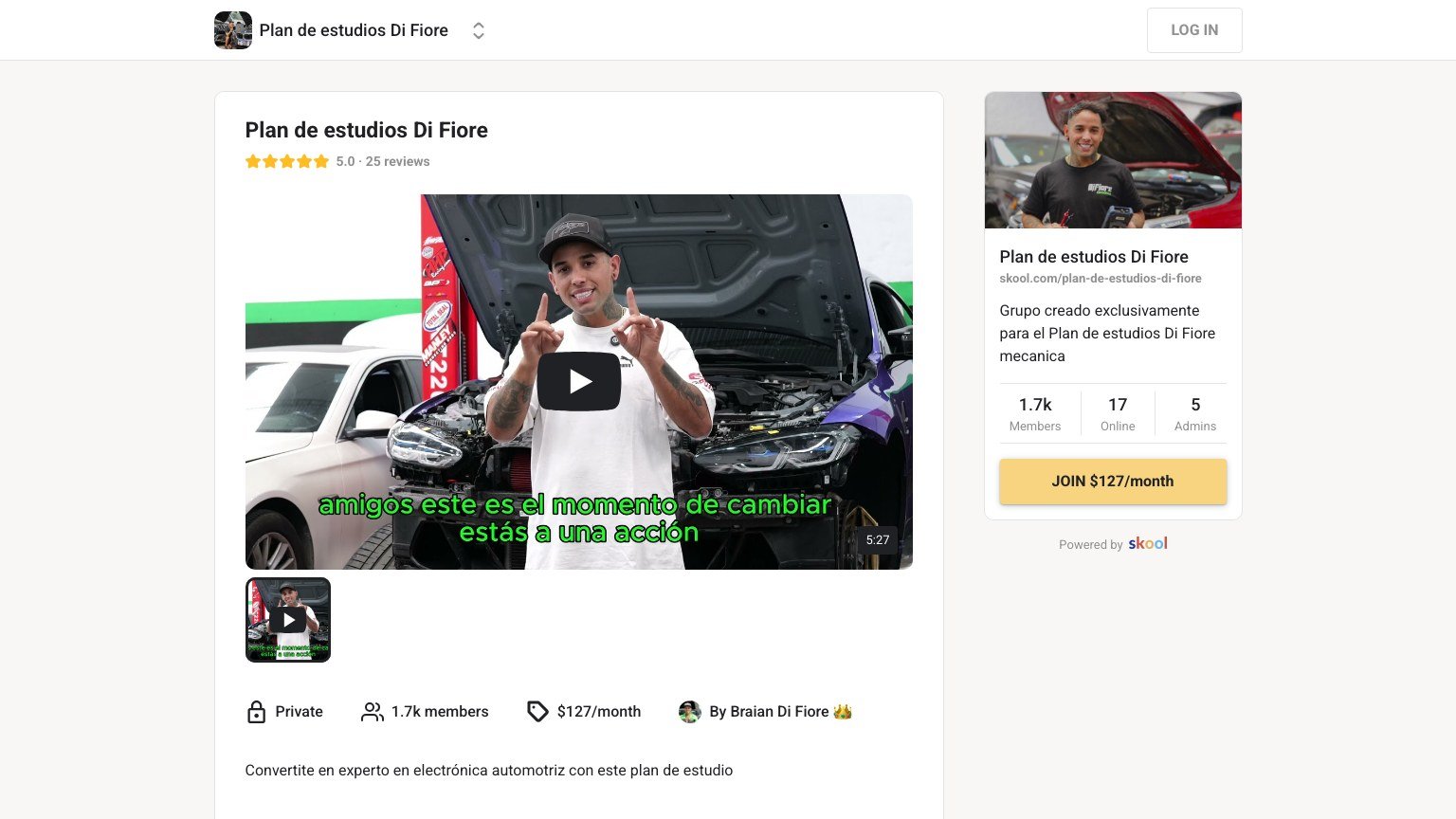
The community name is Spanish. The description is Spanish. The sales line is Spanish. Both visible member reviews are Spanish.
The seller’s line reads “Convertite en experto en electrónica automotriz con este plan de estudio”, which promises expertise in automotive electronics through a study plan. The group description says it exists exclusively for the Di Fiore mechanics study plan.
That is the seller talking, and it is also the whole of what the public listing tells you about content.
Nothing on the page offers an English option. No subtitles are mentioned, no translated workbook, no second track. Machine translation will get you through a forum post. It will not get you through a wiring fault diagnosis where one mistranslated term points you at the wrong sensor.
The verb form “convertite” is Rioplatense Spanish, used in Argentina and Uruguay. Combined with the Di Fiore Mecanica brand, that points at a South American audience and a South American shop context.
If you are an English-speaking technician, treat this section as the answer and stop reading before you spend $127.
Braian Di Fiore, And A Bio That Is Just His Name
Braian Di Fiore has held a Skool account since 6 November 2025. At capture that is about ten months, which makes this a young community rather than an established one.
His bio field reads “Braian Di Fiore”. That is the whole of it. His own name, repeated back into the space where a founder explains what he has done and why he is qualified to teach it.
The location field is blank.
Compare that with what the subject demands. Automotive electronics training is credibility-dependent work. A buyer wants to know how many years the man has spent under bonnets, which brands he specialises in, whether he holds a trade certification, and whether he still repairs cars or only films about them. None of that appears.
His account carries a crown badge. On Skool that marks a high-earning community owner, and it tells you the group sells well. It says nothing at all about whether the teaching is any good.
Facebook, Instagram, And No Website
Two public links sit on the founder profile. A Facebook page for Di Fiore Mecanica and an Instagram account under the same brand.
Both are free to look at, and both are the cheapest possible test before you spend anything. Watch the free material for a week. If the explanations make sense to you in Spanish and the shop work looks like work you recognise, the paid plan is at least plausible.
No website is listed. No YouTube channel is listed. For a training business, the absence of a long-form video archive is a gap, because long-form is where a technical teacher either holds up or falls apart.
The two links do more than most Skool founders offer, and the empty location field pulls straight back against them.
$127 A Month, Recorded Twice
The join button reads JOIN $127/month, and Skool’s structured price record independently stores $127 monthly in US dollars. Two matching sources is better than a lot of listings manage.
Twelve months at that rate is $1,524.
There is no sale price on the page. No countdown, no member cap, no “price rises soon” line. That is genuinely refreshing after the scarcity theatre that runs through most of this category, and it deserves credit.
The group is set to private, so the feed and the courses are invisible until you pay.
What Is Missing From The Price Page
No refund policy appears anywhere on the listing.
No trial period is offered. No annual plan is offered, which matters at $127 a month, because a discounted year is the normal way a training seller rewards commitment.
No cancellation terms are stated. Skool subscriptions can generally be stopped from the member’s own billing page, but the seller has not written that down here, and an unwritten term is not a term.
So the real question at signup is what a single month buys you. Twenty-one modules is a quantity you could work through inside a month if you had the time. Whether the feed and the admin access justify month two is the part you cannot check from outside.
Two Courses, 21 Modules, 1,255 Posts
| What | Count |
|---|---|
| Members | 1,782 |
| Members online at capture | 17 |
| Admins | 5 |
| Courses | 2 |
| Modules | 21 |
| Posts in the feed | 1,255 |
Twenty-one modules across 2 courses averages between ten and eleven modules per course. At $127 a month, each module costs about $6 a month to keep access to.
That is the number that decides this review. Communities in this ranking charging $25 carry hundreds of modules. The library here is small, and the price is not.
Five admin accounts serve 1,782 members, one seat per 356 people. For a technical subject where the answer to a question is often a specific diagnostic step, that ratio is the thing to ask about before joining.
The feed holds 1,255 posts, roughly 0.7 posts per member. Seventeen people were online at capture, just under 1% of the membership. Neither number suggests a room that never sleeps.
The one video, and the empty gallery
The About page carries a single video and no gallery images at all.
For a trade where the teaching is visual by nature, one public video is a thin shop window. There is no way to sample the module structure, the filming quality or the diagnostic depth before payment.
Most communities at this price publish a gallery of screenshots showing the course dashboard, a live call, or a member result. This one publishes none. The gallery field is empty.
That leaves the Instagram and Facebook accounts as the only free sample of how Braian Di Fiore explains anything, and social clips are edited for reach rather than teaching.
What Automotive Electronics Training Has To Cover
This is the section where the subject deserves a fair hearing, because the topic is legitimate.
Modern vehicle electronics covers CAN bus diagnostics, ECU behaviour, sensor testing, oscilloscope reading and fault tracing across systems that talk to each other. It is skilled work, it pays, and the shortage of technicians who can do it properly is real in most markets.
A mechanic who can diagnose an intermittent electrical fault correctly bills more per hour than one who replaces parts until the light goes off. Against that, $1,524 a year is not an unreasonable training spend.
What the listing does not do is show you which of those topics the 21 modules cover. No syllabus is published. No module titles. No indication of whether the material is entry-level theory or advanced diagnostics on specific platforms.
So the value case rests on a subject that is worth learning and a curriculum you cannot see. Ask for the module list before you pay, and treat a refusal as an answer.
There is a second question worth putting to the admins. Does the training assume you already own diagnostic equipment? An oscilloscope and a scan tool are the working end of automotive electronics, and 21 modules of theory without access to hardware teaches recognition rather than repair. The listing says nothing either way.
A third question: does the group cover specific vehicle platforms, or general principles? A mechanic in a market dominated by one manufacturer needs that answer before month one.
Twenty-Five Reviews, Two Words Each
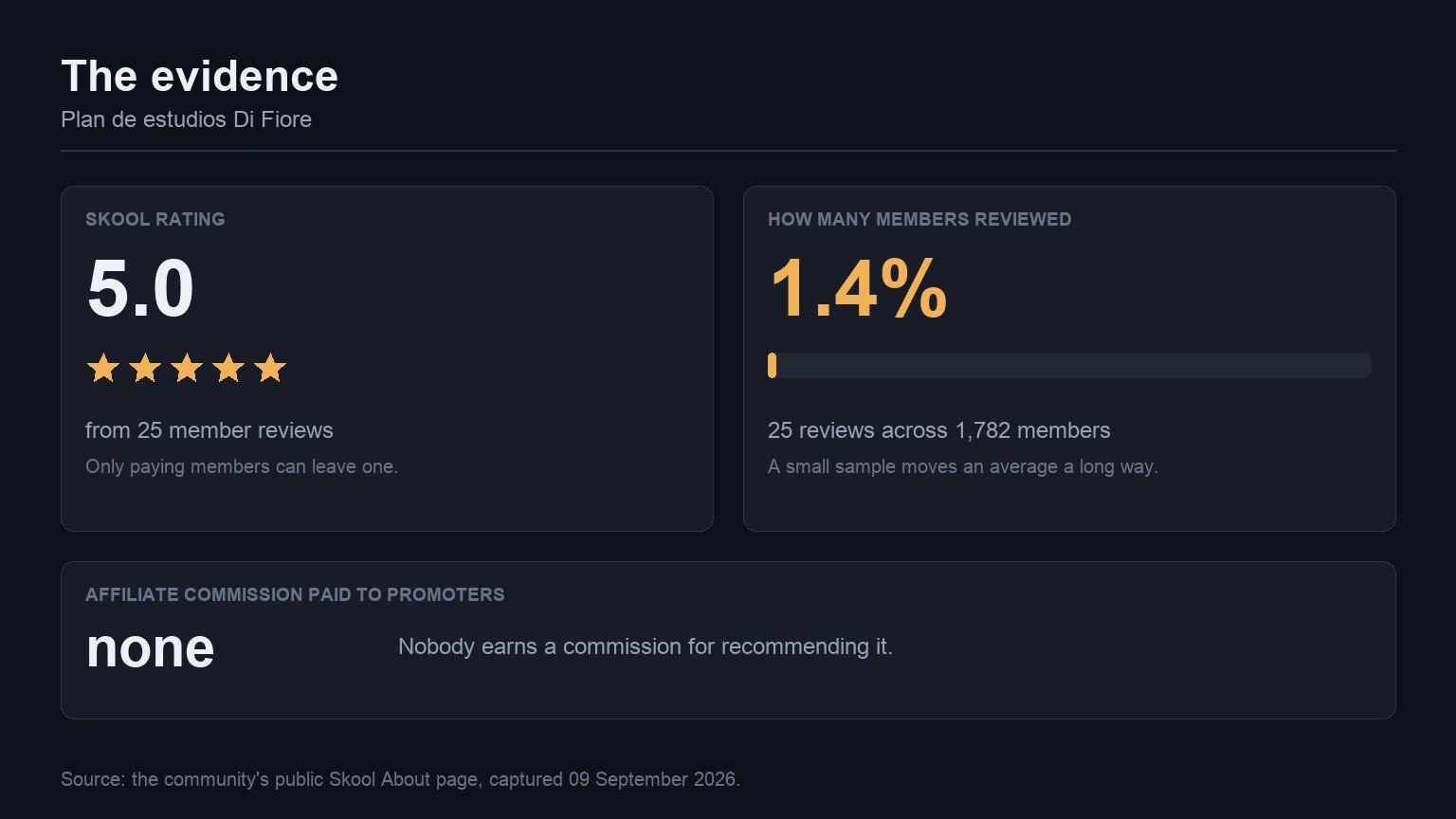
The average is 5.0 from 25 reviews. Out of 1,782 members, that is a 1.4% response rate.
A perfect 5.0 means no member has publicly scored it below five stars, which is worth more here than usual, because the affiliate rate is 0%. Nobody earns a commission for praising this community. Skool also restricts reviews to paying members, so the sample cannot be padded with outsiders.
Then you read them.
One says “Genial”, which means great (a member review on Skool, August 2026). Another says “El mejor”, the best (a member review on Skool, August 2026). Those are the two visible bodies, and between them they run to three words.
What the reviews do not contain
No review names a fault the member learned to diagnose. None names a certification passed, a job won, a shop opened or an hourly rate raised.
None mentions the admins, the response time, or how long the 21 modules took to complete.
For training in a measurable trade, that absence matters more than it would elsewhere. A mechanic who genuinely learned to read a CAN bus properly has a specific story to tell, and none of the 25 reviewers has told it in public.
Five stars from 25 people is a clean record. It is also, in written terms, almost empty.
Don’t Join If
- You do not read technical Spanish. There is no English track anywhere on the listing.
- You judge a library by size. Twenty-one modules for $127 a month is about $6 per module.
- You want proof before payment. Twenty-five reviews from 1,782 members is 1.4%, and none names an outcome.
- You need to know the founder’s credentials. His bio field holds his own name and his location field is blank.
My Verdict
I score Plan de estudios Di Fiore 3.1 out of 5.
The subject is the strongest part. Automotive electronics is a skill with a working job market behind it, and this is training rather than a business-opportunity pitch, which puts it above most of the category on honesty alone. The price is stated plainly with no fake scarcity, two sources record it identically, and a 0% affiliate rate means every one of those 25 five-star ratings was written by someone with nothing to gain.
The deductions are about value and evidence. Twenty-one modules across 2 courses for $127 a month is roughly $6 per module per month, and no syllabus is published to justify it. Twenty-five reviews from 1,782 members is a 1.4% sample, and the two visible bodies total three words. The founder’s bio repeats his own name, his location is blank, and no refund policy, trial or annual plan appears anywhere.
Watch the free Instagram and Facebook material first, in Spanish, and see whether the explanations land. Then ask in the community for the module list before month two renews. For a look at another Spanish-language community priced very differently, read our La Tribu Divisual review, and the AI Agents Course review shows what a technical community with a published curriculum looks like. The listing is here.
Full pros & cons
- A 5.0 average across 25 reviews, with no rating below five stars anywhere in the record
- The affiliate rate is 0%, so nobody earns a cent for recommending it and the praise is unbought
- 1,782 members and 17 online at capture, which is real traffic for a trade-specific niche
- Braian Di Fiore links a Facebook page and an Instagram account, both public and free to check first
- Automotive electronics is a licensed-trade skill with a working job market behind it, not a business-opportunity pitch
- Every course, post and review is in Spanish, and no English track is offered anywhere on the listing
- $127 a month buys 21 modules across 2 courses, roughly $6 per module per month
- Only 25 of 1,782 members have written a review, a response rate of 1.4%
- The founder's bio field contains his own name and nothing else, with the location field left blank
- 1,255 posts across 1,782 members is 0.7 posts per person, a quiet feed for the price
Try it yourself
Ready to put it to the test?
We may earn a commission at no extra cost to you. Affiliate disclosure.
Frequently Asked Questions
What language is Plan de estudios Di Fiore taught in?
How much does Plan de estudios Di Fiore cost?
How many members does the community have?
What is inside the community?
Is $127 a month good value for 21 modules?
How reliable are the 25 reviews?
Who is Braian Di Fiore?
Does the community pay affiliates?
Reader feedback
Was this review helpful?
Your feedback helps us write better reviews.
Thanks for your feedback.
Ray Okafor is the analyst behind AI Insider Edge, covering AI tools, online courses, and paid communities in the make-money-online space. Hands-on reviews say so and state what was actually paid for access. Research reviews say that too, and are built from the seller’s own public pages, verified member reviews, and the founder’s public record. Either way the aim is a buyer’s-eye read, not a press release. Reviews are independent and may contain affiliate links, at no extra cost to you.
More reviews: Careers and skills

Talas Akademija Review: 1,145 Members, $70/mo
Talas Akademija holds 1,145 members, 23,723 posts and 15 admins at $70 a month. Everything is in Serbian and the founder bio is four words long.

Level Up Psych Academy Skool Review (2026)
Level Up Psych Academy runs at $199/month with 564 modules for 416 members. No CE accreditation is mentioned anywhere on the listing.

Colorist Inc. Review: 349 Members, $209/mo
Colorist Inc. charges $209/month for 349 members, 70 modules and 7 admins. Only 8 reviews exist, and the founder's profile carries no public links.

Is Studicata Worth $29/mo? (2026 Skool Review)
Studicata is free to join on Skool, with upgrades at $29, $99 and $995. 19,461 members, 934 posts, 3 reviews and a 4.3 rating. Read before you upgrade.

خلك فاهم Review: 1,683 Members, $99/mo
خلك فاهم charges $99 a month with a 7-day trial for 1,683 members and 82 modules. Everything runs in Arabic for the Saudi job market.

Is The 1550+ Formula Worth $99/mo?
The 1550+ Formula charges $99 a month for 307 SAT modules and 16,989 posts. One admin runs it, and every score claim is unverified. Full breakdown.
The Edge Briefing
One honest review, every Sunday.
One email a week: which AI tools, courses & communities passed the rubric — and which to skip. Built for people funding their own stack.