Rich Habits Network Review: 1,086 Members, $77/mo
Rich Habits Network runs $77/mo for 1,086 members and 27 modules. Only 24 people have reviewed it. The private deal pitch and the numbers, checked.
 By Ray Okafor ·

No score: research review
We only score what we used. The verdict below is built from public sources. Price at review: $77/month after a 7-day free trial.
A 7-day free trial means you can read the whole library before any money moves
27 modules across 12 courses averages 2.3 modules per course, a thin library for the price
Source: Skool public About page, captured September 9, 2026
Twelve courses. Twenty-seven modules. That is 2.3 modules per course, and it is the first number worth sitting with.
The second is $77 a month, or $924 a year, for a room where 24 of 1,086 members have written a review.
A disclosure before anything else. I am not a member of Rich Habits Network and no money has gone to Austin Hankwitz or Robert Croak from this site. Everything below comes from the community’s public Skool About page, the written reviews Skool only accepts from paying members, and the founder’s own public profiles, captured on 9 September 2026. Where a claim comes from the sales copy rather than Skool’s own records, I say so.

Quick Decision
Join if you want a weekly finance conversation with two hosts you already follow, and $77 a month sits comfortably inside a budget you are already saving from. The 7-day free trial removes the risk of the first payment entirely. Read every module in that week and decide with your eyes open.
Hold off if you are joining for the private deals. Those are the headline and the least documented part of the listing. Hold off too if you want a deep course library, because 27 modules is a weekend of study rather than a curriculum.
Current terms sit on the Rich Habits Network listing.
Austin Hankwitz, And The Second Name Nobody Documents
Austin Hankwitz has been on Skool since 11 November 2023, about two years and ten months before capture. His bio is one line: co-host the number one business podcast on Spotify. That is his claim, not a chart position Skool verifies.
He links five public profiles: Instagram, LinkedIn, X, YouTube and witz.vc. His location reads Nashville, Tennessee. That is a full transparency record and it is the strongest single thing on this listing. Before spending a dollar you can read his LinkedIn history, watch years of free podcast episodes and look at the venture site.
His profile carries a crown badge. Skool awards those on owner earnings, so it tells you the community sells well and nothing about how members did.
Now the gap. The community description names Robert Croak alongside Hankwitz. Skool’s owner record for this listing holds one person. Croak has no bio, no location, no links and no join date in the data behind the About page. If you are paying partly for his involvement, you are paying on the strength of a name in a sentence.
Seventy-Seven Dollars A Month, With A Week In Front Of It
The join button reads START FREE TRIAL and the price shows as $77 a month. The listing promises 7 days free.
One caveat on that price. Skool’s structured price field for this community is empty. The $77 appears as display text, not as a recorded amount and interval, which is unusual and means the figure carries slightly less weight than on listings where both agree.
A year at $77 is $924. Nothing on the page frames it annually, so do that arithmetic yourself. No refund policy is published, no annual plan is offered and no lower tier exists.
The free trial changes the risk profile more than the price does. Seven days is enough to read all 27 modules, sit in one weekly call and scroll the feed. Most communities at this price give you nothing before the charge.
Set a calendar reminder for day six. Free trials convert by silence, and the listing publishes no refund route once the first $77 clears. Cancelling is a two-click job inside Skool, but only if you remember to do it.
One more thing the price does not cover. Any money you put into a private deal sits on top of the $77, and the listing never says how much that is. Budget the membership and the allocation as two separate decisions.
Twelve Courses, Twenty-Seven Modules
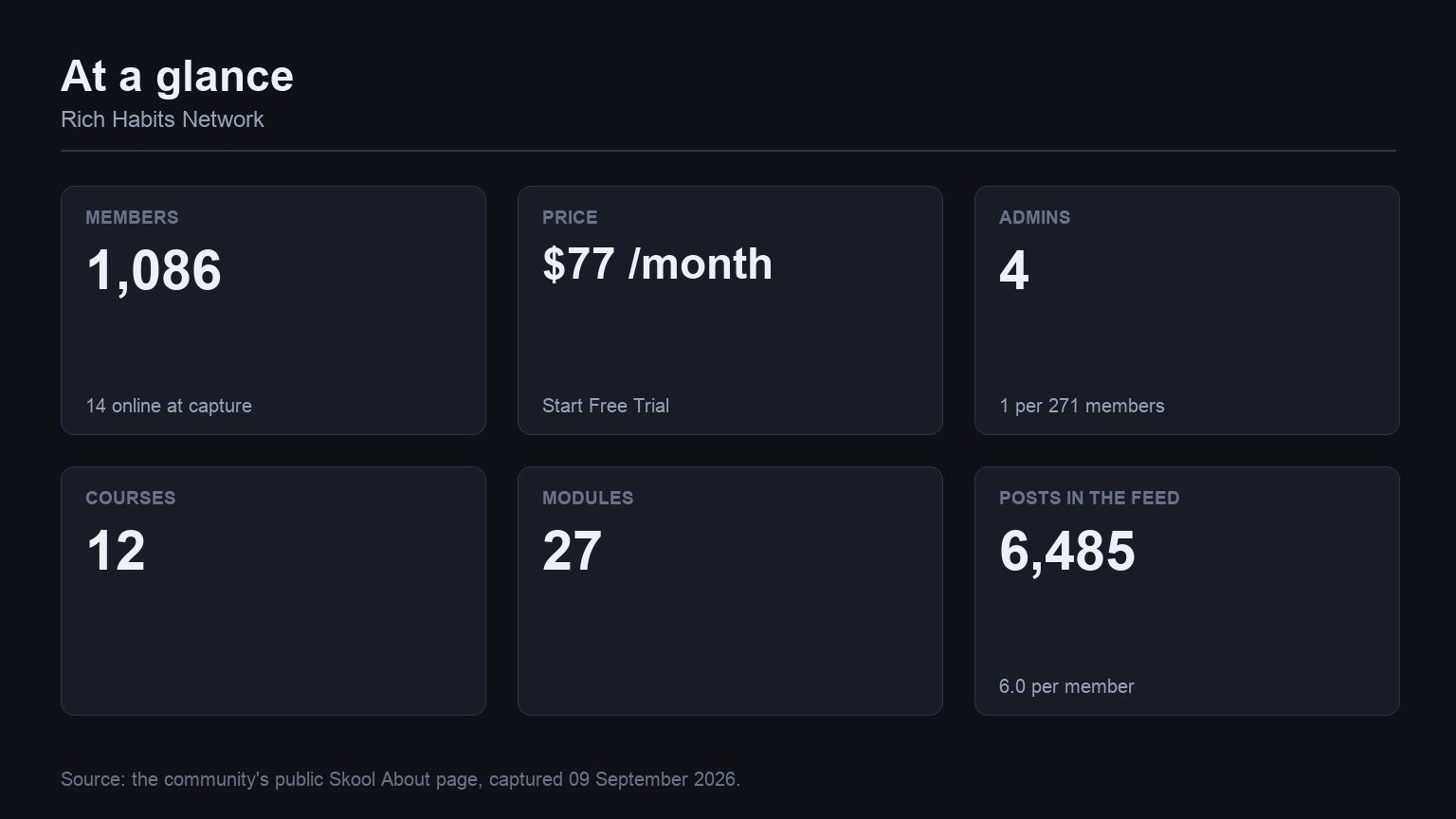
| What | Count |
|---|---|
| Members | 1,086 |
| Members online at capture | 14 |
| Admins | 4 |
| Courses | 12 |
| Modules | 27 |
| Posts in the feed | 6,485 |
Twenty-seven modules across 12 courses is the number that decides this review. Several of those courses hold two modules. The seller puts the total at roughly 8 hours of video, which matches the module count and confirms this is a short library rather than a large one.
Compare that to the money. At $924 a year you are paying about $34 per module of recorded content. Communities at half this price routinely ship 200 modules or more.
The library is not the product here, and the page is fairly open about that. The courses are framed as a foundation under weekly coaching, weekly research and deal flow. Judge the recurring output, because the recorded material will be finished inside your free week.
What The Eight Named Courses Cover
The listing names eight of the twelve: a $100K savings base, buying and operating a cash flowing business, calculating a freedom number, hitting an 800+ credit score, analysing stocks from scratch, protecting assets, mastering a savings rate and mindset shifts.
That spread is wider than most finance communities attempt. It reaches from credit repair to business acquisition, which are different disciplines with different readers.
Wide and shallow is a real trade. Two modules on buying and exiting a business is an introduction, not a playbook. If one of those eight topics is the reason you are joining, ask in the feed how many modules sit inside that specific course before your trial ends.
Three free bonuses are listed: a net worth tracker, a financial planning workbook and an honest budget template. Spreadsheets like these are widely available free. Treat them as convenience, not value.
Four Admins, 6,485 Posts, And 14 People Online
Four admin accounts serve 1,086 members. That is one staff account per 272 people. It is a normal ratio for a $77 room and a weak one in absolute terms, so the promised weekly coaching call matters more than direct messages will.
The feed is the better signal. Six thousand, four hundred and eighty-five posts across 1,086 members works out to roughly 6 posts each. Rooms this size often show a fifth of that.
Fourteen people were online at capture, about 1.3% of the membership. That is a low simultaneous count, though a finance community is not somewhere people sit all day.
The listing promises every question answered on the weekly live call, guaranteed. No support window, response time or refund attaches to that guarantee anywhere on the page.
The Private Deals Are The Headline, And The Thinnest Part
This is the finding I would weigh above every other number here. The top line of the sales copy says you can invest in companies like SpaceX, Apptronik and Perplexity before they go public. It claims 30+ deals closed.
Every one of those words is the seller’s. The About page publishes no deal terms at all.
Work through what is missing. There is no fee schedule for participating in a deal, no minimum cheque size, no statement about whether US securities rules limit access to accredited investors, no lock-up period, no explanation of the structure holding the shares, and no performance record for any of the 30+ deals already closed.
Private company shares are illiquid. You cannot sell them when you want to, valuations are set infrequently, and the money can go to zero. None of that appears on the listing.
A $77 membership is a small decision. An allocation into a pre-IPO vehicle is not. Those two decisions are being sold in the same sentence, and only one of them has a published price.
Ask for the full deal documents, the fee stack and the closed deal history during your free week. A community that has genuinely closed 30 deals will have that paperwork ready.
The New York Times line, read carefully
The sales copy opens by saying the New York Times wrote about the community for a reason, and links to a Times article about buying stock in Elon Musk’s private companies.
Read that construction again. The sentence implies coverage of Rich Habits Network. The link points at an article about private company stock as a subject.
I cannot verify from the listing what that article says about this community, or whether it names it at all. It may. The About page gives you no way to tell, and the phrasing does the work of implying press coverage either way.
Treat it as marketing until you read the article yourself. It takes two minutes and it is the cheapest check on this page.
Twenty-Four Reviews From 1,086 Members
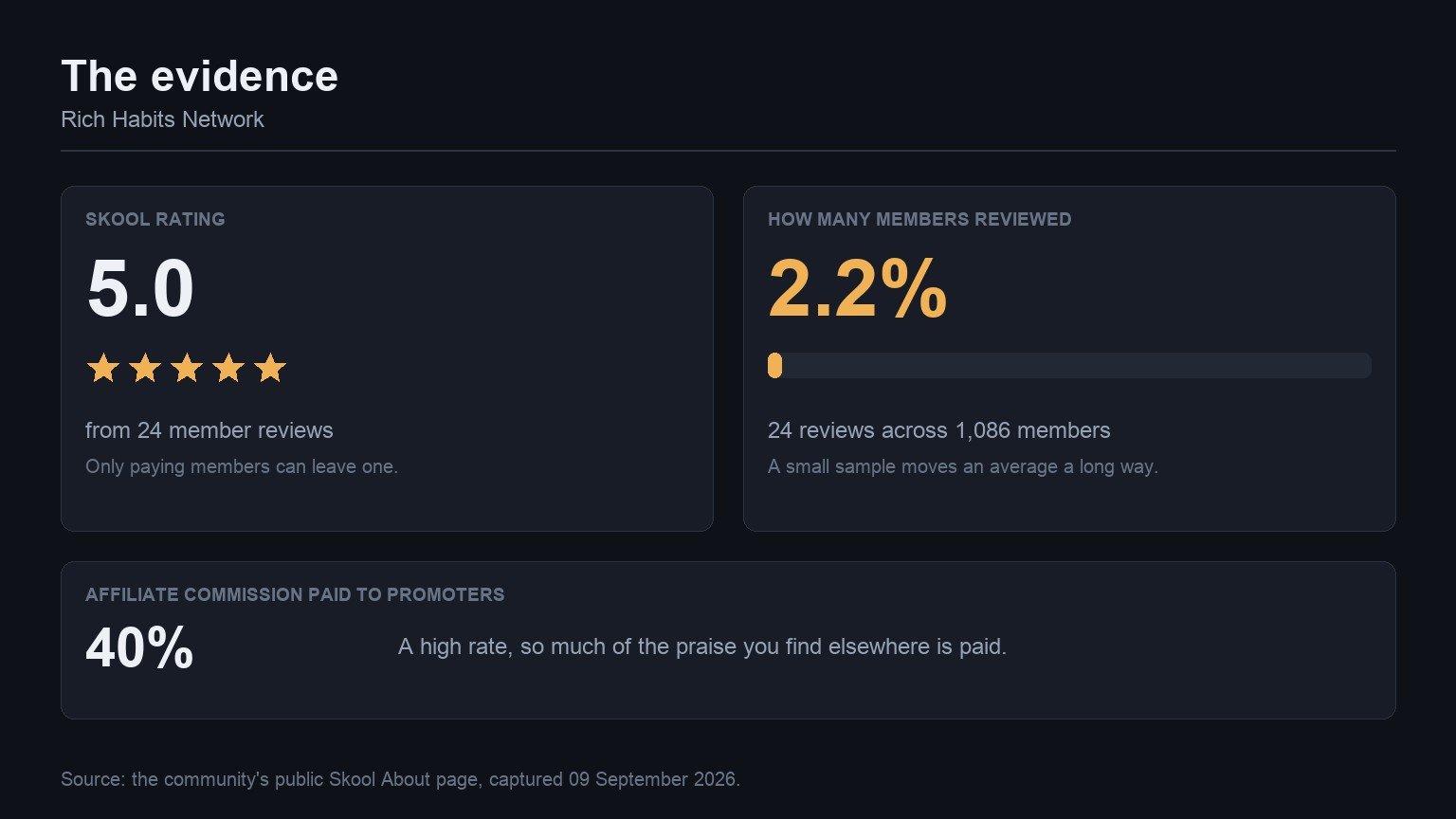
The average is a clean 5.0 across 24 reviews. Skool only accepts reviews from paying members, so nobody bought those stars.
Twenty-four reviews from 1,086 members is a response rate of about 2.2%. That is thin, and thinner than it looks, because members who cancel almost never write on the way out.
Five are visible. One calls it the best financial community available (a member review on Skool, September 2026). Another says they are not using it to its full potential and still find it has changed their life, and looks forward to each weekly call and office hours session (a member review on Skool, September 2026). A third writes that they are happy they invested in joining and praises the support around financial advice (a member review on Skool, August 2026).
What none of them mentions
Not one visible review names a deal they invested in, a return they earned, a credit score they moved or a savings rate they hit.
They praise the calls, the people and the access. Those are real things and the warmth reads as genuine. For a community selling pre-IPO allocations and an 800+ credit score course, first-person numbers are the evidence a buyer needs, and there are none.
No review mentions the private deals at all, which is worth noticing given that the deals lead the sales page.
The 40% Commission Behind Every Recommendation
Rich Habits Network pays affiliates 40%. On a $77 membership that is $30.80 for every month a referral stays, or about $370 across a full year.
That is a strong recurring payout, and it means a large share of the enthusiastic coverage you find elsewhere is written by people who get paid when you join.
This review earns nothing from the community. Read the rest of the internet’s coverage with the commission rate in mind.
Don’t Join If
- You are joining for the private deals. No fee, minimum, accreditation rule or past performance is published for any of the 30+ claimed.
- You want a deep library. Twenty-seven modules across 12 courses is roughly 8 hours, finished inside the free trial.
- You expect Robert Croak’s involvement. Skool’s owner record for this listing holds one person, and it is not him.
- You need a refund route after the trial. No refund policy appears anywhere on the About page.
My Verdict
The free week earns most of that score. Seven days with full access before any charge is the fairest structure on this list, and it means the price question answers itself. Austin Hankwitz links five public profiles and a real location, so his record can be checked in advance. The feed carries 6,485 posts from 1,086 members, which is genuine activity rather than a dead room, and all 24 reviewers gave five stars.
The weak points come from depth and disclosure. Twenty-seven modules across 12 courses is a thin library at $924 a year. The private deal flow is the headline of the sales page and carries no published fee, minimum, eligibility rule or track record, which is the single finding I would weigh most heavily. Robert Croak is named in the description with no owner record behind him. Twenty-four reviews from 1,086 members is a 2.2% sample, and not one of them names a deal, a return or a score.
Use the trial properly. Read all 27 modules in the first three days, then spend the rest of the week asking for the deal paperwork and the closed deal history. If that documentation does not arrive before day seven, cancel and keep following the free podcast. For a cheaper room with a much larger review base, read our Affiliate Marketing Launchpad review, and the La Tribu Divisual review shows what a heavily reviewed community looks like by comparison. The listing is here.
Full pros & cons
- A 7-day free trial means you can read the whole library before any money moves
- Austin Hankwitz links five public profiles, including LinkedIn, YouTube and a venture site, so his record is checkable
- 6,485 posts from 1,086 members is about 6 posts each, a busy feed for a $77 room
- All 24 reviews on file are five stars, and Skool only accepts reviews from paying members
- Twelve courses span credit score, savings rate, stock analysis and buying a business, which is broader than most finance rooms
- 27 modules across 12 courses averages 2.3 modules per course, a thin library for the price
- Only 24 of 1,086 members have written a review, a response rate of about 2.2%
- The private deal flow carries no published fee, minimum cheque, accreditation rule or past performance
- Robert Croak is named in the community description but has no owner record in Skool's data
- Skool's structured price field is empty, so $77 appears only as button text on the listing
Try it yourself
Ready to put it to the test?
We may earn a commission at no extra cost to you. Affiliate disclosure.
Frequently Asked Questions
How much does Rich Habits Network cost?
How big is the community?
What is inside the courses?
Can you really invest in SpaceX through it?
Who runs it?
Reader feedback
Was this review helpful?
Your feedback helps us write better reviews.
Thanks for your feedback.
Ray Okafor is the analyst behind AI Insider Edge, covering AI tools, online courses, and paid communities in the make-money-online space. Hands-on reviews say so and state what was actually paid for access. Research reviews say that too, and are built from the seller’s own public pages, verified member reviews, and the founder’s public record. Either way the aim is a buyer’s-eye read, not a press release. Reviews are independent and may contain affiliate links, at no extra cost to you.
More reviews: Trading, credit and personal finance

Mikey's Money House Review: 9,043 Members, $8/mo
Mikey's Money House costs $8 a month and states no refunds. 9,043 members, 4 admins, 76 modules, 160 reviews at 4.9. What the listing does and does not show.

Is Haddini Aş Kulübü Worth $50/mo?
Haddini Aş Kulübü costs $50/mo, states no refunds, and holds 45 modules for 2,410 members. It is Turkish-language only. The terms, read closely.

Is The Capitalist Network Worth $147/mo?
The Capitalist Network charges $147/month for 794 members, 309 modules and 9 admins. Only 13 reviews exist, and one says the deals are out of reach.

Is Miguel Angel Correa Worth $150/mo? Spanish Trading
Comunidad Crece charges $150 a month for a Spanish trading room with 458 members. No track record and no risk warning appear on the listing.

CGC Credit HQ Skool Review (2026)
CGC Credit HQ lists $99/month for 603 members, 38 modules and 2 admins. Three reviews exist, one member was online, and no price sits on record.

Is Credit to Keys Lab Worth $79/mo?
Credit to Keys Lab charges $79 a month for credit repair training. 155 modules, 1,039 members, 13 reviews, no published credentials and no refund terms.
The Edge Briefing
One honest review, every Sunday.
One email a week: which AI tools, courses & communities passed the rubric — and which to skip. Built for people funding their own stack.