Story Hacker AI Review: 1,850 Members, $67/mo
Story Hacker AI costs $67/mo and pays affiliates 50%. The 90-day guarantee has a condition worth reading.
 By Ray Okafor ·
16,094 posts across 1,850 members, one of the busiest feeds in the Skool top 20
The money-back guarantee is conditional on putting in the work, and the page does not define that
Source: Skool public About page, captured September 9, 2026
Sixty-seven dollars a month buys AI novel-writing training, a software tool, and weekly calls with an author who publishes in volume. It also buys a guarantee with a condition attached that the page never defines.
This is a research review. I have not joined and have paid nothing. It draws on the public Skool About page, the reviews Skool restricts to paying members, and Jason Hamilton’s public profiles, captured on 9 September 2026.
Quick Decision
Worth it if you want to finish a novel and you are comfortable with AI in your drafting process. The library is deep, the feed is genuinely busy, and the free trial lets you check both before paying.
Skip it if you object to AI in fiction on principle, or if you want the guarantee to be your safety net. The refund promise is conditional and the condition is undefined.
Jason Hamilton, And The YouTube Trail
Most founders in this ranking ask you to trust a bio. Hamilton lists a website, storytellingdb.com, and a YouTube channel, The Nerdy Novelist, straight on his Skool profile.
That matters more here than it would elsewhere. AI fiction is a contested subject, and the substance of the objection is that the output is generic. A public YouTube channel with years of videos on it lets you judge whether this particular person thinks carefully about craft, before you spend anything.
His Skool bio reads: “Son of God. Husband. Father. Entrepreneur. Author. YouTuber. In that order.” Make of that what you will, but it tells you the community will carry a specific culture, and the member reviews describe exactly that tone.
His Skool account dates to 29 July 2024, so this is a two-year-old operation rather than a launch.
The 90-Day Promise, Read Closely
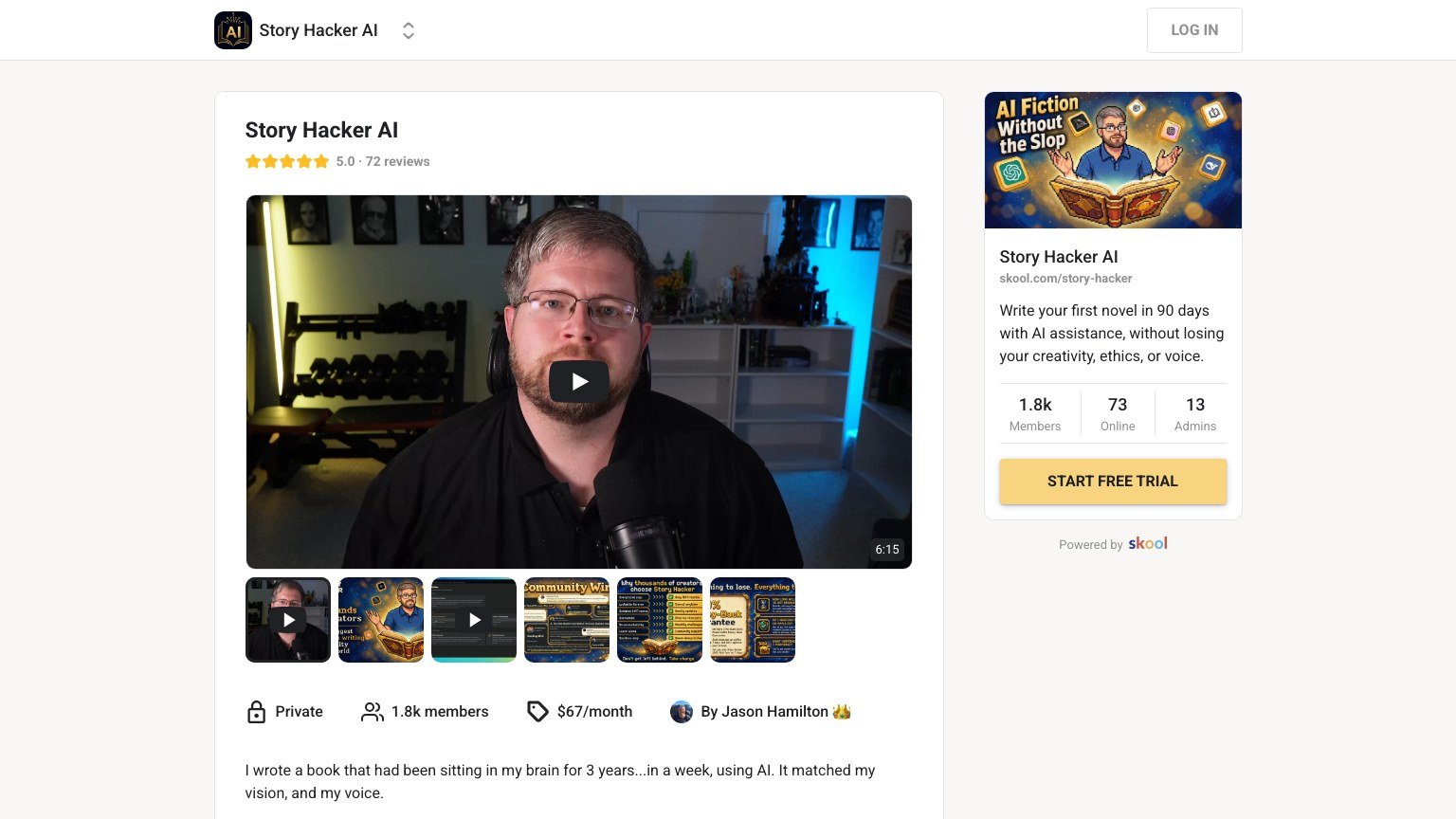
The community’s one-line description is direct: write your first novel in 90 days with AI assistance, without losing your creativity, ethics, or voice.
The longer pitch expands that into four guarantees. You will finish your first book in 90 days. The book will be high quality. You will not have to give up your creativity. You will become a better storyteller.
Then comes the qualifier, and it governs all four: “if you put in the work.”
That phrase is not unreasonable. No writing programme can guarantee a finished novel to somebody who never opens the document. What the page does not do is say what the work is. There is no word count, no call attendance requirement, no submission deadline, no checklist you can point at when you ask for your money back.
The result is a guarantee you cannot evaluate from outside. It is not a red flag on its own, and Skool’s own refund handling sits behind it, but it is the single thing I would resolve in the feed before the trial ends.
The third promise is the interesting one for anybody hesitating over AI in fiction. The page commits to not giving up your creativity and to becoming a better storyteller, which is a direct answer to the main objection to AI-assisted writing. Whether the training delivers that is exactly what the free week is for, and the place to check is the craft modules rather than the automation ones. If the genre guides teach convention and structure, the claim holds. If everything routes through a prompt, it does not.
What $67 A Month Buys
The page itemises the membership rather than gesturing at it, which is more than most listings at this price manage.
| What is included | Detail |
|---|---|
| Story Hacker OS | The writing tool the community is built around |
| Publishing system | Guides for Amazon publishing and genre branding |
| Genre guides | 200+ |
| AI automations | 20+ |
| Live calls | Weekly, with Hamilton and other book experts |
| Bonus | Hamilton’s own published books for authors |
The two items I would pay for here are the genre guides and the automations. Genre convention is where most first novels fail, and 200 guides is a reference library rather than a module. Readers of romance, cosy mystery and litRPG all expect specific beats in specific places, and a first-time author who ignores them writes a book that is competent and unsellable. A guide per genre is the sort of unglamorous reference material most AI writing courses skip entirely.
The automations are the part that dates fastest, since they depend on whichever AI tools were current when they were built. Twenty automations built around one model provider become twenty broken automations when that provider changes an interface, so treat them as a current snapshot rather than a permanent asset.
The Amazon publishing and genre branding material is the piece that separates this from a writing course. Finishing a manuscript and selling one are unrelated skills, and the second is where most finished novels stall. That the system covers listing, categories and branding to a genre is a real part of the value here.
The output claim on the page is a full system to go from zero to twelve or more books a year. Twelve books a year is a real thing in indie publishing and it is also the number that tells you what kind of writing this community is oriented around. If you want to write one careful literary novel, the system is pointed somewhere else.
The Free Trial And The Guarantee
Seven days free, cancel anytime, and the join button reads START FREE TRIAL rather than showing a price.
Use the week properly and it answers most of what this review cannot. Seventeen courses and 759 modules are open to you on day one, so you can check whether the teaching is careful or padded. You can read the feed and see what members are actually stuck on. You can attend one live call.
Two things to note on price. The page says to lock in the rate before it goes up, which is standard urgency framing but does mean current members are likely on legacy pricing. And the value figures, “worth +$50K” for the core and “worth +$10K” for the bonuses, have nothing behind them. Set them aside and judge the $804 a year on the library and the calls.
Where The 50% Affiliate Rate Leaves You
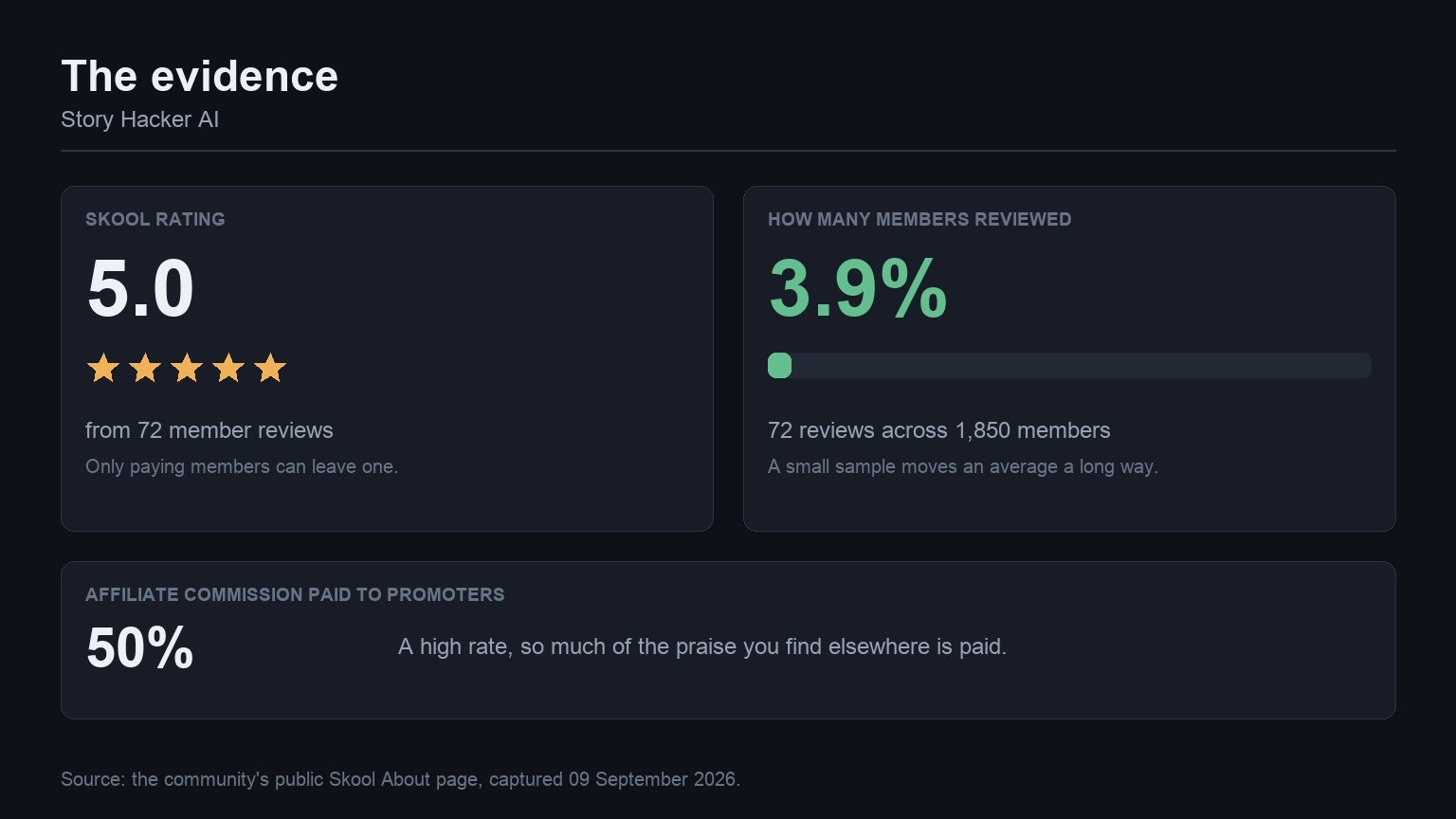
Story Hacker AI pays affiliates 50% of the subscription. That is at the top end of what Skool communities pay, and it changes how you should read every write-up you find, including the incentives behind this one.
At $67 a month, a referral is worth about $33 a month to whoever sent you, for as long as you stay. Whoever sent you therefore has $33 a month riding on your enthusiasm, and no incentive at all to mention the undefined guarantee condition.
Ignore the ranked lists and the round-up posts and read the 72 member reviews on the Skool page instead. Skool restricts those to people who are paying, which makes them the only source in this entire market with a structural reason to be honest.
The rate tells you something about the business as well. Handing over half of every subscription in perpetuity only works if members stay long enough to make the remaining half worthwhile, which points at a community built for retention rather than a launch. A 90-day project with a library and weekly calls fits that. It also means the marketing budget here is entirely other people’s enthusiasm, so the sales pressure you meet will come from writers rather than ads.
759 Modules Across 17 Courses
| What | Count |
|---|---|
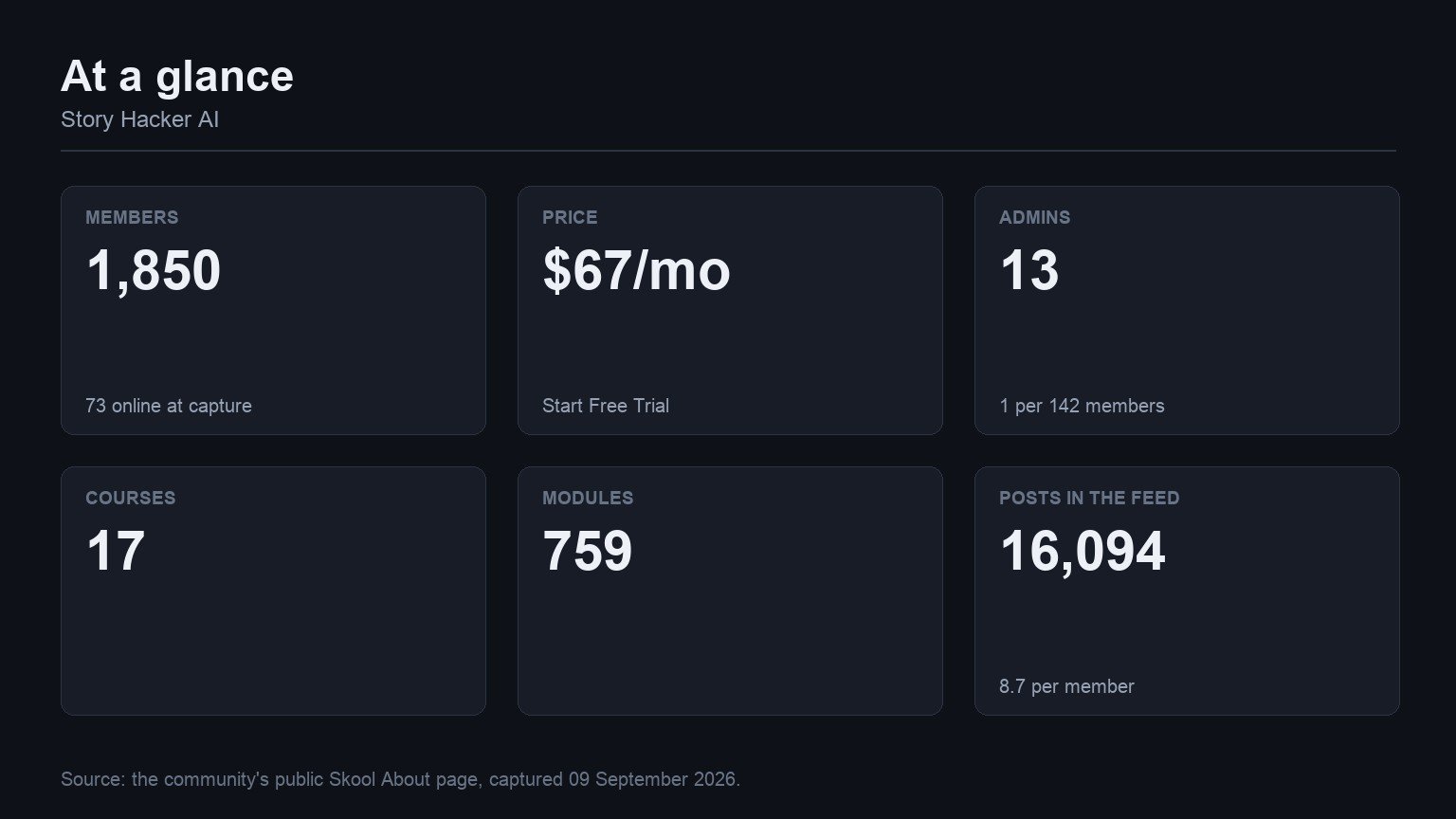
| Members | 1,850 |
| Members online at capture | 73 |
| Courses | 17 |
| Modules | 759 |
| Posts in the feed | 16,094 |
| Admins | 13 |
Seven hundred and fifty-nine modules is roughly 45 per course, which reads like short lessons rather than long lectures. For a subject taught in steps, from premise to outline to draft to Amazon listing, that structure fits.
Seventeen courses on one subject also tells you the library has been built out over the two years since Hamilton opened the community, not shipped in one batch. That pattern usually means the later courses answer questions the earlier ones raised, which is the most useful kind of library.
It also means volume is not the constraint here. Seven hundred and fifty-nine modules is more material than anybody finishing a novel in 90 days can watch, so the real question during the trial is whether there is a defined path through it. Ask which courses the 90-day route actually uses. A library this size without a sequence is a way to spend three months studying instead of writing.
The number I would watch is the admin count. Thirteen admins across 1,850 members is about one per 142. That is a reasonable ratio in isolation, but against 16,094 posts it means the moderation load per admin is high, and the answers you get in the feed will mostly come from other members.
The Feed Is The Unusual Part
Just over 16,000 posts across 1,850 members works out at roughly nine posts each. Compare that with the communities I have looked at in the same ranking, where two or three per member is normal, and this one is an outlier in the right direction.
Seventy-three members were online at the moment of capture. That is close to four percent of the membership present at a single arbitrary time on a Tuesday.
There is a plain reason for it. Writing a novel takes months, and people who are stuck at chapter nine have something specific to ask most weeks. A community selling a 90-day project generates far more sustained conversation than one selling a weekend tactic, and the post count is what that difference looks like in numbers.
There is a second reason worth naming. AI fiction is contested enough that writers using it get argued with elsewhere, so a room where the method is assumed rather than defended has a pull that a marketing community does not need to provide.
For your decision, the feed is the asset here. Sixteen thousand posts is a searchable archive of problems other members already hit, which is worth more on day 40 of a manuscript than any module. Search it during the trial for the specific thing you are worried about and you will learn more about this community than the sales page can tell you.
Story Hacker OS, The Tool You Are Also Renting
The software is the part of this offer that separates it from a course, and it is the part a review from outside can say least about.
What the page claims is that it is the tool for writing good books fast. What the members say is more useful. A September 2026 review describes it as “amazing” and adds, pointedly, that it is “not a click button tool. It’s a course and continual self improvement.” Another notes that it “took an incredible amount of work to create, and actually works.”
Both of those are member reviews on Skool, September 2026. Neither is a demo, and I cannot verify the tool without joining.
The consequence for your decision is about the exit rather than the entry. When you cancel a course subscription, you keep what you learned. When you cancel this one, you also lose the software your manuscript workflow now runs through. Ask, during the trial, what happens to your drafts and outlines if you leave.
The upside of bundling a tool with the training is that the lessons and the software agree with each other. Most AI writing courses teach a process on top of a general chat interface, and the instructions drift out of date every time that interface changes. A purpose-built tool taught by the person who built it removes that gap.
The cost is a subscription you cannot stop paying without changing how you work. Ninety days of drafting inside somebody else’s tool is a real switching cost, so decide up front whether you are buying a course with a tool attached or a tool with a course attached. The second one is harder to leave.
What 72 Five-Star Reviews Do And Do Not Prove
Seventy-two reviews sit at a straight 5.0 average, from a base of 1,850 paying members.
A perfect average at that volume usually makes me suspicious. Here it is harder to dismiss, because Skool only accepts reviews from members who are paying, so there is no path for a bought review or a bot.
The two captured reviews are worth reading closely. One argues that most people build courses and apps as a side hustle for income, and that Hamilton does it because he is passionate about writing and a natural teacher. The other says: “The course is very good. The community is exceptional, its very positive, supportive and helpful.” Both are member reviews on Skool, September 2026.
What neither does, and what none of the visible reviews do, is name a finished book, a page count, or a royalty figure. Members praise the teaching and the tool. Nobody publicly reports the outcome the page guarantees. For a community whose central promise is a completed novel in 90 days, that is the gap I would want filled before I stopped treating the guarantee as decorative.
My Verdict
I score Story Hacker AI 4.4 out of 5, which is the highest I have given a community in this ranking so far.
The reasons are all in the numbers. Nine posts per member is exceptional engagement. Seven hundred and fifty-nine modules with 200 genre guides inside them is a real library rather than a landing page. The founder is publicly verifiable in a way most of this market is not, and the free trial removes almost all of the risk of finding out for yourself.
The deductions are about the fine print. The money-back guarantee rests on an undefined condition, the 50% affiliate rate means the internet’s opinion of this community is bought, and the value figures on the page are invented. Cancelling costs you the software as well as the training, which is a lock-in most course subscriptions do not have.
Every one of those is answerable inside the free week, so spend it interrogating the offer instead of browsing it. Ask what the work requirement means and ask what happens to your drafts if you cancel. For a comparison at a similar price in a different creative niche, our La Tribu Divisual review covers a design community with a busier feed, and the AI Video Creators Community review covers the video side of the same AI-creative shift.
Full pros & cons
- 16,094 posts across 1,850 members, one of the busiest feeds in the Skool top 20
- 759 modules across 17 courses, including 200+ genre guides most AI writing training skips
- 72 reviews at a straight 5.0 average, and only paying members can leave one
- Jason Hamilton's YouTube channel and website are public, so his track record is checkable before you pay
- 7-day free trial, so you can read the library before the first $67 leaves your account
- The money-back guarantee is conditional on putting in the work, and the page does not define that
- The 50% affiliate rate means most reviews you find have a commission behind them
- Part of what you rent is Story Hacker OS, so cancelling costs you the tool as well as the training
- The $50K and $10K value figures on the page are seller framing with nothing behind them
- 13 admins on 1,850 members is roughly one per 142, thin for a feed this active
Try it yourself
Ready to put it to the test?
We may earn a commission at no extra cost to you. Affiliate disclosure.
Frequently Asked Questions
How much does Story Hacker AI cost?
Is the 90-day money-back guarantee real?
What is Story Hacker OS?
Does the 5.0 rating from 72 reviews mean anything?
Who is Jason Hamilton?
Reader feedback
Was this review helpful?
Your feedback helps us write better reviews.
Thanks for your feedback.
Ray Okafor is the analyst behind AI Insider Edge, covering AI tools, online courses, and paid communities in the make-money-online space. Hands-on reviews say so and state what was actually paid for access. Research reviews say that too, and are built from the seller’s own public pages, verified member reviews, and the founder’s public record. Either way the aim is a buyer’s-eye read, not a press release. Reviews are independent and may contain affiliate links, at no extra cost to you.
More reviews: AI tools, courses and communities

AI SEO Rainmakers Skool Review: I Paid Charles Floate $269
I joined Charles Floate's AI SEO Rainmakers Skool and paid $269. Here is what is really inside, who it fits, and who should skip it.

AI Mavericks Review 2026: I Pay $7/mo (Worth It?)
I'm a paying AI Mavericks member at $7/month. What's really inside Scott Simson's 494-member Skool, and the catch: the price jumps to $59 after Aug 21.

AI Profit Boardroom Review (2026): 6 Months, $500 In
I've paid over $500 into AI Profit Boardroom since January 2026. The hidden costs, what the workflow vault is really worth, and who should skip it.

AI Video Creators Community Review 2026: I Joined
I joined the AI Video Creators Community after five months inside its bigger rival. What $9/month gets you in Sergey Kabankov's Skool, and how they compare.

AI Video Bootcamp Review: I'm a Level 6 Member (2026)
I'm a Level 6 member of AI Video Bootcamp. What $9/month really buys, the fake-scarcity trick on the sales page, and who should skip it.

Maker School: AI Automation Skool Review (2026)
Maker School charges $184/mo with a 90-day money-back guarantee. 2,525 members, 745 modules, and only 2 admins. What the numbers show.
The Edge Briefing
One honest review, every Sunday.
One email a week: which AI tools, courses & communities passed the rubric — and which to skip. Built for people funding their own stack.