Is The Credit Framework Worth $49/mo? 353 Members
The Credit Framework charges $49 a month for 187 modules and 353 members. The owner bio is two characters. The affiliate rate is 50%.
 By Ray Okafor ·

No score: research review
We only score what we used. The verdict below is built from public sources. Price at review: $49/month.
187 modules across 17 courses for $588 a year, about $3.14 per module
The owner's public bio is the two-character string ':)' with no links and no location
Source: Skool public About page, captured September 9, 2026
Brianna Shehee’s public bio on Skool is two characters long. It reads :).
That is the whole founder record behind a community teaching people to rebuild credit and qualify for funding at $49 a month.
The rest of the listing is more solid than that sounds: 353 members, 17 courses, 187 modules, 947 posts, 18 reviews at a straight 5.0.
How this review was built. I have not joined The Credit Framework and no money has moved in either direction. Everything below comes from the community’s public About page on Skool, the review panel that Skool restricts to paying members, and the owner’s public profile, all captured on 9 September 2026. Where a figure comes from the seller’s own copy rather than Skool’s records, I label it as such.
One more thing before the numbers. Credit repair and consumer credit are regulated in several countries, and nothing here is financial or legal advice. What a programme like this can do for you depends on your own credit file, your income, your jurisdiction and your paperwork. Two people paying the same $49 will not get the same result.
Quick Decision
Join if you want structured credit and funding material at a low monthly price, you are comfortable that the teacher publishes nothing verifiable about herself, and you can afford $49 to look inside for a month. The library is genuinely large for the money and the 18 paying members who reviewed it all gave five stars.
Do not join if you need to check the person teaching you before you pay. There is no website, no social account, no location and no business name on the owner profile. In a category where regulators, licensing and complaint records exist for a reason, a two-character bio is the loudest fact on this page.
Also skip it if you were sent here by a video or a blog post you trusted. The affiliate rate is 50%, so half your first payment goes to whoever pointed you at it.
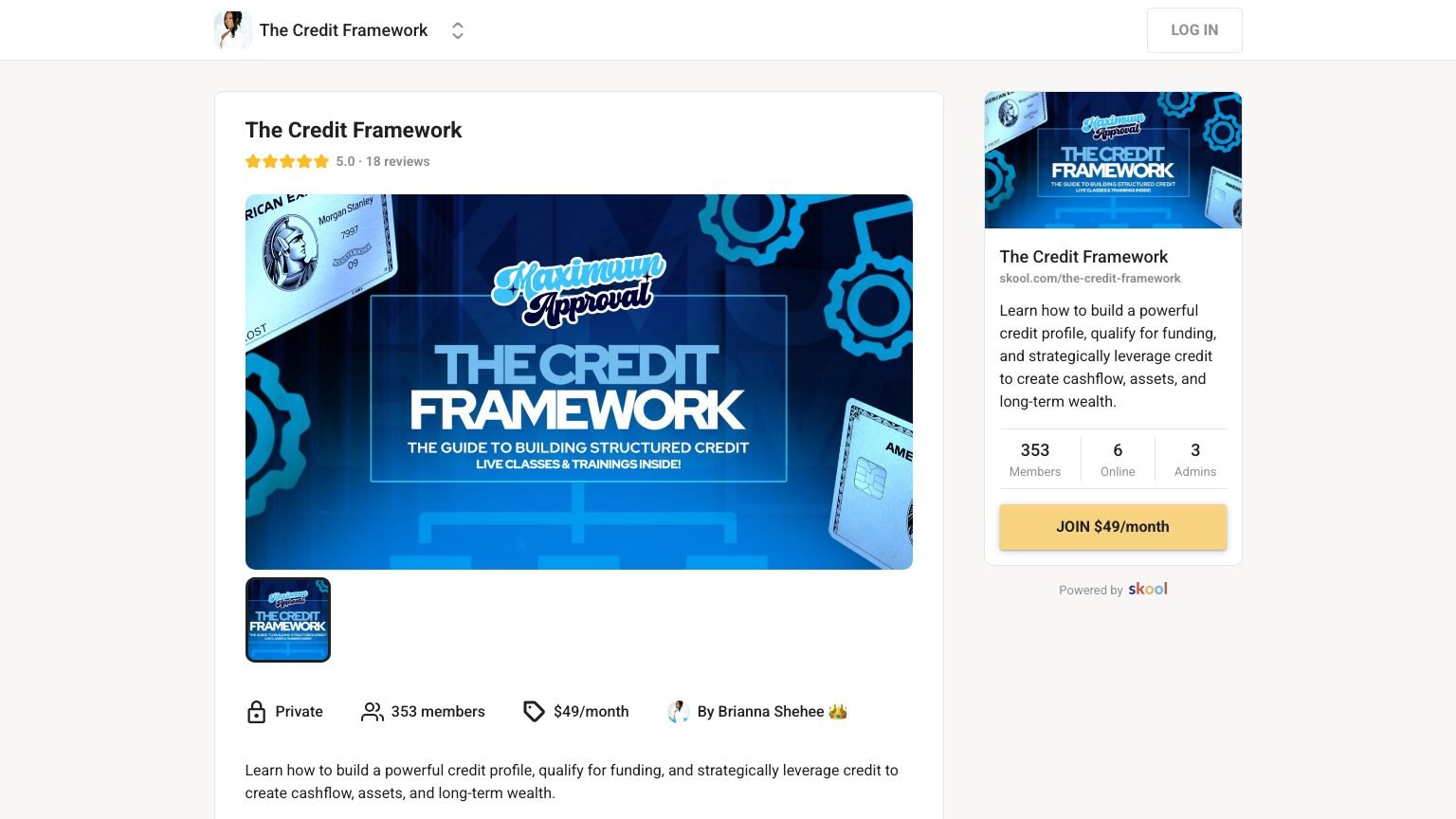
The Credit Framework listing shows the current price and member count.
$49 A Month, And What The Listing Does Not Say About Leaving
The price is $49 US dollars a month. Skool stores that in its structured record with the amount, the currency and the billing interval all present, and the join button reads JOIN $49/month. Both sources agree, which is better than many listings manage.
Across a year that is $588.
For 187 modules, that comes to about $3.14 per module. Add 947 feed posts and three admins and the price-to-material ratio is strong. Communities in the money category regularly charge four to six times this for smaller libraries.
Nothing is published about refunds
No refund window. No trial. No minimum term. No cancellation note.
The listing carries none of it. At $49 the exposure is one billing cycle, which is why I have not weighted this heavily, but the absence is worth naming. You are agreeing to terms you cannot read before you click.
The group is private
The community is set to private on Skool. That means the classroom, the feed and the member list are all closed until payment clears.
So the 187 modules cannot be sampled. The 947 posts cannot be skimmed. You are buying the About page description and 18 reviews, and finding out what is behind them afterwards. That is normal for Skool and it is still worth stating plainly, because a $49 decision made on a paragraph of sales copy is a different decision from one made on a preview.
What The Page Says Is Inside, And What Skool Actually Counts
The seller’s description is one sentence. It says you will learn to build a powerful credit profile, qualify for funding, and use credit strategically to create cashflow, assets and long-term wealth.
That is the entire public pitch. There is no module list, no curriculum breakdown, no named instructor besides the owner, and no sample lesson.
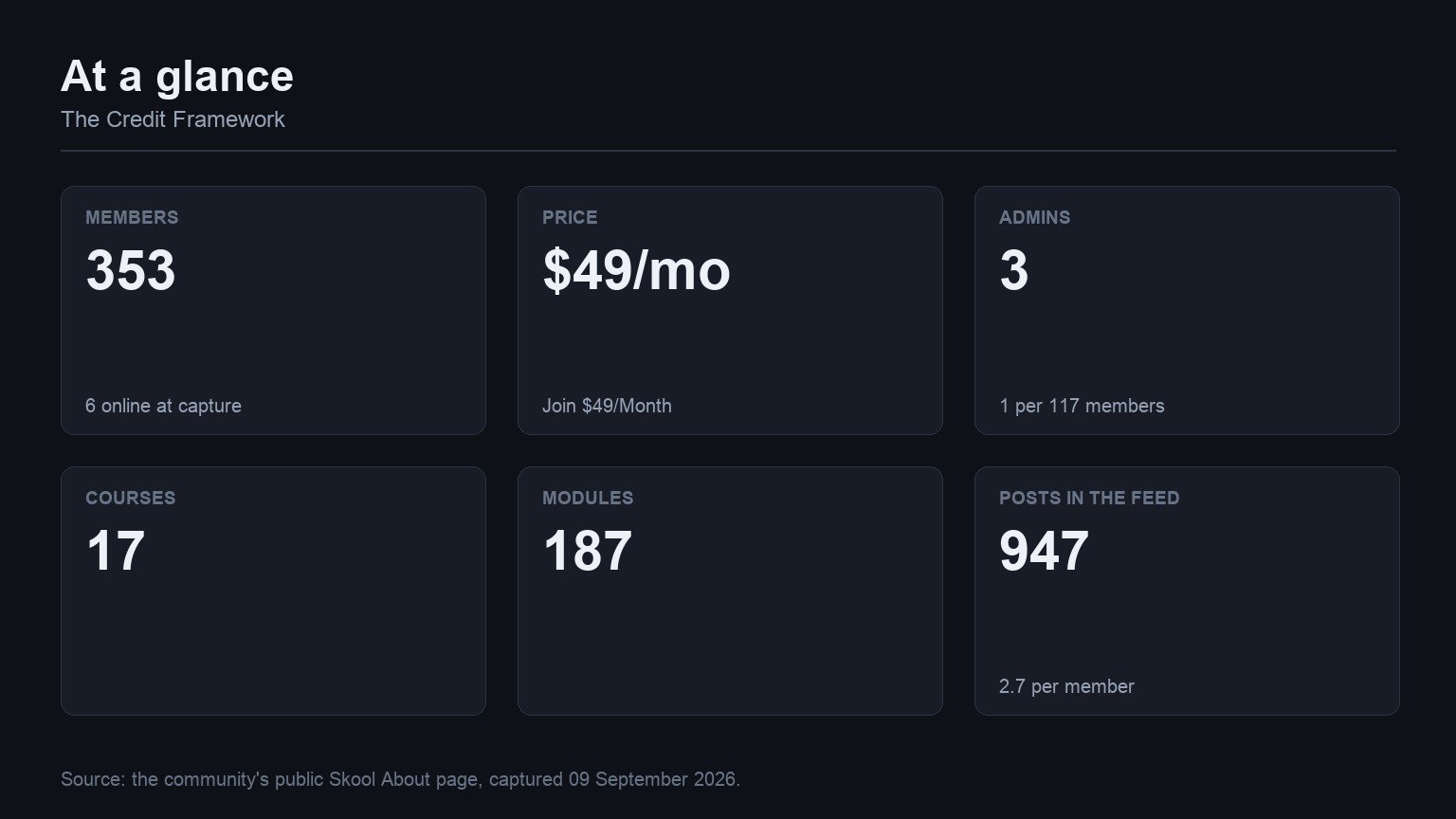
What Skool counts independently is more useful:
| What | Count |
|---|---|
| Members | 353 |
| Members online at capture | 6 |
| Admins | 3 |
| Courses | 17 |
| Modules | 187 |
| Posts in the feed | 947 |
| Reviews | 18 |
| Average rating | 5.0 |
Seventeen courses averaging 11 modules each is a real structure rather than one long playlist split into chapters. A community this size with 187 modules has been building material for a while, and the owner account dates back to November 2024, which fits.
The activity numbers are thin
Nine hundred and forty-seven posts across 353 members is 2.7 posts each. Six members online at capture is 1.7% of the room.
Compare that with the feed volumes I have seen on communities of a similar size, where 8 to 15 posts per member is common in an active room. This one is quieter. Not dead, and 947 posts is a working feed, but a member joining for daily discussion should set expectations lower than the member count implies.
There is no video on the listing
The gallery holds one image and zero videos.
Most communities at this level put a founder walkthrough or a testimonial reel on the About page. There is nothing here to watch, which removes the one cheap way a stranger could form an impression of the teaching style before paying.
Brianna Shehee, And A Profile With Nothing In It
The owner account is Brianna Shehee, a member of Skool since 16 November 2024.
The bio field contains :). The location field is empty. The links object on the profile is empty: no website, no Instagram, no YouTube, no TikTok, no LinkedIn, no company page.
I want to be fair about what that means. Plenty of competent operators keep a quiet profile, and nobody owes a stranger a public résumé. Skool profiles are also easy to leave half-finished.
But the category changes the weight of it. This community teaches credit rebuilding and funding, an area where the people you should trust generally have something checkable attached to their name: a registered business, a licence where one is required, a track record you can look up, a complaints history. None of that is available from this listing. You cannot confirm the teacher’s own credit or funding results, because there is nothing published to confirm them against.
The one thing that is platform-verified
The account carries a crown MRR badge.
Skool issues that from its own revenue data, so it is not something a seller types in. It confirms the community earns real recurring money. It says nothing at all about whether the method works for members, and the two should not be confused.
Three admins, none of them named
Three admin accounts run the community, roughly one per 118 members.
The About page names none of them. One member review thanks “Ms Brianna and your team”, so members clearly know who the team is. A buyer reading the listing does not. Another review refers to “the creator at Maximum Approval”, which is the only other business name that surfaces anywhere in the public material, and the listing itself does not mention it.
Eighteen Five-Star Reviews, And The Number Nobody Writes
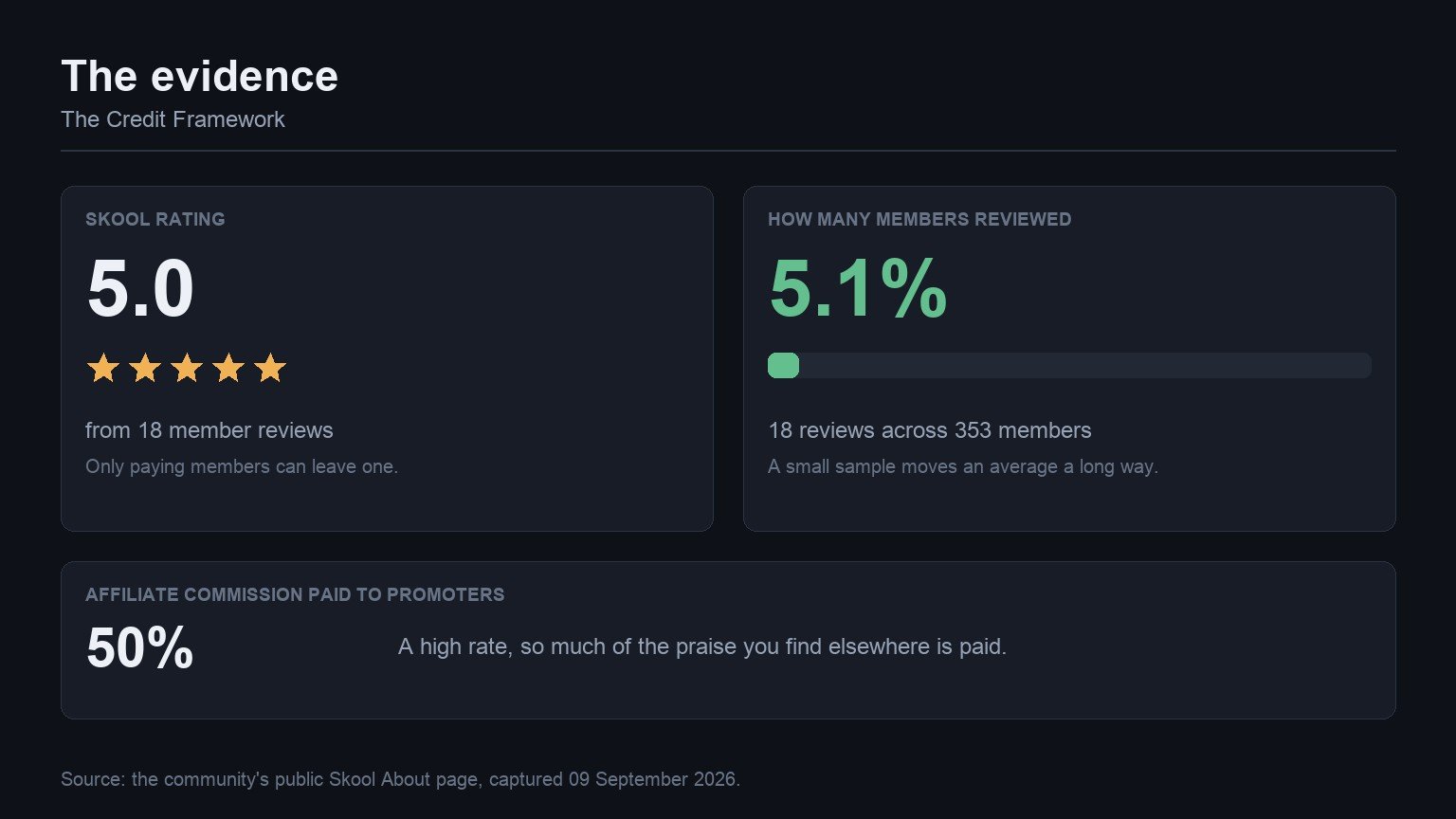
Eighteen reviews at a 5.0 average, four bodies visible at capture.
Eighteen from 353 members is a 5.1% response rate, which is normal for Skool. A straight 5.0 with no dissent is less normal, and small samples do that: it takes only one unhappy member out of 18 to move the average to 4.8, and none has appeared.
Skool blocks non-paying accounts from leaving reviews, so these 18 people paid. That makes them better evidence than anything published off-platform, which is the part the 50% affiliate rate contaminates.
One member writes that the experience is far exceeding expectations and that they look forward to more success and opportunity just from being in the room (a member review on Skool, September 2026). Another thanks Brianna and the team, says the training and knowledge is remarkable and that they are still learning (a member review on Skool, August 2026). A third describes the group as a chance to rebuild and start over, and to be mindful about credit (a member review on Skool, August 2026).
What the reviews never say
Not one visible review names a credit score.
No starting score, no ending score, no points gained, no timeframe. Nobody names a funding approval, a credit limit, a loan, a card or a dollar amount. Nobody says what their file looked like before or after.
In a credit community that is the gap that matters. The praise is about the room, the teaching and the feeling of opportunity, and it is warm and specific about those things. As evidence that the method moves a credit file or produces funding, the visible reviews carry nothing. Read them as evidence that members are happy, which is a real signal, and stop there.
The 50% affiliate rate explains the rest of the internet
The listing pays affiliates 50%, the top rate Skool offers.
On $49 that is $24.50 a month to the referrer, recurring, for the life of the membership. Twenty referrals is $490 a month.
At that rate, assume most blog posts, videos and social threads recommending The Credit Framework were written by someone who gets paid when you join. That is not a scandal and it does not make the community bad. It does mean third-party praise is close to useless as evidence here, and the 18 on-platform reviews are worth more than a hundred off-platform recommendations.
Don’t Join If
- You need to verify who is teaching you. The owner bio is two characters, with no links, no location and no business name.
- You want proof the method moves a credit file. No visible review names a score, a funding approval or a date.
- You want a busy room. Nine hundred and forty-seven posts across 353 members is 2.7 each, and six people were online at capture.
- You are relying on an outside recommendation. The 50% affiliate rate paid for most of the coverage you will find.
My Verdict
The offer is priced well. One hundred and eighty-seven modules across 17 courses for $588 a year is about $3.14 per module, the price is published properly in Skool’s structured record rather than only on a button, and three admins for 353 members is a reasonable ratio. Eighteen paying members chose to leave a review and all 18 gave five stars, with bodies that read like real people rather than templates. The crown MRR badge comes from Skool rather than the seller.
The weak points are four. The founder publishes nothing checkable, which in a regulated consumer-credit category is the most serious mark against the listing. The reviews contain no outcome anyone can measure. The feed is quiet for its size. And the 50% affiliate rate means the recommendations that brought most people here were bought.
If you want in, one month at $49 is the honest way to test it, and cancel before the second charge if the classroom does not match the description. Whether any of it applies to your situation depends on your own credit file and the rules where you live, so verify that before you pay rather than after.
Our Affiliate Marketing Launchpad review covers another money-category community where the founder record is far easier to check, and the AI Profit Boardroom review looks at what a higher-priced room offers for the extra money. If you decide to go ahead, the live listing carries the current price.
Full pros & cons
- 187 modules across 17 courses for $588 a year, about $3.14 per module
- Eighteen reviews at a straight 5.0 average, all from paying members
- Three admins for 353 members, roughly one per 118 people
- The price is published in Skool's structured record at $49 USD monthly, not just on a button
- The owner carries a crown MRR badge, which Skool issues rather than the seller claiming it
- The owner's public bio is the two-character string ':)' with no links and no location
- Credit repair is a regulated activity in several countries and the listing publishes no credentials
- The 50% affiliate rate is the highest tier on Skool, so most outside coverage is paid
- Eighteen reviews from 353 members is a 5.1% response rate and a thin evidence base
- No visible review names a credit score, a funding amount or any dated outcome
Try it yourself
Ready to put it to the test?
We may earn a commission at no extra cost to you. Affiliate disclosure.
Frequently Asked Questions
How much does The Credit Framework cost?
How big is The Credit Framework library?
Who runs The Credit Framework?
Is The Credit Framework a credit repair program?
How many reviews does The Credit Framework have?
Does The Credit Framework pay affiliates?
Reader feedback
Was this review helpful?
Your feedback helps us write better reviews.
Thanks for your feedback.
Ray Okafor is the analyst behind AI Insider Edge, covering AI tools, online courses, and paid communities in the make-money-online space. Hands-on reviews say so and state what was actually paid for access. Research reviews say that too, and are built from the seller’s own public pages, verified member reviews, and the founder’s public record. Either way the aim is a buyer’s-eye read, not a press release. Reviews are independent and may contain affiliate links, at no extra cost to you.
More reviews: Trading, credit and personal finance

LetsGetFunded Inner Circle Skool Review (2026)
LetsGetFunded Inner Circle runs $63 to $247 a month for 2,275 members. A 4.3 rating from 18 reviews, and one alleges deleted posts. An outside look.

CGC Credit HQ Skool Review (2026)
CGC Credit HQ lists $99/month for 603 members, 38 modules and 2 admins. Three reviews exist, one member was online, and no price sits on record.

Is Credit to Keys Lab Worth $79/mo?
Credit to Keys Lab charges $79 a month for credit repair training. 155 modules, 1,039 members, 13 reviews, no published credentials and no refund terms.

Credit With 1Eleven Review: 1,224 Members, $37/mo
Credit With 1Eleven lists at $37/month, while its own copy says $67 and a required $39.90 tool sits on top. 1,224 members, 17 reviews, read plainly.

Is Miguel Angel Correa Worth $150/mo? Spanish Trading
Comunidad Crece charges $150 a month for a Spanish trading room with 458 members. No track record and no risk warning appear on the listing.

M71 Trading - AlejandroFx Skool Review (2026)
M71 Trading costs $71 a month and the seller's own copy says there will be no refunds. 933 members, 12,126 posts, 87 reviews, all in Spanish.
The Edge Briefing
One honest review, every Sunday.
One email a week: which AI tools, courses & communities passed the rubric — and which to skip. Built for people funding their own stack.