Is Angel Media Worth $109/mo? Chinese Only, No Refunds
Angel Media charges $109 a month for 22 courses and 52 modules taught in Chinese. The listing states refunds stop the moment billing starts.
 By Ray Okafor ·

No score: research review
We only score what we used. The verdict below is built from public sources. Price at review: $109/month.
55 reviews at a 5.0 average, with no rating below five visible at capture
Every course, post and review is in Traditional Chinese, with no English track mentioned
Source: Skool public About page, captured September 9, 2026
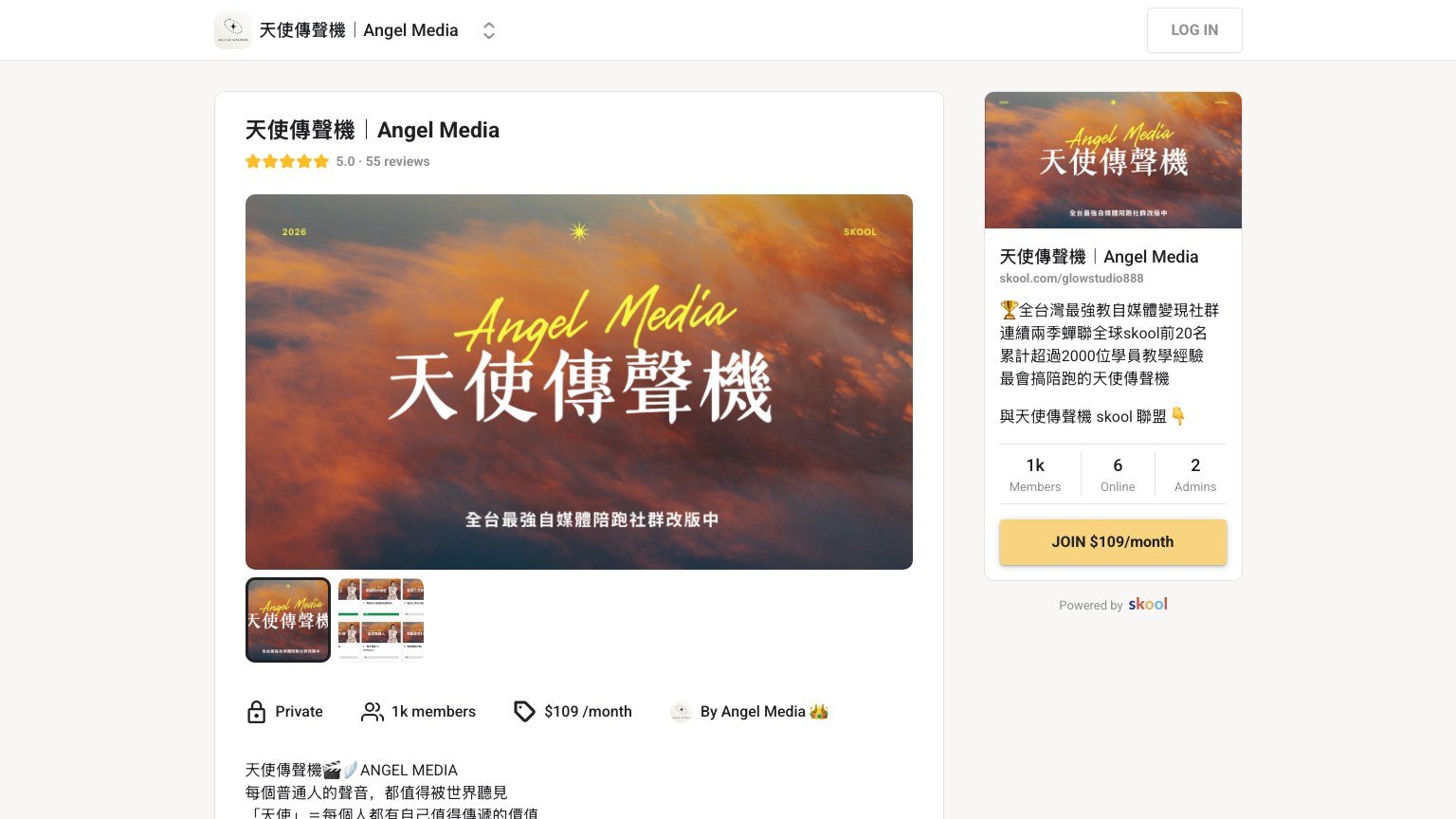
天使傳聲機. Angel Media. The community name appears in Traditional Chinese first, and that is the single most useful thing to know before you read another line.
Everything here runs in Chinese. The About text, the 22 course titles, the sales copy, and all five member reviews visible when I captured the page.
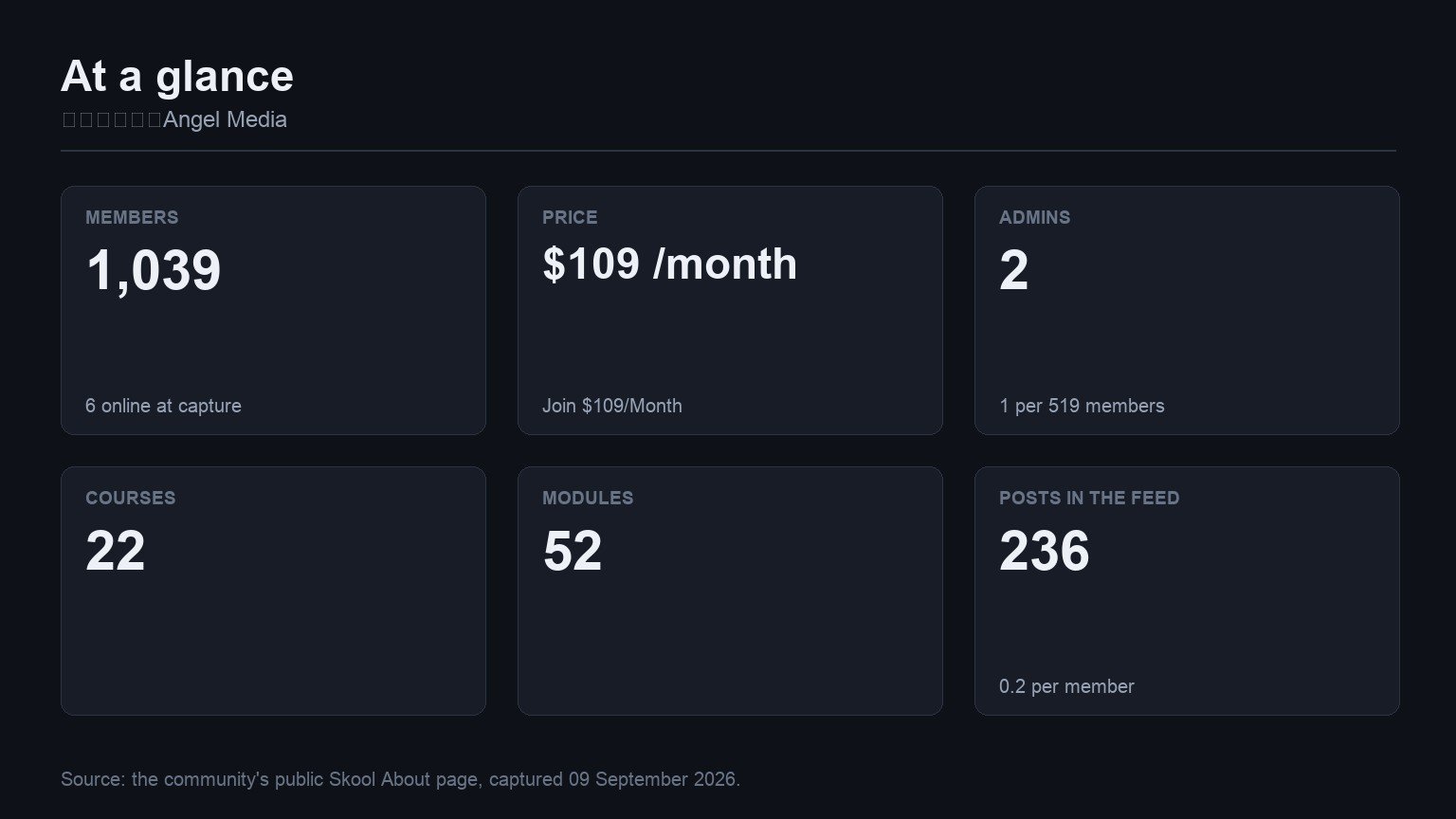
The rest of the numbers: 1,039 members, 52 modules, 236 posts, $109 a month.
How this review was built. I have not joined Angel Media and no money has moved in either direction. What follows comes from the community’s public About page on Skool, the review panel Skool restricts to paying members, the owner’s public profile and the linked subscription terms, all captured on 9 September 2026. Anything that comes from the sales copy is labelled as the seller talking.
Quick Decision
Join if you read Traditional Chinese, you are building an Instagram audience in Taiwan or the wider Chinese speaking market, and you can treat the first $109 as spent money. The review record is strong, the live schedule is real, and the curriculum covers the whole path from profile setup to closing in DMs.
Do not join if you read only English. There is no English track, no subtitle note and no translation offer anywhere on the listing, which closes all 52 modules to you.
Also pause if you expect a refund safety net. The linked terms state plainly that once billing starts, no refund request is accepted. That is the sentence that shaped my verdict.
The Angel Media listing shows the current price and course list.
$109 A Month, With Refunds Ruled Out In Writing
The join button reads $109 per month. Across a year that is $1,308.
Skool usually stores a structured price record with an amount, a currency and a billing interval. For this community that record was empty at capture, so the button text is the only number available. Confirm the currency at checkout rather than assuming.
The terms are published on a linked Canva page, and they are worth reading before you click anything. Three things are stated there. The course is sold on subscription and rebills automatically. Membership grants access to digital products, digital assets and live training from the moment it activates. And once a charge has gone through, no refund request will be accepted.
I want to be fair about that last line. A seller who publishes a hard no-refund policy is being clearer than one who says nothing, which is the more common pattern on Skool. Most listings I look at simply omit the subject.
Clarity is not the same as a good deal for the buyer, though. There is no trial, no cooling-off period and no stated minimum term. Your entire evaluation window happens before you pay.
The page also notes that Skool bills in US dollars. For a Taiwan based audience that adds a currency conversion on every renewal, and the monthly figure will move with the exchange rate.
One more cost, further down the page
The quarterly in-person meetup is not covered by the subscription. The page says attendees pay a venue fee of 150 to 500 in local currency. Small money, but it is a second line item, and it is the only part of the offer that requires being physically in Taiwan.
What The 22 Courses Actually Cover
| What | Count |
|---|---|
| Members | 1,039 |
| Members online at capture | 6 |
| Admins | 2 |
| Courses | 22 |
| Modules | 52 |
| Posts in the feed | 236 |
| Reviews | 55 |
Twenty-two courses holding 52 modules averages 2.4 modules per course. That is thin by Skool standards, where a mature library often carries ten or more units per course. Read these as short focused tracks rather than long programmes.
The seller lists the tracks as follows. Instagram foundations covers the marketing funnel, positioning, audience definition, the bio, the three pinned videos, covers and link placement. The copywriting system covers three post formats, how to use AI on them, how to judge what needs changing, and how to split one topic into ten pieces. Stories covers everyday posting, a five step selling sequence, story-driven retention, highlight covers and the route from story to purchase.
Then it gets more specific. DM selling covers comment keywords, ManyChat automation, moving a lead from guide to purchase, handling one-to-one consultations and a documented DM closing process. A separate track teaches running a Chinese language Skool community: opening the group, positioning it, deciding what free material to publish, and driving traffic from Instagram.
Editing has its own track covering phone and desktop workflows, quoting for freelance edit work and training an editor. Two topic units are named as ongoing additions: AI generated carousels and online recruitment.
The live schedule is the part that does not show up in the module count. Two online sessions a month, one taught class with a Q and A, both recorded. A larger group coaching push every two months where a team captain works with you to finish a video. And a quarterly offline event.
The feed is quiet
Two hundred and thirty-six posts across 1,039 members is 0.23 posts per member. Six people were online at capture, which is 0.6% of the room.
That is a low number and I am not going to dress it up. A community sold partly on peer connection should have a busier board than one post for every four members.
There are two readings. The teaching may be happening inside the courses and the live calls, with the feed used only for announcements. Or a large share of the 1,039 have paid and gone quiet. The public data cannot separate those, so treat the feed as a weak point rather than a disqualifier, and ask about it before you subscribe.
Peggy Teaches It, But The Profile Says “Hi”
The Skool owner account is a brand account called Angel Media. It joined the platform on 30 July 2025.
The bio is one word: Hi. The location field is empty. The links object is empty, so there is no website, no Instagram, no YouTube and no TikTok listed on the profile.
The teacher is named in the sales copy instead. Peggy, written 施宇緹, with the Instagram handle @yuyu1sxj. The claims attached to her are specific: a personal account past 100,000 followers this year, growth from 1,300 to 25,000 followers in six months using recruitment style videos, one video that added 22,000 followers and brought 675 business enquiries, one monetisation video that sold 100 units in ten minutes, 700,000 in local currency turned over in four days, and 29 monetising Skool communities launched this year.
None of that is verified by Skool. The platform confirms member counts, posts, courses, modules and reviews. It does not confirm follower counts or revenue, and no source, screenshot or date range is attached to any of those figures on the listing.
The gap that bothers me is structural rather than personal. This is a community teaching Instagram growth, and the profile you buy from links to no Instagram account. The handle appears in body copy where a reader has to notice it, not in the links field where a buyer would check it.
Two things do count in the seller’s favour. The account holds a crown MRR badge, which Skool assigns from its own revenue data rather than from anything the owner types. And the About text claims two consecutive seasons in the global Skool top 20 plus more than 2,000 students taught, which remains a seller claim, but the crown badge at least confirms the revenue is substantial.
Two admins run a room of 1,039, or one per 520 members. Neither is named on the page.
Fifty-Five Reviews, Five Of Them Filed On The Same Day
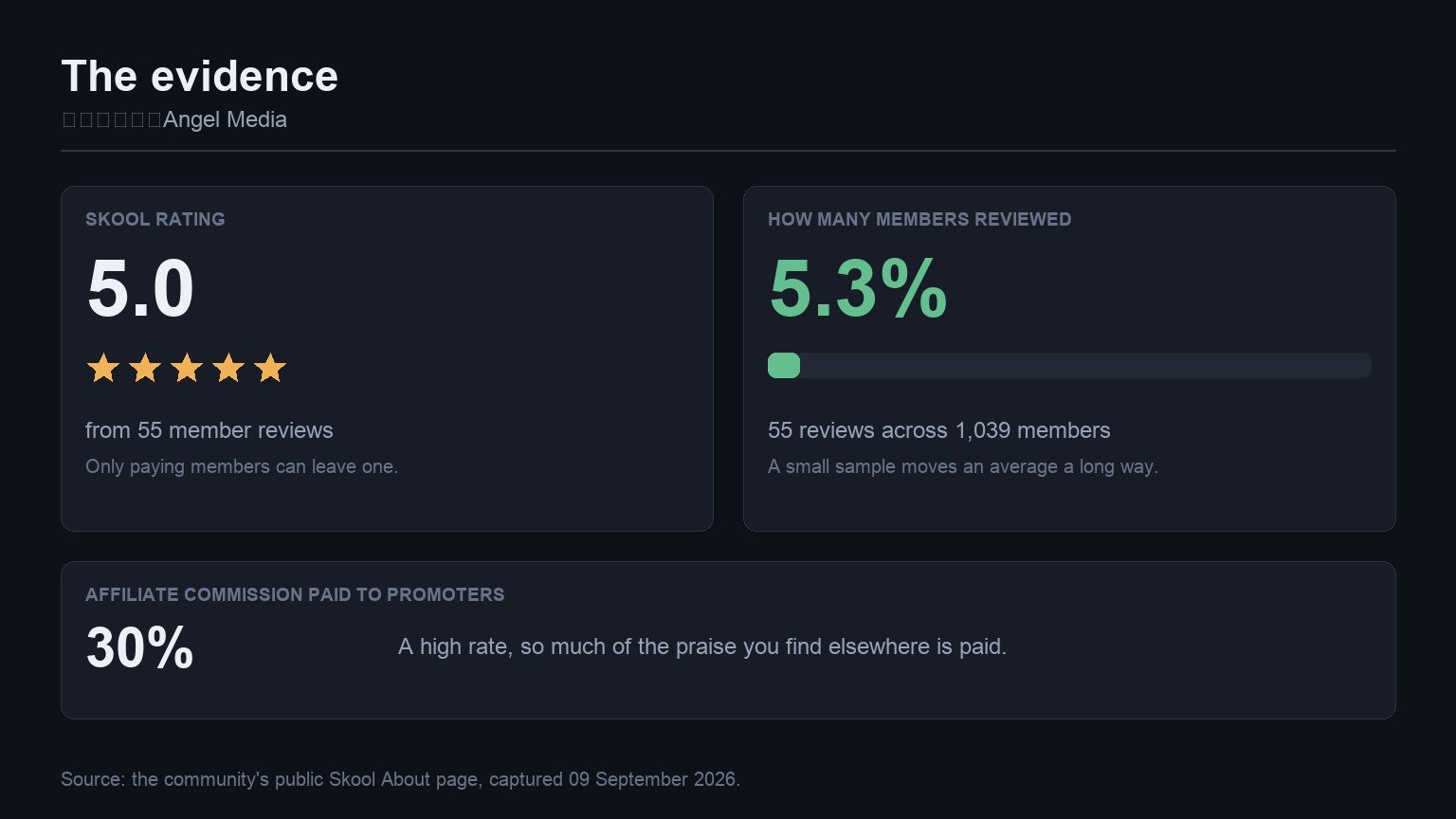
Fifty-five reviews from 1,039 members is a 5.3% response rate at a 5.0 average. No rating below five was visible at capture.
Five review bodies were readable, and here is the detail worth pausing on. All five were posted on 31 August 2026. Four of them landed inside a six hour window that morning.
That pattern usually means the community asked. A review push is common, it is not against Skool’s rules, and the reviewers are still paying members, since Skool blocks non-paying accounts from the review panel. But a 5.0 average built from a coordinated request tells you less about steady satisfaction than 55 reviews spread across a year would.
One member writes that she has learned a great deal since joining and that the teacher keeps updating the material to match current trends (a member review on Skool, August 2026). Another says the course is practical and systematised with templates a complete beginner can follow (a member review on Skool, August 2026). A third says she has been subscribed for close to a year, is renewing next month, finds Peggy approachable and down to earth, and values the people she has met there (a member review on Skool, August 2026).
That third one is the most useful of the set. Nearly a year of retention from a paying member is harder to manufacture than a sentiment.
What none of the reviews mention
No visible review states a follower count, a revenue figure or a sale. Nobody quantifies what changed for them.
The praise is about teaching quality, updates, approachability and templates. Given that the sales page leads with 22,000 new followers and 700,000 in four days, the silence on results in the member reviews is the contrast to hold on to.
Skip This One If
- You do not read Traditional Chinese. All 22 courses, both monthly live calls and every review are Chinese only.
- You want the option to change your mind. The terms rule out refunds once billing starts.
- You buy for the peer network. The feed holds 236 posts across 1,039 members.
- You need to check the teacher before paying. The owner profile carries no links and no location.
My Verdict
The strengths are real. Fifty-five reviews at a clean 5.0 from paying members is a stronger evidence base than most communities of this size collect, the crown badge comes from Skool rather than the seller, and the curriculum covers a complete path from an empty Instagram profile through to a documented DM closing process. Two live sessions a month with replays is a proper schedule at $109, and the quarterly offline meetup is unusual.
The weak points come from four places. The no-refund clause means the whole $109 is at risk on a decision made from a sales page. The feed is quiet at 0.23 posts per member, which undercuts the community half of the pitch. The owner profile is a blank record with a one-word bio in a business built on a personal brand. And the five visible reviews all landing on one day makes the 5.0 average softer than it looks.
If you read Chinese and sell on Instagram in Taiwan, this is a serious offer with a serious catch attached to the billing terms. If you do not read Chinese, our La Tribu Divisual review covers a similar creator community in Spanish, and the MarketingSecrets AI review covers an English language option in the same price band. Check the current listing before you decide either way.
Full pros & cons
- 55 reviews at a 5.0 average, with no rating below five visible at capture
- 22 courses covering Instagram setup, copywriting, stories, DM selling and editing
- Two live sessions a month with replays, plus a quarterly in-person meetup
- The owner account carries a crown MRR badge, which Skool issues rather than the seller
- The subscription terms are published on a linked page instead of being hidden
- Every course, post and review is in Traditional Chinese, with no English track mentioned
- The terms state that no refund request is accepted once billing begins
- 236 posts across 1,039 members is 0.23 posts per member, a quiet feed
- 52 modules across 22 courses averages 2.4 modules per course
- The owner profile carries the bio 'Hi', no location and no links at all
Try it yourself
Ready to put it to the test?
We may earn a commission at no extra cost to you. Affiliate disclosure.
Frequently Asked Questions
How much does Angel Media cost?
Can Angel Media be followed in English?
Does Angel Media offer refunds?
How big is the Angel Media library?
How active is the Angel Media community?
Who teaches Angel Media?
Are Peggy's follower numbers verified?
Does Angel Media pay affiliate commission?
Reader feedback
Was this review helpful?
Your feedback helps us write better reviews.
Thanks for your feedback.
Ray Okafor is the analyst behind AI Insider Edge, covering AI tools, online courses, and paid communities in the make-money-online space. Hands-on reviews say so and state what was actually paid for access. Research reviews say that too, and are built from the seller’s own public pages, verified member reviews, and the founder’s public record. Either way the aim is a buyer’s-eye read, not a press release. Reviews are independent and may contain affiliate links, at no extra cost to you.
More reviews: Marketing, ads and sales

Affiliate Marketing Launchpad Review: 5 Skools, 1 Real
I joined Affiliate Marketing Launchpad and worked through the classroom. Five Skools share this name, so here's the real one and what $29 vs $49 buys.

Is BAMx | Real Estate Worth $197/mo?
BAMx charges $197 a month for 1,315 modules and 21 admins across 2,137 members. Only 4 reviews exist and the free trial length is never published.

Disrupter Academy Review: 1,326 Members, $29/mo
Disrupter Academy lists $29 a month for 1,326 members and 508 modules. The page flags a price rise, and the Premium tier has no published price.

AAAgency US Skool Review (2026): $1,000/mo, 57 Members
AAAgency US charges $1,000 a month for 3 courses, 12 modules and a feed with 1 post. 57 members, 8 admins, 1 review. What the public listing shows.

Email Marketing Mastery Review: 328 Members, $247/mo
Email Marketing Mastery costs $247/mo for 119 modules and 250+ templates. Just 16 of 328 members have reviewed it. The numbers and the $250M claim, checked.

Is Círculo de Crecimiento Worth $40/mo? 3,052 Members
Círculo de Crecimiento runs at $40 a month for 3,052 members, 849 modules and 79,601 posts. Everything is in Spanish, and the best perks need the annual plan.
The Edge Briefing
One honest review, every Sunday.
One email a week: which AI tools, courses & communities passed the rubric — and which to skip. Built for people funding their own stack.