Email Marketing Mastery Review: 328 Members, $247/mo
Email Marketing Mastery costs $247/mo for 119 modules and 250+ templates. Just 16 of 328 members have reviewed it. The numbers and the $250M claim, checked.
 By Ray Okafor ·

No score: research review
We only score what we used. The verdict below is built from public sources. Price at review: $247/month.
7 admin accounts for 328 members, one staff seat per 47 people, the best ratio in this ranking
$247 a month is $2,964 a year, one of the highest prices on Skool for a single-topic course
Source: Skool public About page, captured September 9, 2026
Three hundred and twenty-eight members paying $247 a month. Sixteen of them have written a review.
That is the shape of this listing before you read a word of the sales copy.
A disclosure up front. I am not a member of Email Marketing Mastery and nothing has been paid to Max Sturtevant or Well Copy. What follows comes from the community’s public Skool About page, the written reviews Skool restricts to paying members, and the founder’s own public profiles, captured on 9 September 2026. Anything that comes from the seller’s marketing rather than Skool’s records is labelled that way.
Quick Decision
Join if you run or manage ecommerce email for a brand with real list volume, and $247 a month is a line item you can recover from a single improved flow. Seven admins across 328 members means you can actually get an answer, and 250 editable templates save working hours you would otherwise bill.
Hold off if you are early. At $2,964 a year the price only makes sense against a list already producing revenue. Hold off too if you want a heavy review record before paying that much, because 16 reviews is a small sample, and none of them names a number the writer measured.
Current terms sit on the Email Marketing Mastery listing.
Who Max Sturtevant Is, And What He Publishes
Max Sturtevant has been on Skool since 13 July 2023, a little over three years before capture. His bio names him as owner of Well Copy and claims $200M generated through email.
He links five public profiles: Instagram, LinkedIn, X, YouTube and wellcopy.net. That is more public surface than almost any founder in this ranking, and it is the strongest thing on the listing. You can read his LinkedIn history, look at the agency site, and watch his free video before spending $247.
His profile carries a crown badge. Skool awards that on owner earnings, so it tells you he sells well and nothing about how his members did.
One gap. No location is listed. For a founder this easy to research elsewhere it is a small omission, but the field is blank and worth noting.
Two Hundred And Forty-Seven Dollars A Month
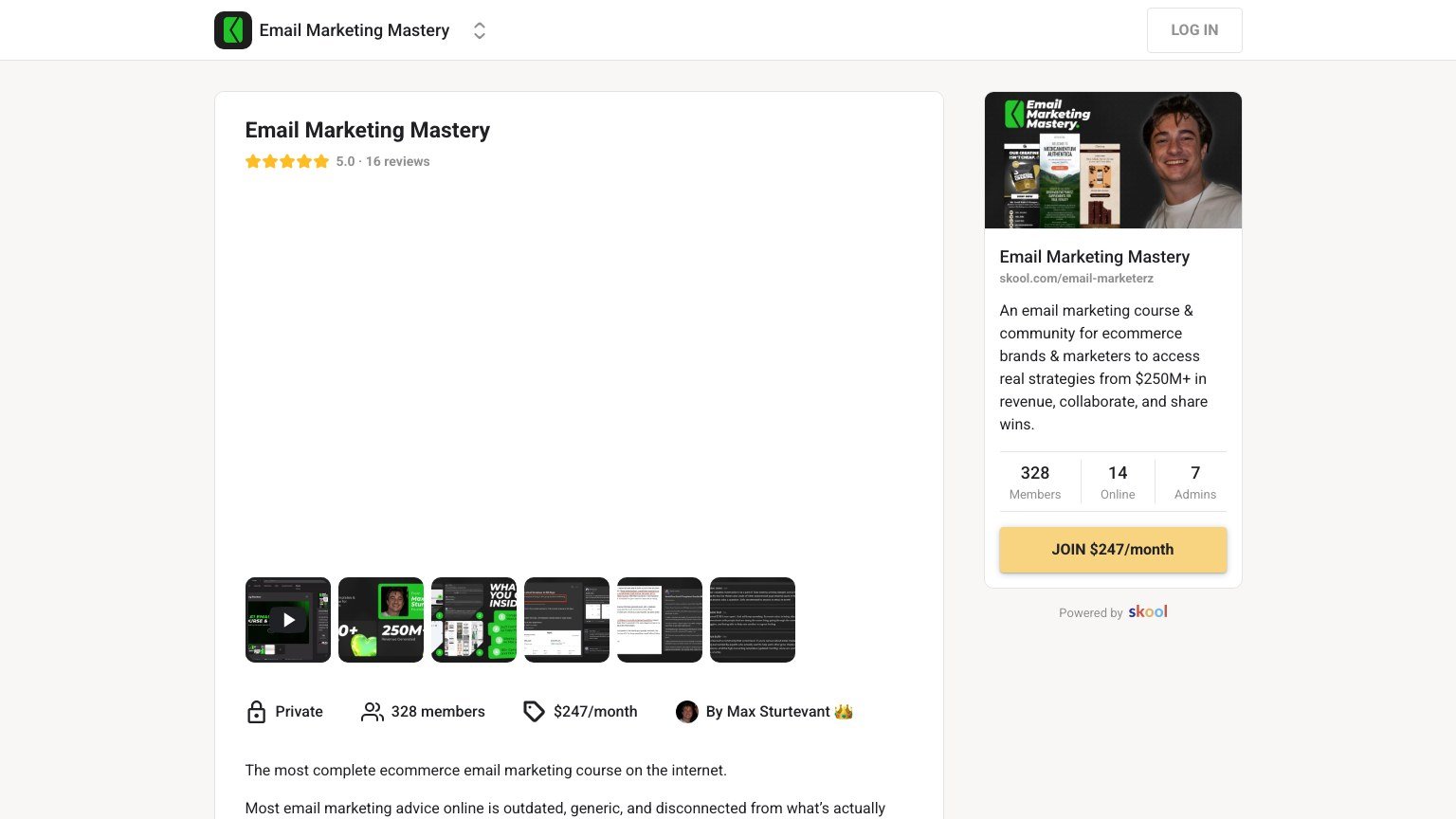
Skool’s price record lists 247 US dollars on a monthly interval, and the join button reads JOIN $247/month. Two sources agreeing is better than many listings manage, and a published price counts in the community’s favour.
The copy says cancel anytime, no lockups. That is the only term published. There is no refund policy on the page, no trial, no annual plan and no lower tier.
A year at this rate is $2,964. Nothing on the listing frames the price that way, so do it yourself before joining.
What $2,964 A Year Has To Earn Back
This is the question the sales page skips. At $247 a month the community is not competing with other courses. It is competing with the hours of a freelance email specialist, or with a fraction of an agency retainer.
Work the arithmetic on your own list. If email currently produces $20,000 a month for your brand, a 15% lift is $3,000 a month and the membership pays for itself in the first week. If email produces $2,000 a month, the same 15% lift is $300 and you are underwater.
The templates change that calculation more than the modules do. Two hundred and fifty editable emails is real production time saved, and that value lands whether or not the strategy advice works for your account.
Five Courses, 119 Modules, 1,246 Posts
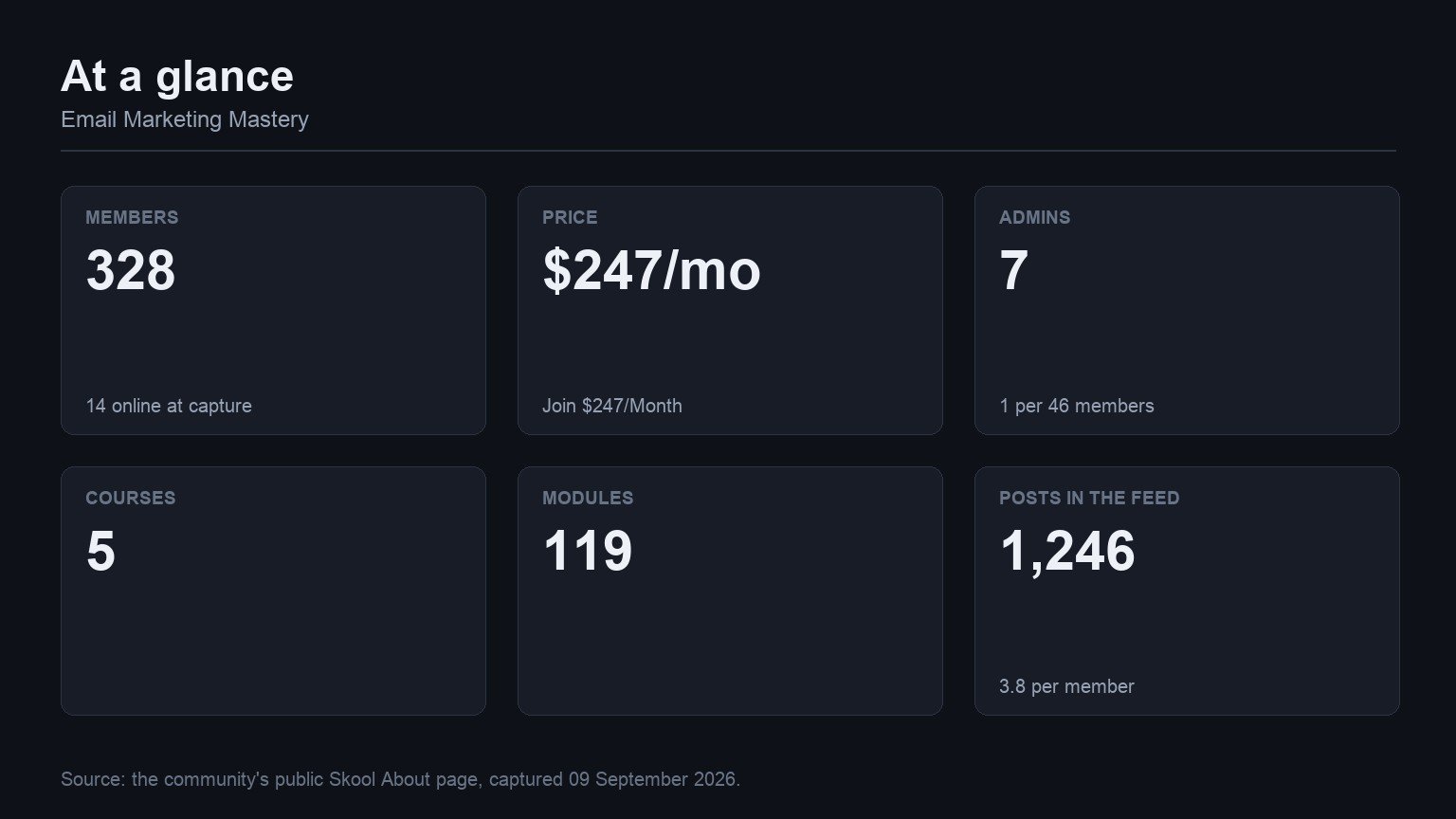
| What | Count |
|---|---|
| Members | 328 |
| Members online at capture | 14 |
| Admins | 7 |
| Courses | 5 |
| Modules | 119 |
| Posts in the feed | 1,246 |
One hundred and nineteen modules across 5 courses averages 24 modules per course. For a single subject that is deep rather than wide, which is what you want at this price.
The feed holds 1,246 posts among 328 members, about 3.8 each. Fourteen people were online at capture, roughly 4% of the room. Small, but the members are paying $247 a month, so the ones who show up tend to be working practitioners rather than browsers.
The listing puts the course at 30+ modules and Skool counts 119 across all courses. Both can be true if the flagship course is one of five. Ask which course the 30 sit in before you assume the rest are equally maintained.
The Templates And The A/B Test Library
The page promises 250+ editable email templates, described as every flow templatised plus the best performing campaign templates. It also promises new templates monthly and monthly A/B test results drawn from 100+ actively managed brands.
Those are the two items here you cannot get from a cheaper course. Test results from a portfolio of live accounts are genuinely difficult to assemble alone.
They are also entirely unverified. No sample test result appears on the public page, no brand is named, and there is no way to check that the monthly additions have kept up. Ask in the feed for the last three months of test posts before your first renewal.
The $250M Figure, And The $200M One
The listing says the course was created by Max Sturtevant and the team behind $250M+ in ecommerce email revenue. His own Skool bio says $200M generated through email.
Two different numbers for the same claim, published in the same place on the same day. Neither carries a date range, a client list or any third-party confirmation.
The gap does not prove anything is wrong. Agency revenue figures grow, and a bio can go stale. It does mean the headline number is a marketing figure that moves, and it should not carry any weight in your decision. Judge the 119 modules and the 7 admins instead, because those are counted by Skool rather than written by the seller.
Sixteen Reviews From 328 Members
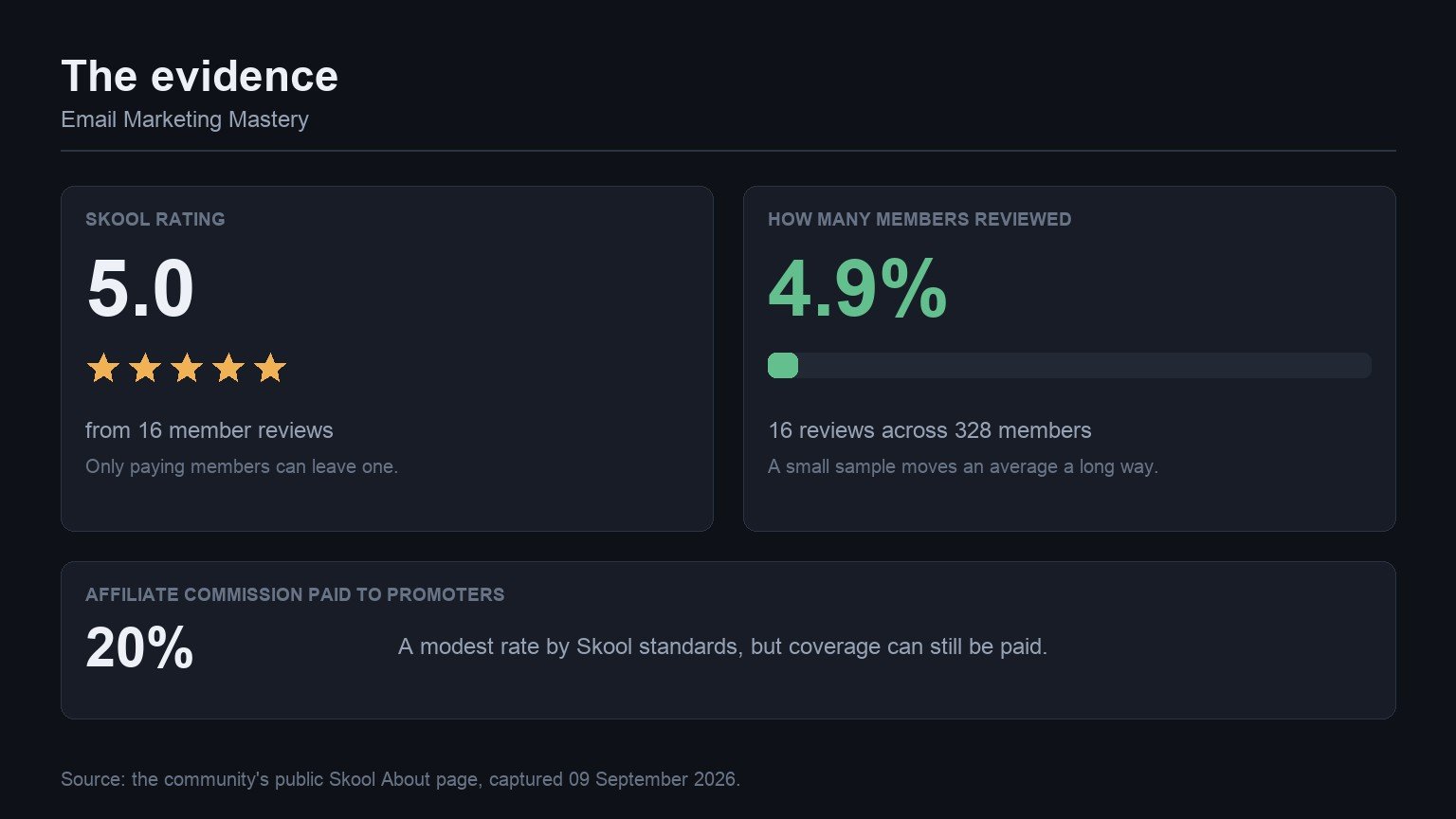
The average is 5.0 across 16 reviews, from 328 members. That is a response rate of about 4.9%, thin in absolute terms but better than most communities twice this size manage.
A clean 5.0 means nobody who wrote a review scored it below five stars. Skool only accepts reviews from paying members, so no rating here was bought. The usual blind spot applies: members who cancel rarely write on the way out.
Four are visible. One member says they have been in since day one and points to material from Max not shared elsewhere (a member review on Skool, September 2026). Another says they had followed him for two years, started an ecommerce brand, and calls the investment worth it (a member review on Skool, September 2026). A third praises the collaboration and the information sitting in one place (a member review on Skool, August 2026).
What none of them reports
Not one visible review names a revenue figure, an open rate, a click rate or a flow result the writer measured in their own account.
They praise access, teaching and the room. One says they learned what they needed within two weeks. For a $247 product sold on $250M of claimed revenue, first-person numbers are the evidence a buyer needs, and none appear.
Seven Admins For 328 Members
This is the best support ratio in this ranking: one staff account per 47 members. Communities charging a quarter of the price routinely run one admin per 300 people or worse.
Seven admins for a 328-member room also tells you the promised weekly Friday Q&A and the daily feedback are staffed rather than aspirational. It is the clearest sign that the price funds service, not just a library.
Verify it anyway. Post a question in your first week and time the reply. If it takes more than a day at this ratio, the ratio is decorative.
Don’t Join If
- Your email programme is small. At $2,964 a year the price needs an existing list to earn it back.
- You want the headline claim to hold. The page says $250M and the founder’s bio says $200M.
- You need a refund route. No refund policy is published anywhere on the listing.
- You want deep member proof. Sixteen reviews from 328 members, and none reports a measured result.
My Verdict
The staffing is the strongest part. Seven admins for 328 members is one per 47, and it makes the weekly calls and daily feedback credible in a way most listings never manage. The price is published in two places, 119 modules sit across 5 courses, and the founder links five public profiles so his work can be checked before a dollar changes hands. Sixteen out of 16 reviewers gave five stars.
The weak points come from price and proof. Two thousand, nine hundred and sixty-four dollars a year is a serious commitment with no refund policy, no trial and no annual discount published. The revenue claim appears as $250M on the page and $200M in the founder’s own bio, which is the single finding I would weigh most. Sixteen reviews from 328 members is a 4.9% sample, and none of the visible reviews reports a number the writer measured.
Watch the free YouTube material and read the Well Copy site first. If the approach fits your account, ask in the feed to see the last three monthly A/B test posts before you renew, because that library is the part you cannot buy elsewhere. For a cheaper room with a much larger review base, read our Affiliate Marketing Launchpad review, and the MarketingSecrets AI review covers what a low-cost marketing community looks like by comparison. The listing is here.
Full pros & cons
- 7 admin accounts for 328 members, one staff seat per 47 people, the best ratio in this ranking
- 119 modules across 5 courses, plus a template library the page puts at 250 editable emails
- The price is published in two places on the listing: $247 a month, US dollars
- Max Sturtevant links five public profiles, so his work and his agency can be checked before you pay
- All 16 reviews on file rate it 5 stars, and Skool only accepts reviews from paying members
- $247 a month is $2,964 a year, one of the highest prices on Skool for a single-topic course
- Only 16 of 328 members have written a review, a response rate of about 4.9%
- The listing says $250M+ in email revenue while the founder's own bio says $200M
- No refund policy, trial or annual plan appears anywhere on the About page
- No review names a revenue figure, an open rate or any result the writer personally measured
Try it yourself
Ready to put it to the test?
We may earn a commission at no extra cost to you. Affiliate disclosure.
Frequently Asked Questions
How much is Email Marketing Mastery?
How many members does it have?
What is inside the course?
Who is Max Sturtevant?
Is the $250M revenue claim verified?
How strong are the reviews?
Does it pay affiliates?
Is $247 a month worth it for a beginner?
Reader feedback
Was this review helpful?
Your feedback helps us write better reviews.
Thanks for your feedback.
Ray Okafor is the analyst behind AI Insider Edge, covering AI tools, online courses, and paid communities in the make-money-online space. Hands-on reviews say so and state what was actually paid for access. Research reviews say that too, and are built from the seller’s own public pages, verified member reviews, and the founder’s public record. Either way the aim is a buyer’s-eye read, not a press release. Reviews are independent and may contain affiliate links, at no extra cost to you.
More reviews: Marketing, ads and sales

Is The Facebook Ads Blueprint Worth $297/mo?
The Facebook Ads Blueprint costs $297/month for 6 courses and 136 modules. 697 members, 5 admins, and only 6 reviews. An outside look at the numbers.

Affiliate Marketing Launchpad Review: 5 Skools, 1 Real
I joined Affiliate Marketing Launchpad and worked through the classroom. Five Skools share this name, so here's the real one and what $29 vs $49 buys.

Is Angel Media Worth $109/mo? Chinese Only, No Refunds
Angel Media charges $109 a month for 22 courses and 52 modules taught in Chinese. The listing states refunds stop the moment billing starts.

Is BAMx | Real Estate Worth $197/mo?
BAMx charges $197 a month for 1,315 modules and 21 admins across 2,137 members. Only 4 reviews exist and the free trial length is never published.

Disrupter Academy Review: 1,326 Members, $29/mo
Disrupter Academy lists $29 a month for 1,326 members and 508 modules. The page flags a price rise, and the Premium tier has no published price.

AAAgency US Skool Review (2026): $1,000/mo, 57 Members
AAAgency US charges $1,000 a month for 3 courses, 12 modules and a feed with 1 post. 57 members, 8 admins, 1 review. What the public listing shows.
The Edge Briefing
One honest review, every Sunday.
One email a week: which AI tools, courses & communities passed the rubric — and which to skip. Built for people funding their own stack.