Is Blue Collar Closer Worth $49/mo?
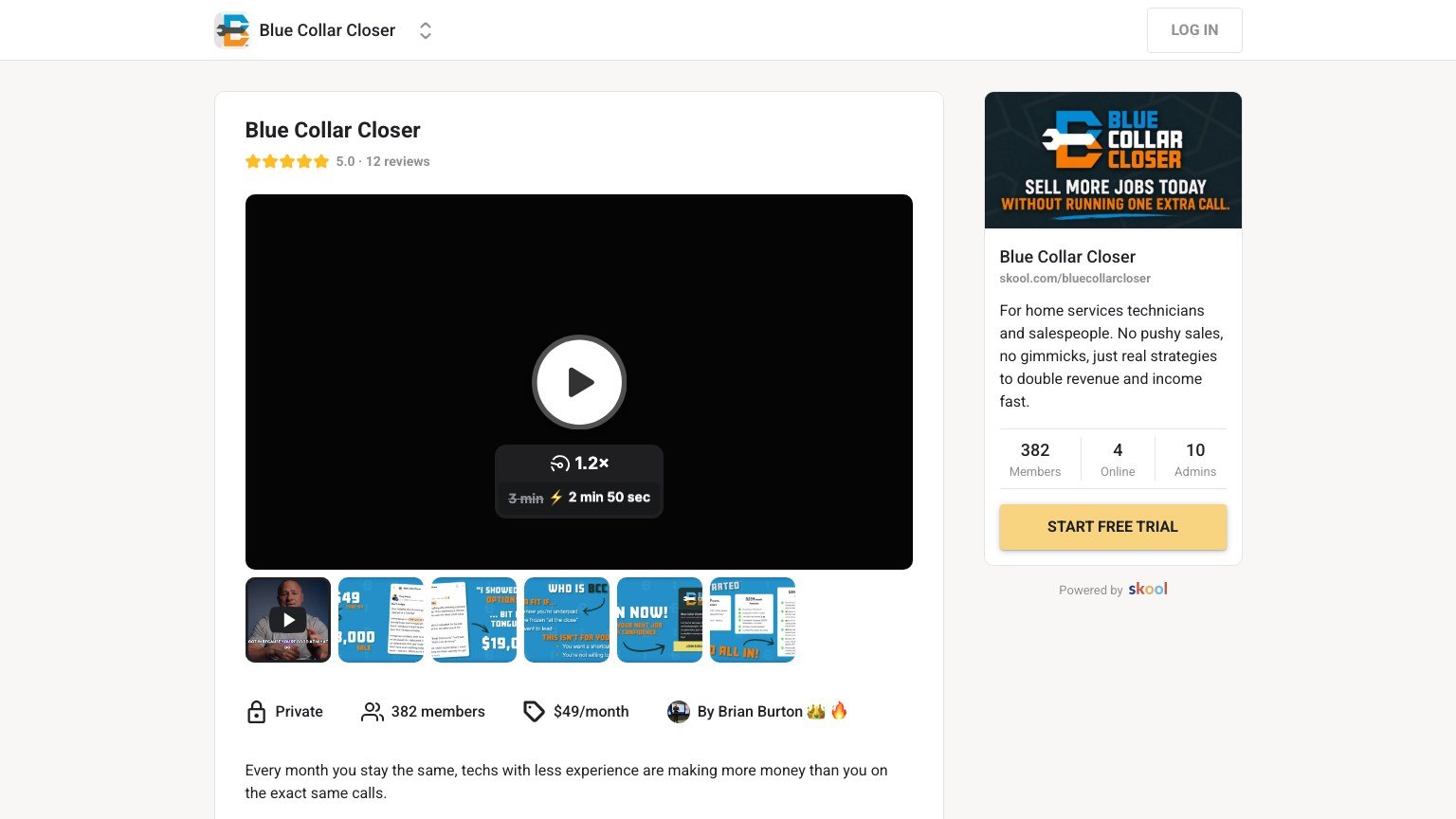
Blue Collar Closer charges $49/mo for 186 modules and 10 admins across 382 members. Only 12 have reviewed it. The income claims, checked honestly.
 By Ray Okafor ·
Ten admin accounts for 382 members, one staff seat per 38 people, the best ratio in this ranking
The page names three member income jumps, none of which can be checked by anyone outside
Source: Skool public About page, captured September 9, 2026
Ten admins for 382 members. That is one staff seat per 38 people, and no other community in this ranking comes close.
Twelve written reviews, though. And three income claims nobody outside can check.
A disclosure before the detail. I am not a member of this community and nothing has been paid to Brian Burton or his team. What follows was built from the community’s public Skool About page, the reviews Skool restricts to paying members, and the founder’s own public channels, captured on 9 September 2026. Where a figure comes from the seller’s marketing rather than Skool’s records, I label it that way.
One point to settle at the top. This community sells an income outcome for tradespeople. Every earnings figure on the page is the seller’s unverified claim, and nothing here should be read as a suggestion that a member will earn more.
Quick Decision
Join if you are a plumber, HVAC tech, electrician, roofer or comfort advisor who already runs calls and loses jobs on price. The material is sales communication for people who are technically competent and commercially awkward, and 10 admins across 382 members means you can actually get an answer. At $49 a month with a free trial, the downside is small.
Hold off if you are hoping the income screenshots on the page describe your next six months. They are unverified, they use inconsistent units, and none of them identifies a member you could contact. Hold off too if you are not running calls yet, because sales training with no calls to practise on is theory you will forget.
Current terms are on the listing if you want to read them first.
Forty-Nine Dollars, A Free Trial, And A Tier With No Price
Skool’s price record stores $49 monthly in US dollars. The join button does not show it. It reads START FREE TRIAL.
A trial is worth a lot here. Sales training is personal, the delivery either suits you or it does not, and being able to look inside before paying removes most of the guesswork.
Twelve months at $49 is $588. Against a single upsold job on a service call, that is a small number, which is the strongest version of this community’s value argument.
Then look at what is missing. The trial length is not published anywhere. No refund policy appears. No annual plan is offered.
The second tier nobody prices
The copy describes two routes. Get Started, framed as building the skills. Go All In, framed as the full classroom with live calls and role play.
Only one price is published. If Go All In sits above the $49 plan, the listing does not say what it costs, and a buyer joining for the live calls and role play could find the real number is somewhere else entirely.
Ask that before the trial ends. What does Go All In cost, and is it inside the $49 or on top of it?
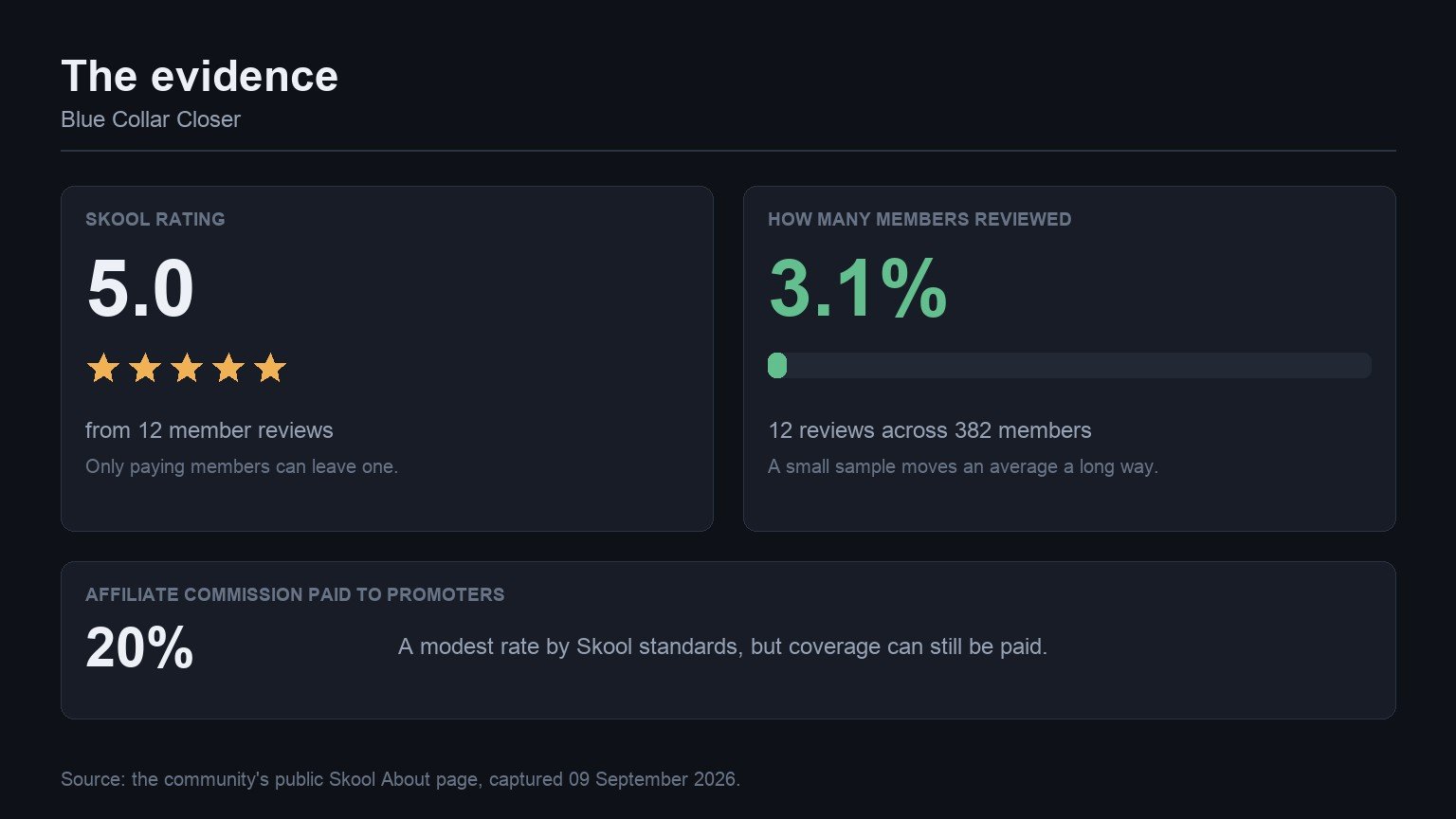
The affiliate rate is 20%, which pays $9.80 a month per referral, about $118 over a year. That is enough to explain some third-party enthusiasm. This review earns nothing.
Thirteen Courses, 186 Modules, 3,047 Posts
| What | Count |
|---|---|
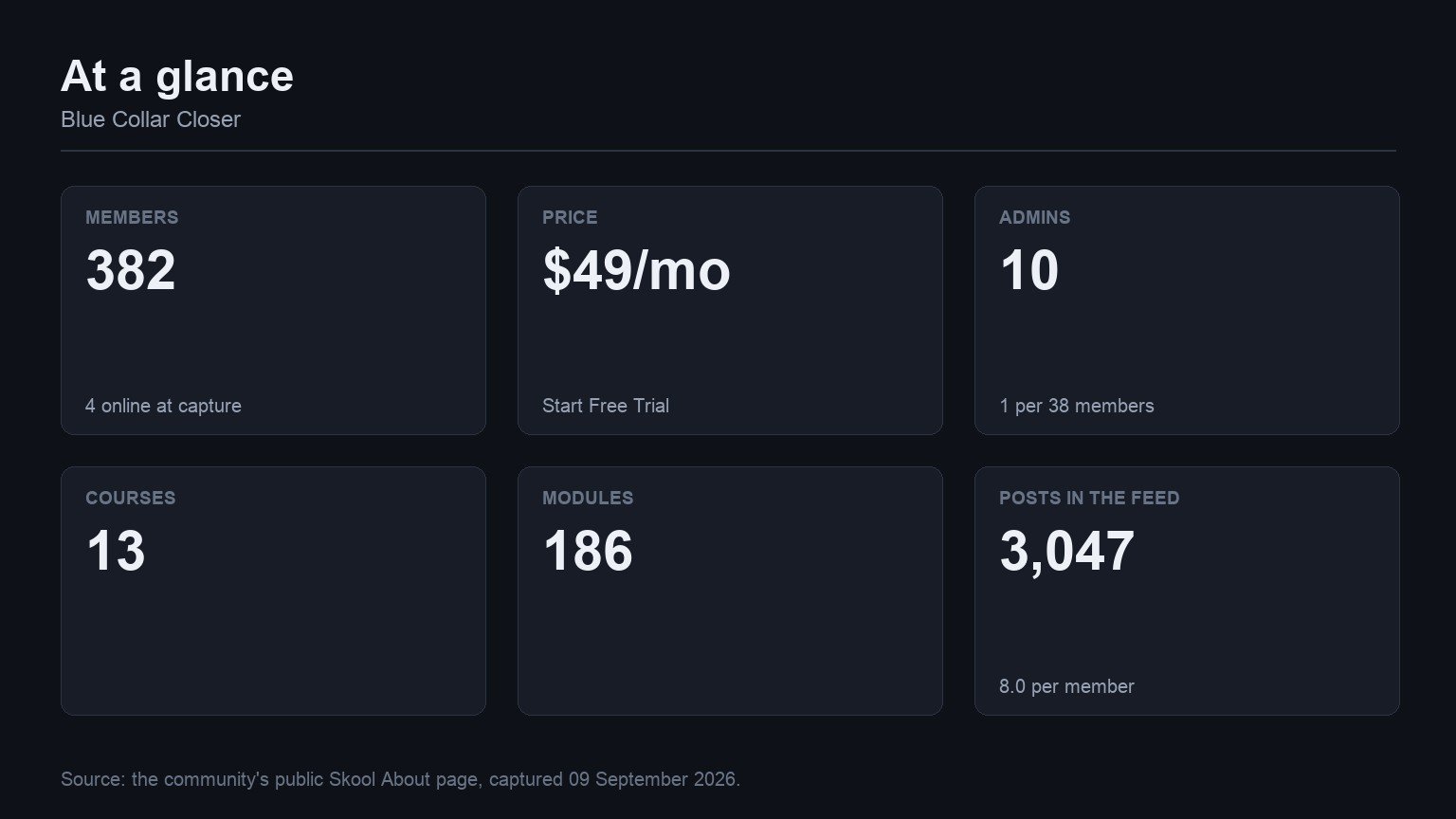
| Members | 382 |
| Members online at capture | 4 |
| Admins | 10 |
| Courses | 13 |
| Modules | 186 |
| Posts in the feed | 3,047 |
One hundred and eighty-six modules across 13 courses averages 14 modules per course. At $49 a month that is about 26 cents per module per month.
The admin count is the standout. Ten staff accounts for 382 members is one per 38, and communities in this ranking with twenty times the membership frequently run one per 200 or worse. Whatever else is true, this is a heavily staffed room.
The feed holds 3,047 posts, roughly 8 per member. That is one of the highest posts-per-member figures here, and it points to a group that writes rather than lurks.
Four members were online at capture. Small, though a room of 382 field technicians is unlikely to be sitting at a keyboard mid-afternoon.
Brad K, Mike K, and three numbers you cannot check
The sales page names three results. Brad K went from $40,000 to $160,000 a year. Mike K went from $30,000 to $100,000 a month in six months. One unnamed member went from $40,000 to over $400,000.
Those are the seller’s claims, presented without evidence.
Read the units. The first is annual. The second is monthly, and a jump from $30,000 a month to $100,000 a month is a business revenue pattern rather than a technician’s wage, though the page does not say which it is. The third gives no period at all, so $40,000 to $400,000 could be a year, a month or a career.
Members are identified by a first name and an initial. Nobody outside can contact them, verify the numbers, or ask what else changed in those six months.
None of that proves the results false. It means the page offers you no way to test them, and the free trial is the only inspection you actually get.
Brian Burton, Phoenix, And Five Public Links
Brian Burton has run this community since 10 December 2024, about 21 months at capture.
His bio is the most useful in this ranking. It names him as the Blue Collar Closer founder, host of the Waste No Day podcast, general manager at Benjamin Franklin Plumbing in Phoenix, and a father of four. His location field reads Phoenix, Az.
Five public links sit on his profile: Facebook, Instagram, LinkedIn, YouTube and wastenoday.com.
That combination matters more than it sounds. A current operating job at a named plumbing company means he is still inside the trade he teaches, and the podcast gives you hours of free material to judge his thinking before you spend $49. Most founders in this category link a sales page and nothing else.
The sales copy leans on the podcast too, telling readers that if they listen to Waste No Day they already know what is possible. That is a fair pitch, and it also tells you the community is downstream of an audience rather than a cold offer.
His account carries a crown badge, which marks a high-earning Skool owner and reflects sales rather than member results.
One name appears in the reviews that does not appear in the owner record. A member credits Brian Burton and Nate Minnich with building the community. If you are evaluating who teaches what, ask about that split.
Twelve Reviews From 382 Members
The average is 5.0 from 12 reviews. Out of 382 members, that is a 3.1% response rate, and 12 is one of the smallest review counts in this ranking.
Skool only accepts reviews from paying members, so nothing here can be bought. Twelve voices still cannot represent 382 people, and members who quit rarely write on the way out.
Three are worth reading. One says good tradesmen are often poor communicators who can fix the system but cannot convey the value they provide, and that the program gets technical people communicating at a high level (a member review on Skool, August 2026). Another makes a similar point more briefly, adding that building the habit takes real work and repetition (a member review on Skool, August 2026). A third thanks the two founders, names the Arcade and Wiser Wednesdays as features worth digging through, and describes members pushing their peers to improve (a member review on Skool, August 2026).
What the reviews do not say
Not one reviewer states their own income before joining or after.
The first review predicts higher conversion rates, higher average tickets and better Google reviews as outcomes, but it frames them as expectations rather than results the writer measured.
For a community whose sales page opens with three income jumps, that gap is the important one. The members who wrote publicly talk about communication skills. The dollar figures come only from the seller.
The consistency is worth noting on the positive side. All three describe the same problem, which is skilled tradespeople who cannot explain value to a homeowner. That is a coherent picture of what the training addresses.
Not For You If
- You need the income claims to hold. Three figures, no verification, and inconsistent units.
- You want a deep review record. Twelve reviews from 382 members is 3.1%.
- You are not running service calls yet. Sales practice needs live jobs to practise on.
- You are buying for the live calls and role play. That tier is described without a published price.
My Verdict
I score Blue Collar Closer 4.1 out of 5.
The operational side is the best in this group of reviews. Ten admins for 382 members is one seat per 38, the feed runs at 8 posts per member, and 186 modules across 13 courses for $49 a month works out near 26 cents per module. Brian Burton publishes his city, his current job at a named plumbing company, and five public links including a podcast you can judge him by for free. The free trial lets you inspect before paying, and the niche is narrow enough that the teaching can actually be specific.
The deductions are about claims and evidence. The page opens with three member income jumps, none verifiable, one mixing monthly and annual units, and one with no time period at all. Twelve reviews from 382 members is a 3.1% sample, and not one names the writer’s own earnings. The Go All In tier is sold in the copy with no price attached, and neither the trial length nor a refund policy appears anywhere on the listing.
Listen to a few Waste No Day episodes first, then take the trial and ask two questions in the feed: what Go All In costs, and how long the trial runs. For a comparison with another trade-focused community, read our Affiliate Marketing Launchpad review, and the AI Profit Boardroom review shows what a higher-priced business community publishes about its results. The listing itself is here.
Full pros & cons
- Ten admin accounts for 382 members, one staff seat per 38 people, the best ratio in this ranking
- 3,047 posts across 382 members works out at 8 posts per person, a genuinely busy feed
- 186 modules across 13 courses for $49 a month, about 26 cents per module per month
- Brian Burton lists Phoenix, a current GM job at a plumbing company, and five public links including a podcast
- The join button offers a free trial, so you can see inside before any money moves
- The page names three member income jumps, none of which can be checked by anyone outside
- Those figures mix annual and monthly units, and one carries no time period at all
- Only 12 of 382 members have written a review, a response rate of 3.1%
- The copy describes a second tier called Go All In, and no price for it is published
- No refund policy and no trial length appear anywhere on the listing
Try it yourself
Ready to put it to the test?
We may earn a commission at no extra cost to you. Affiliate disclosure.
Frequently Asked Questions
How much does Blue Collar Closer cost?
Are the income claims on the page verified?
How well staffed is the community?
Who is Brian Burton?
What do the 12 reviews say?
Reader feedback
Was this review helpful?
Your feedback helps us write better reviews.
Thanks for your feedback.
Ray Okafor is the analyst behind AI Insider Edge, covering AI tools, online courses, and paid communities in the make-money-online space. Hands-on reviews say so and state what was actually paid for access. Research reviews say that too, and are built from the seller’s own public pages, verified member reviews, and the founder’s public record. Either way the aim is a buyer’s-eye read, not a press release. Reviews are independent and may contain affiliate links, at no extra cost to you.
More reviews: Trades and local service businesses

Rascals Education Academy Skool Review (2026)
Rascals Education Academy charges $127 a month for 152 modules and 1,100 barbers. Only 16 members have reviewed it, a 1.5% response rate.

Is Wealthy Plumber Worth $99/mo?
Wealthy Plumber charges $99 a month for 819 members, 379 modules and 9 admins. The million dollar guarantee has no published terms and 12 reviews exist.

MedSpa Performance Academy Review: 59 Members, $2,500/mo
MedSpa Performance Academy charges $2,500 a month. 59 members, 6 admins, 248 modules and zero written reviews on the public Skool listing.

MiNT MVMT | Window Cleaning Skool Review (2026)
MiNT MVMT charges $1,997 a month behind an application. 127 members, 9 admins, 202 modules, 35 reviews. What the public listing does and does not show.

Blue-Collar Biz Accelerator Skool Review (2026)
Blue-Collar Biz Accelerator charges $1,597/mo for 831 members and 161 modules. The founder sold his own trade business in 2024. An outside look.

RAMP REI Skills Academy Skool Review (2026)
RAMP REI lists $9/mo, but says plans are priced for teams and solo pricing is by email. 601 modules, 564 members, 1 review. What to check before joining.
The Edge Briefing
One honest review, every Sunday.
One email a week: which AI tools, courses & communities passed the rubric — and which to skip. Built for people funding their own stack.