Meta Ads Mastery Skool Review (2026)
Meta Ads Mastery lists $497/month, 619 members and 371 modules. The page claims 119+ reviews while Skool counts 36. An outside look at the numbers.
 By Ray Okafor ·

No score: research review
We only score what we used. The verdict below is built from public sources. Price at review: $497/month (rising to $600 for new members).
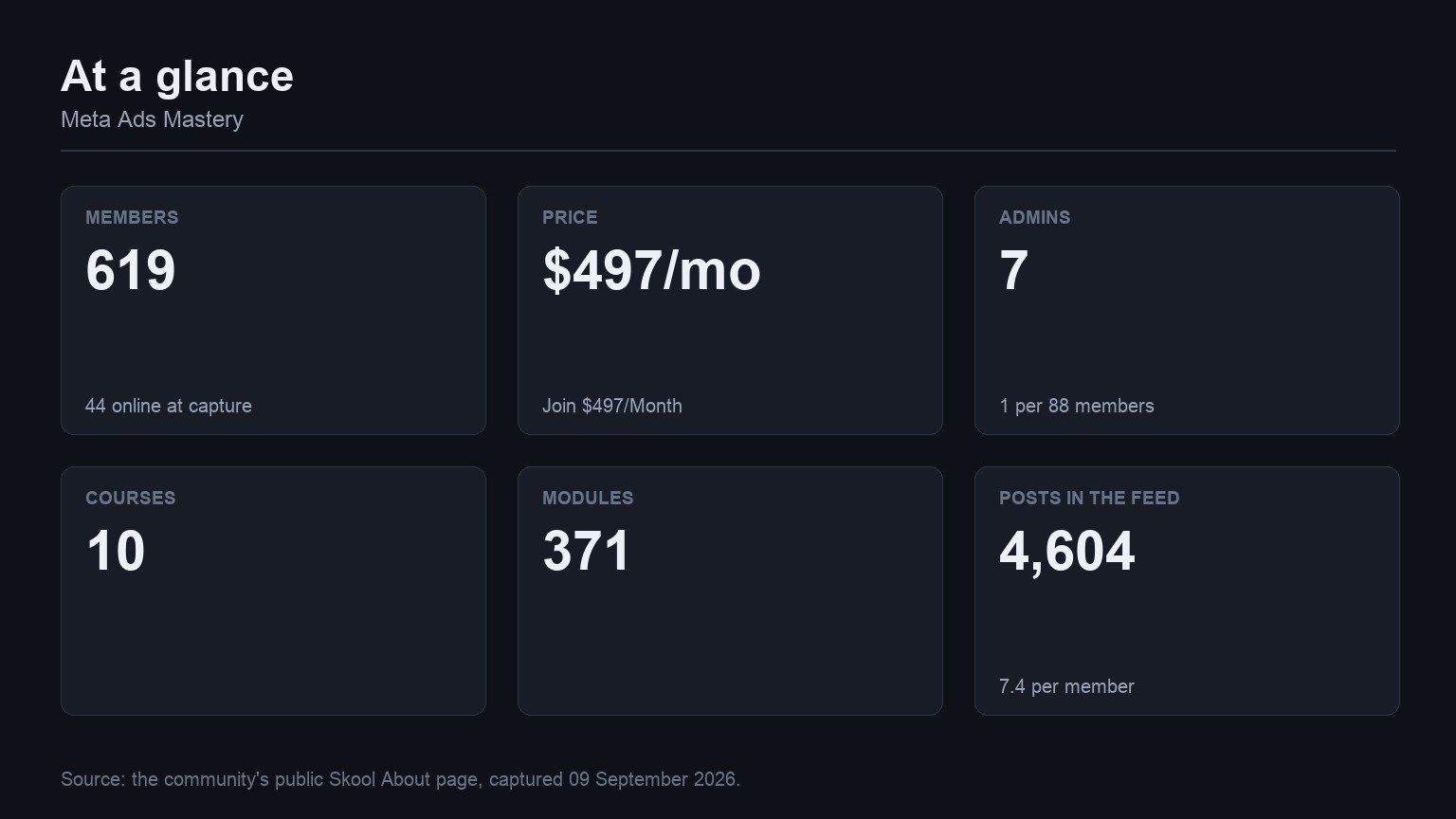
7 admins for 619 members is one per 88 people, among the tightest staffing here
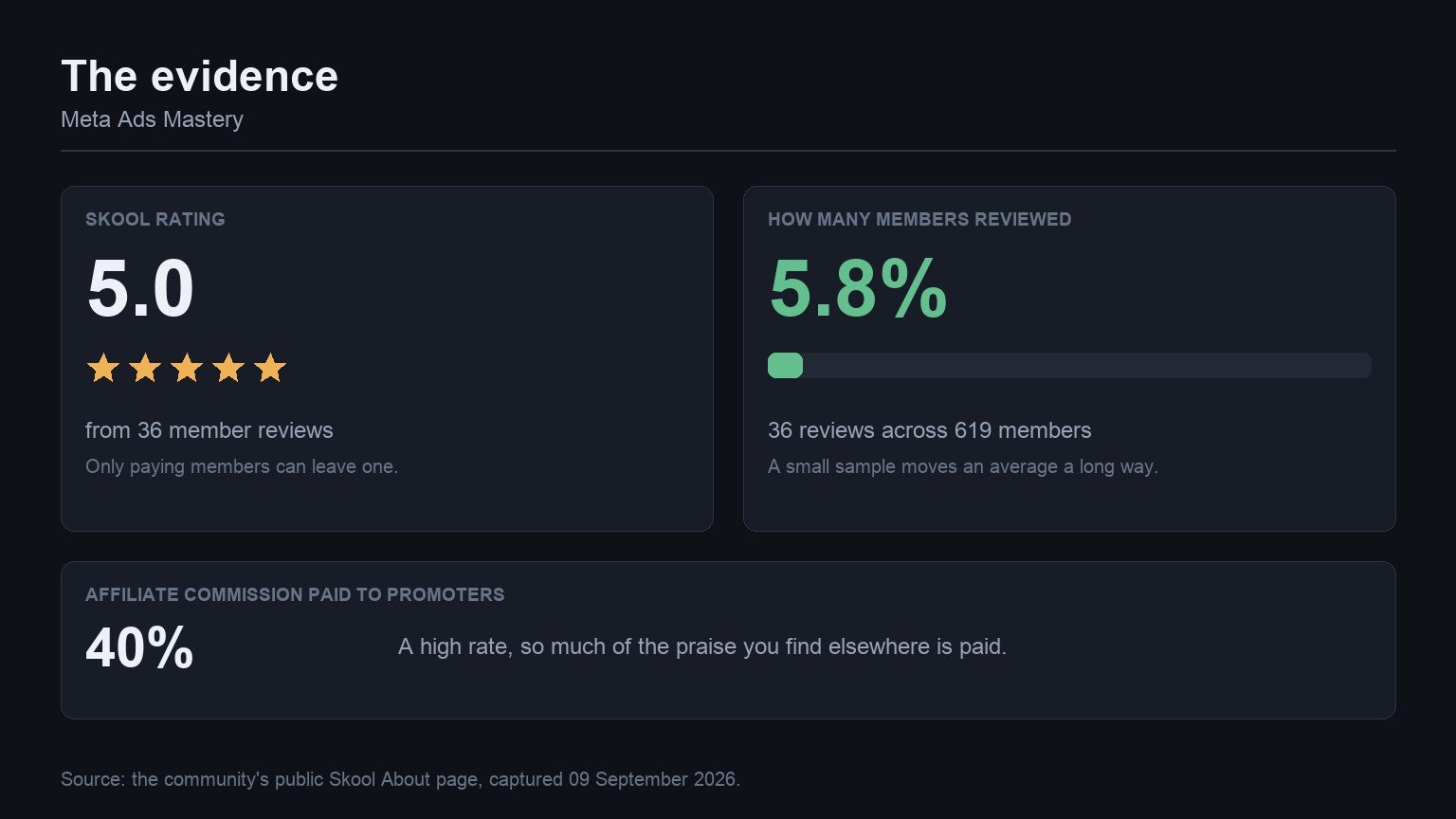
The page advertises 119+ 5-star reviews while Skool's own counter shows 36
Source: Skool public About page, captured September 9, 2026
Meta Ads Mastery asks $497 a month and tells buyers that price becomes $600 on 31 October. The description at the top of the same page advertises 119 or more 5-star reviews. Skool’s own counter, on that same page, says 36.
This is a research review written from outside. Nobody at this site has paid the $497 or opened the member area. The facts below come from the community’s public Skool About page, the reviews Skool restricts to paying members, and Michael Diaz’s public profiles, captured on 9 September 2026.
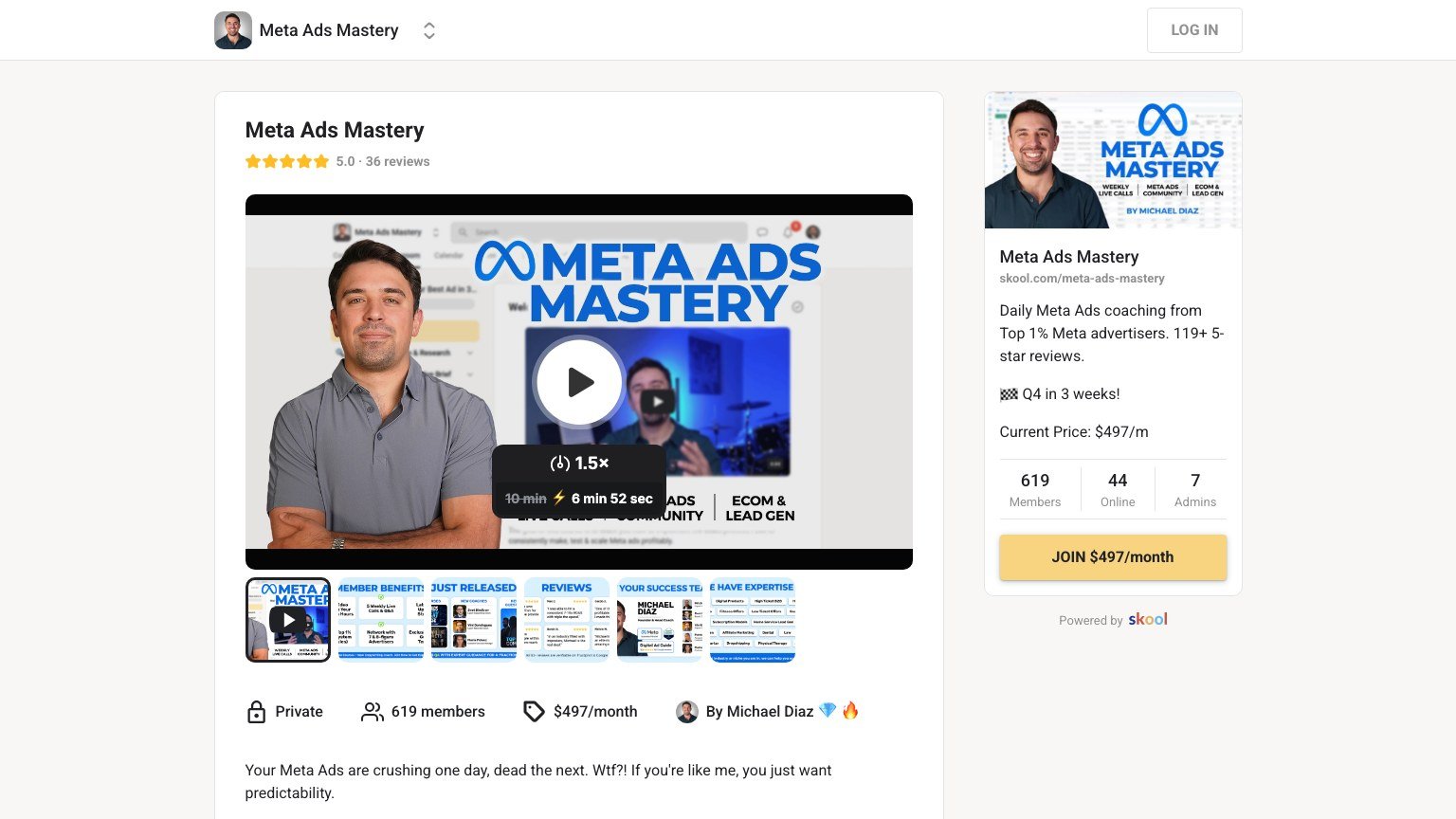
Quick Decision
Worth $497 if you manage real Meta budgets and want an answer inside a day rather than a course to watch. Seven admins over 619 members is among the tightest staffing in this ranking, five live calls a week is a heavy schedule, and 371 modules sit underneath the coaching for anything you want to study alone.
Skip it if the claims on the page bother you, and they should give you pause. The review count in the sales copy is more than three times what the platform records, the daily spend figure has no source, and the year-long guarantee has no published terms. Ask about all three before paying.
Inside 10 Courses And 371 Modules
| Metric | Listing value |
|---|---|
| Members | 619 |
| Members online at capture | 44 |
| Admins | 7 |
| Posts | 4,604 |
| Courses | 10 |
| Modules | 371 |
| Videos on the About page | 1 |
Three numbers carry weight here.
Seven admins for 619 members works out to one per 88 people. That is among the best staffing ratios of any community covered in this ranking, and it is the number that makes the same-day answer promise plausible. Most communities charging a fraction of this run one admin over several hundred members.
4,604 posts across 619 members averages 7.4 posts each. Forty-four members were online at the moment of capture, 7.1 percent of the room at one arbitrary second. Both figures point to a feed that people actually use.
371 modules is a large library for a community that sells coaching first. At $497 that is about $1.34 per module in the opening month, though nobody buys 371 modules for the modules. The library here is the thing you fall back on between calls.
What The Coaching Week Looks Like
The seller lists five weekly live calls, same-day video answers to member questions, and reviews of a member’s ad account, offer, creatives and copy. Guest speakers appear on the list too. The four-part course promise covers making ads, writing copy, testing and scaling.
That is a demanding delivery schedule for a team of seven, and it is the reason the price sits where it does. Five calls a week is roughly 20 a month. If even half of them run at a useful length, the hourly cost of $497 compares well against a consultant.
None of it is confirmable from outside. Skool shows the counts and the price. The calendar, the response time and the account reviews are promises made by the seller on a sales page, and no member review mentions any of them by name.
Michael Diaz And The $70,000 A Day Claim
Skool lists Michael Diaz in Denver, Colorado, on the platform since 1 October 2024, carrying the diamond badge tied to recurring revenue tiers. He links four public accounts: Instagram, X, a YouTube channel and michaeldconsulting.com. A named city, a named company and four live profiles is a strong transparency record by the standards of this ranking.
His bio calls him a top 1 percent freelancer with an Excellent rating on Trustpilot. The community description says he personally manages more than $70,000 a day on Meta for clients, which annualises to over $25M.
That figure has no source on the page. No client list, no date range, no screenshot, no account count. It is the seller describing his own book of business, and it should be read as advertising rather than as evidence. The Trustpilot mention is easier to check, and checking it is a ten-minute job before spending $497.
The same applies to the top 1 percent framing used in the headline. Nobody publishes a ranking of Meta advertisers, so the phrase describes a market position the seller has assigned himself.
$497 Now, $600 On 31 October
The join button reads JOIN $497/month. Twelve months is $5,964.
The page then adds a deadline: the new member price moves to $600 a month on 31 October 2026, tied to what the seller calls a new AI Michael feature. At $600 a year of membership costs $7,200.
Price-rise deadlines are the oldest lever in this business, and this one has a specific date attached rather than a vague soon. Two honest readings exist. Either the price genuinely rises on that date and joining before it locks a $103 monthly saving, or the deadline moves. Nothing on the public listing lets an outsider tell which, and the pressure it creates is a reason to slow down rather than speed up.
There is no annual plan and no discount route. Billing is monthly and the page says you can cancel at any time.
A Guarantee With No Terms
The listing advertises a 1-year money back guarantee.
A twelve-month guarantee on a monthly subscription is rare and, if honoured as written, it transfers a lot of risk away from the buyer. The problem is that no conditions appear anywhere. No refund window, no qualifying criteria, no process, no note on whether it covers one month or twelve.
Guarantees on Skool listings frequently carry conditions that only appear after purchase, such as proof of attendance or completed work. Request the full terms in writing before the first charge. If the answer is slow or vague, that itself is information.
The 119 Reviews That Skool Counts As 36
This is the finding that matters most on the page.
The community’s own description says 119+ 5-star reviews. Skool’s review counter on the same listing recorded 36 on 9 September 2026, at a 5.0 average. The listing never reconciles the two numbers.
An innocent explanation exists. The founder’s bio mentions Trustpilot, so the 119 may include off-platform feedback or reviews from an earlier product. The page does not say so, and a reader arriving on Skool would reasonably assume both numbers describe the same thing. Only the 36 can be checked, and only paying members can leave one.
Credit where it is due: 36 reviews from 619 members is 5.8 percent, a much better response rate than the 1 to 3 percent that is normal on Skool. The verifiable number here is healthy on its own. It did not need the larger one.
Four reviews carry visible text, posted between 28 August and 2 September 2026.
- A member in September 2026 called it very helpful for understanding advanced media buying and ad creation.
- A member in August 2026 said it was the best group they had ever been in and called the knowledge inside insane.
- A member in August 2026 wrote four words: Michael is the man.
None of the four names a budget, a return on ad spend, a cost per acquisition or a revenue figure. For a community whose subject is measurement, that absence is worth noticing. Nobody mentions the five weekly calls, the same-day video answers or the guarantee either.
For cheaper communities aimed at marketers rather than media buyers, the MarketingSecrets.AI review covers a $97 option and the AI SEO Rainmakers review covers a search-focused one at a different price point.
Don’t Join If
- Your Meta spend is small. At $497 a month, the fee needs a budget of roughly $25,000 a month before it reads as 2 percent of spend.
- Unexplained numbers bother you. The page advertises 119+ reviews against a platform count of 36 and never addresses the gap.
- You want the guarantee to be your safety net. Its terms are published nowhere on the public listing.
- You need member proof of results. All four readable reviews are short praise with no performance figure attached.
My Verdict
The delivery machinery is the strongest part: seven admins over 619 members, five live calls a week, 4,604 posts, 371 modules and a founder who names his city, his company and four public profiles. The 5.8 percent review rate is unusually healthy for Skool.
The weak point is for claim accuracy. A page that advertises 119 reviews while its own platform counter shows 36, quotes $70,000 a day in managed spend with no source, and promises a year-long guarantee with no published terms is asking for more trust than it has earned in writing. None of those three needed to be vague.
Ask for the guarantee terms and the review-count explanation before you pay, not after. You can check the current listing on Skool to see whether the $497 still holds or the 31 October rise has landed, and the same join link shows the live review counter. One more thing to weigh while reading other coverage: this community pays affiliates 40 percent recurring, close to $199 per referral per month.
Full pros & cons
- 7 admins for 619 members is one per 88 people, among the tightest staffing here
- 4,604 posts across 619 members averages 7.4 each, a genuinely busy feed
- 371 modules across 10 courses, large for a coaching-first community
- Michael Diaz links four public accounts and names a city, Denver, Colorado
- 36 reviews from 619 members is 5.8 percent, a far better response rate than most
- The page advertises 119+ 5-star reviews while Skool's own counter shows 36
- $497 a month is $5,964 a year, and new members are told it becomes $600 on 31 October
- The $70K per day managed spend figure is the seller's claim with no source attached
- The 1-year money back guarantee has no terms published anywhere on the listing
- All four readable reviews are one-liners and none names a budget or a return
Try it yourself
Ready to put it to the test?
We may earn a commission at no extra cost to you. Affiliate disclosure.
Frequently Asked Questions
How much does Meta Ads Mastery cost?
Why does the page say 119 reviews when Skool shows 36?
What do you get for $497 a month?
Who is Michael Diaz?
Is the 1-year money back guarantee real?
Reader feedback
Was this review helpful?
Your feedback helps us write better reviews.
Thanks for your feedback.
Ray Okafor is the analyst behind AI Insider Edge, covering AI tools, online courses, and paid communities in the make-money-online space. Hands-on reviews say so and state what was actually paid for access. Research reviews say that too, and are built from the seller’s own public pages, verified member reviews, and the founder’s public record. Either way the aim is a buyer’s-eye read, not a press release. Reviews are independent and may contain affiliate links, at no extra cost to you.
More reviews: Marketing, ads and sales

Disrupter Academy Review: 1,326 Members, $29/mo
Disrupter Academy lists $29 a month for 1,326 members and 508 modules. The page flags a price rise, and the Premium tier has no published price.

Grow With Evelyn Skool Review (2026): 1,034 Modules
Grow With Evelyn holds 1,034 modules across 27 courses for $29 a month, with 3,591 members and 109 reviews at 5.0. The seller's $33M figure is unverified.

Is The Facebook Ads Blueprint Worth $297/mo?
The Facebook Ads Blueprint costs $297/month for 6 courses and 136 modules. 697 members, 5 admins, and only 6 reviews. An outside look at the numbers.

Affiliate Marketing Launchpad Review: 5 Skools, 1 Real
I joined Affiliate Marketing Launchpad and worked through the classroom. Five Skools share this name, so here's the real one and what $29 vs $49 buys.

Is Angel Media Worth $109/mo? Chinese Only, No Refunds
Angel Media charges $109 a month for 22 courses and 52 modules taught in Chinese. The listing states refunds stop the moment billing starts.

Is BAMx | Real Estate Worth $197/mo?
BAMx charges $197 a month for 1,315 modules and 21 admins across 2,137 members. Only 4 reviews exist and the free trial length is never published.
The Edge Briefing
One honest review, every Sunday.
One email a week: which AI tools, courses & communities passed the rubric — and which to skip. Built for people funding their own stack.