Is Skoot CRM for Skool Worth $99/mo? 690 Members, 38 Reviews
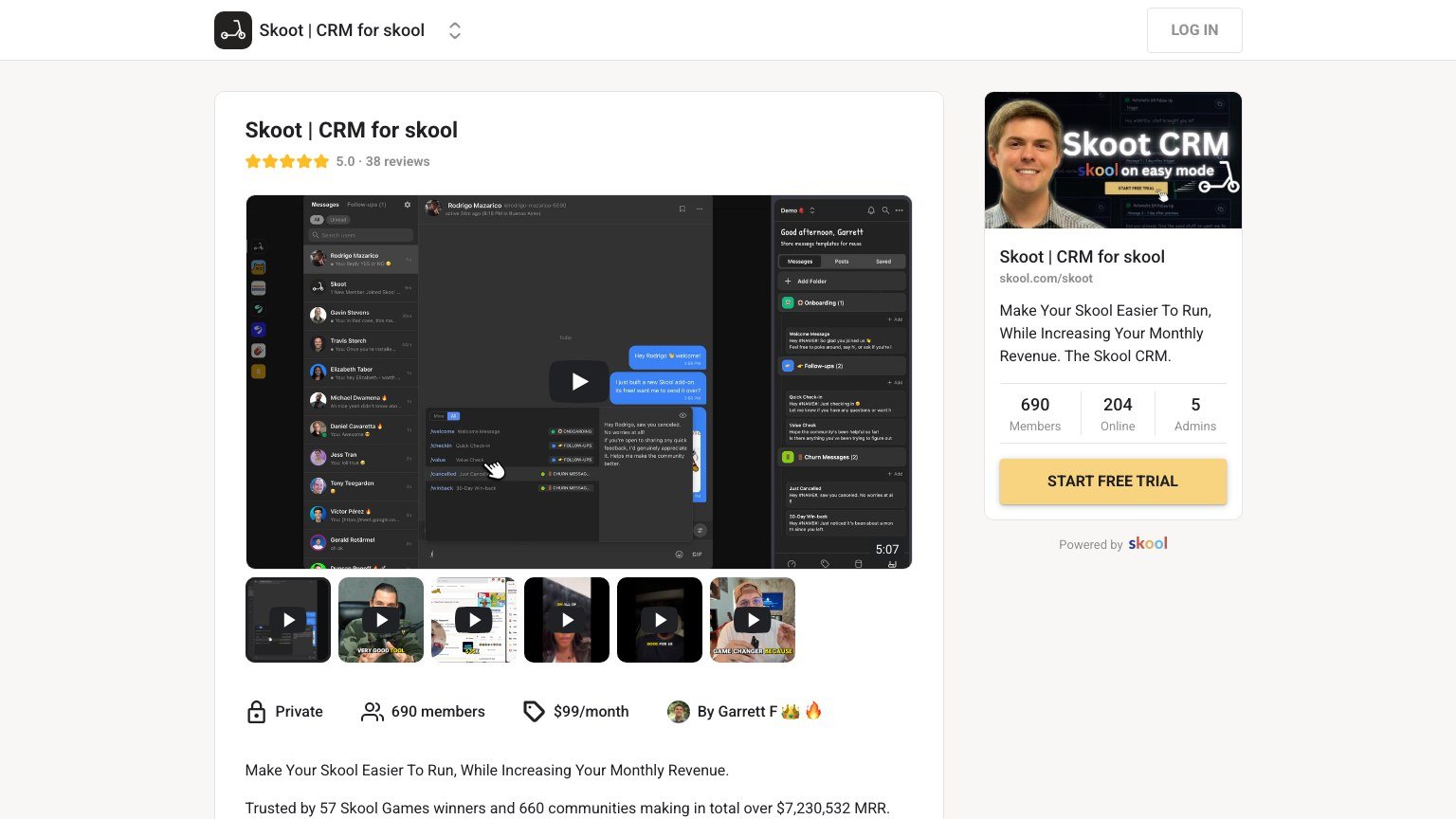
Skoot CRM costs $99/mo and automates Skool DMs. The premium tier it sells has no price on the page.
 By Ray Okafor ·

No score: research review
We only score what we used. The verdict below is built from public sources. Price at review: $99/month.
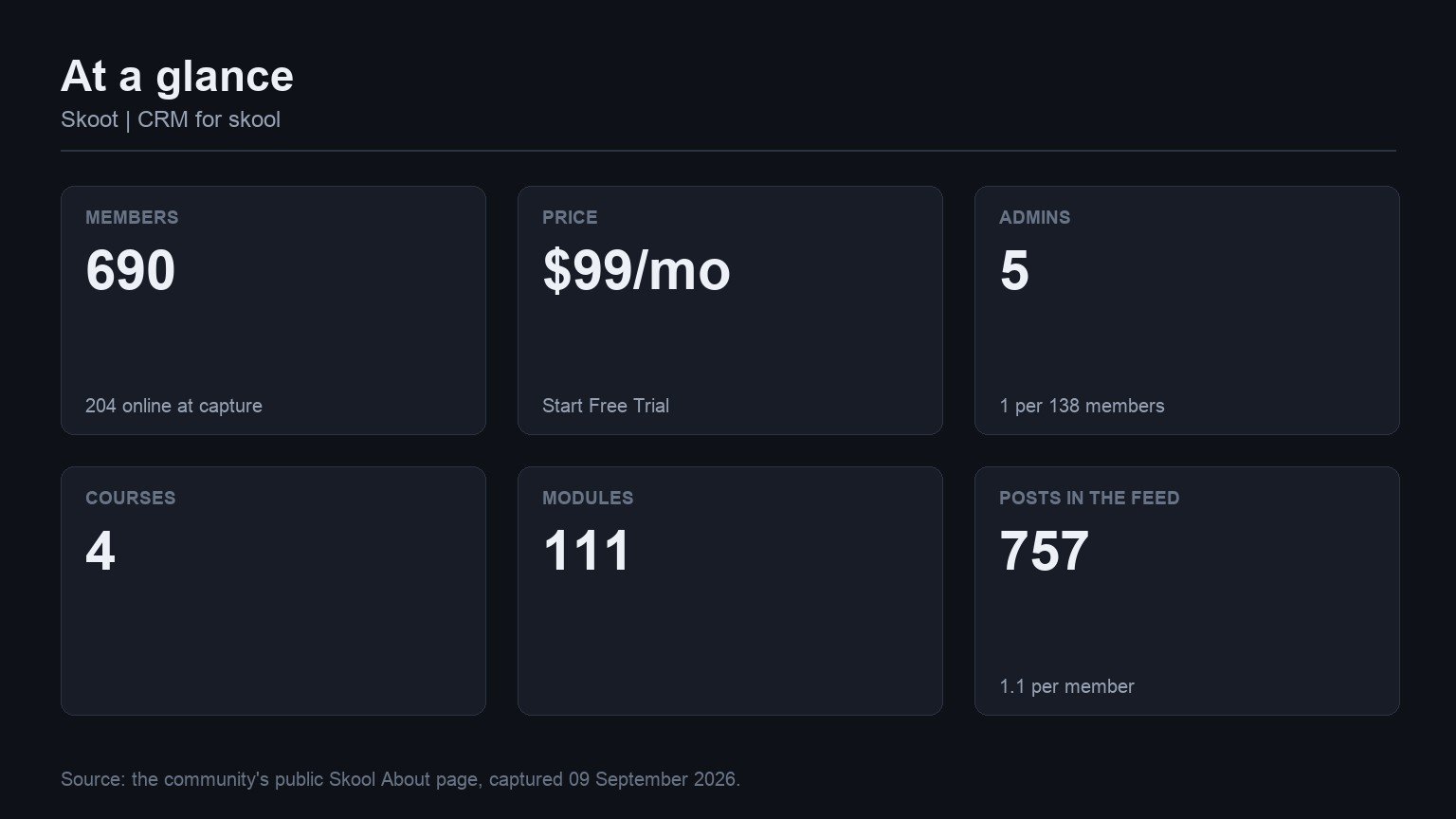
204 of 690 members were online at the moment of capture, close to 30% of the membership
The premium tier is advertised in detail and carries no price anywhere on the page
Source: Skool public About page, captured September 9, 2026
Ninety-nine dollars a month to run automated DMs inside a community you already pay Skool for. The pitch is that it recovers more than it costs, and the arithmetic behind that is simple enough to check before you buy.
This is a research review. I have not joined and have paid nothing. It draws on the public Skool About page, the reviews Skool restricts to paying members, and Garrett’s public profile, captured on 9 September 2026.
Quick Decision
Worth it if you run a paid Skool community with real churn and you already know your monthly cancellation count. The failed-payment sequence is the feature carrying this product, and it works on a number you can measure.
Skip it if your community is free or under a hundred members. Automating retention before you have retention to protect is $1,188 a year spent on the wrong problem, and at that size you can message every new member yourself in ten minutes a week.
What $99 A Month Actually Covers
Skoot is software with a Skool community wrapped around it, which is worth being clear about before you compare it to the courses in this ranking. The $99 buys a tool. The 111 modules behind the login are documentation for that tool.
The listed plan covers automatic DMs for onboarding and retention, member tagging that tracks engagement and buying intent, failed-payment and churn sequences, and post scheduling. Every plan includes a 1:1 setup call the page promises is completed in under 23 minutes, marked limited time only.
That oddly precise 23 minutes is the most reassuring detail on the page. A tool this configurable usually dies from an unfinished setup, and somebody has clearly measured how long it takes to get an owner running.
The feature I would look hardest at during the trial is the tagging. Onboarding DMs are a solved problem and plenty of owners already send them by hand. Tagging members by engagement and buying intent is different, because it turns your member list into a segmented one, and every upgrade offer you ever send afterwards depends on that segmentation being accurate. Get it wrong and the automations built on top of it are pointed at the wrong people.
Post scheduling is included on both the hobby and pro plans according to the page, which is the only place the plan names appear. What separates hobby from pro is left unstated, so add it to the list of questions for the setup call.
The Premium Tier Question
The page then spends a full paragraph selling a tier it never prices. AI community management through Skoot MCP, upgrade and churn tracking pulled from classroom data, generated lead magnets for individual members, and an AI sales rep.
One member review from 26 August 2026 says, in full: “If you have a skool community and you take business seriously, join this group and join the highest membership tier.”
So the most enthusiastic public advice about this product is to buy the tier whose price you cannot see. That is a pricing-page problem rather than a product problem, and it is the first thing to settle on the setup call. Ask what the premium tier costs and which of those four features you would actually switch on.
What Is Behind The Login
| What | Count |
|---|---|
| Members | 690 |
| Members online at capture | 204 |
| Courses | 4 |
| Modules | 111 |
| Posts in the feed | 757 |
| Admins | 5 |
Two of those numbers deserve attention, and they point in opposite directions.
Two hundred and four members online out of 690 is close to 30% of the entire membership present at one arbitrary moment on a Tuesday. Across every community I have looked at in this ranking, three to five percent is normal. Nothing else comes close.
Then there is the feed: 757 posts across 690 members, barely one each. Set that against the 16,000-post feeds in communities of similar size and it looks dead.
Both readings are correct because this is not really a discussion community. People log in to configure automations and ask support questions, so presence is high and posting is low. If you are buying company, this is the wrong purchase. If you are buying a tool with a fast support channel attached, the presence number is the honest signal.
Five admins across 690 members is roughly one per 138, which is a workable ratio when the questions are technical and repetitive rather than personal. Four courses holding 111 modules reads as product documentation broken into short steps, which is what you want from a tool and not what you want from training. Nobody should buy this for the classroom.
Garrett And The 57 Winners Claim
The founder is listed as Garrett F. No surname, no location, and his only public link is his own Skool About page. His Skool account dates to January 2024.
That is the thinnest founder identity I have come across in this leaderboard, and it matters more here than it would for a course, because this tool reads your member list and sends messages in your name.
Be specific about what that means before you connect anything. A CRM for Skool needs access to who your members are, what they bought, when their payment failed, and what they opened in the classroom. That is your business asset sitting inside somebody else’s software, operated by a person whose surname is not published. Ask on the setup call where the data is stored, what happens to it if you cancel, and whether you can export your tags.
Against that, the page carries named endorsements from people who are straightforward to verify. Calvin Hollywood, Aidan LaBreche, and Matt Ryder, who is quoted saying the failed-payment DM automation was essential to his number one Skool Games finish. The bio claims 57 Skool Games winners use the tool, and the page claims 660 communities running a combined $7,230,532 MRR.
Those totals are seller figures with nothing behind them, so discount them. The named quotes are checkable and they all point at the same feature, which is a more useful signal than the aggregate numbers.
What The 38 Reviews Keep Saying
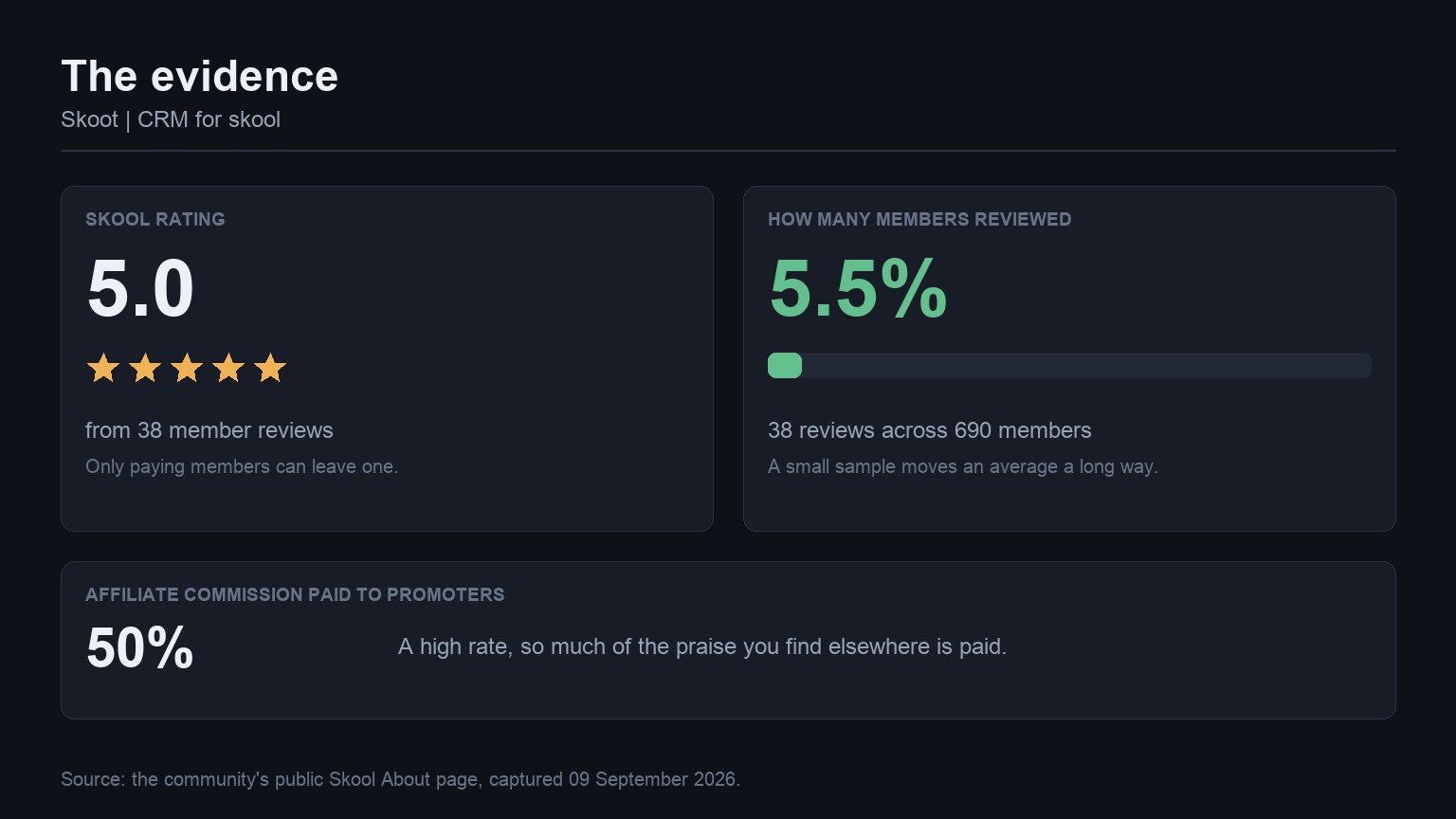
Thirty-eight reviews sit at a straight 5.0, from 690 paying members. Skool only accepts reviews from people with an active subscription, so the base is real even if the unbroken score is unusual.
Read the five most recent and one theme repeats. A reviewer on 8 September 2026 writes that it has “helped me increase retention and member satisfaction in our community by reminding me to check in with members based on the follow-up rules I created.” Another, on 26 August, says: “I love the auto DMs when a member’s payment fails or churns, they have been so helpful for retention!” A third from 27 August describes a community taking 10 or more new members a day and the tool selling premium upgrades every week without supervision.
Three of the five also thank Garrett by name for how fast he replies. All are member reviews on Skool, August and September 2026.
What none of them do is name a number. No recovered MRR, no churn percentage before and after, no dollar figure saved. For a product whose entire case is financial, the absence of a single quantified result across 38 five-star reviews is the gap worth noticing.
The reason is probably mundane. Most Skool owners do not track churn tightly enough to know what the tool recovered, which is the same reason the tool sells well. Still, one owner posting a before-and-after cancellation rate would do more for this product than the other 37 reviews combined, and after a year of operation nobody has.
My Verdict
The product solves a problem Skool owners genuinely have, the failed-payment sequence is the rare automation with a measurable payback, and the 30% online rate plus five named-and-thanked support reviews say the operation behind it is responsive.
The weak points are all about what the page withholds. A premium tier sold in detail and priced nowhere. A founder identified as Garrett F with no verifiable footprint beyond Skool, holding your member data. A 50% affiliate rate that explains why every recommendation you find reads like the ones on the page. And a dependency you cannot control, since the automations run inside a platform Skool owns and Skool can change.
Run your own number during the free trial. Divide $99 by your monthly membership price and you have the count of saved members that makes this profitable. If that count is one or two, the setup call is worth booking. If it is ten, fix your churn by hand first. For the wider platform picture, our Monetise vs Skool comparison covers what you are building on, and the La Tribu Divisual review shows what a high-engagement paid community looks like from the member side.
Full pros & cons
- 204 of 690 members were online at the moment of capture, close to 30% of the membership
- Failed-payment and churn DM sequences target the one number every Skool owner can measure
- 38 reviews at a straight 5.0, and Skool only accepts reviews from paying members
- Five separate reviews name Garrett's response speed, which is rare for a $99 tool
- Free trial plus a 1:1 setup call, so the configuration work happens before you pay
- The premium tier is advertised in detail and carries no price anywhere on the page
- The owner is listed as Garrett F with his Skool page as his only public link
- It automates inside a platform it does not own, so a Skool policy change is your risk
- 757 posts across 690 members is a support desk rather than a community
- The 50% affiliate rate means the recommendations you find are commission-driven
Try it yourself
Ready to put it to the test?
We may earn a commission at no extra cost to you. Affiliate disclosure.
Frequently Asked Questions
How much does Skoot CRM cost?
What does Skoot actually do?
Is $99 a month worth it for a Skool community?
Who runs Skoot?
Does the 5.0 rating from 38 reviews mean anything?
What is the main risk of using Skoot?
Reader feedback
Was this review helpful?
Your feedback helps us write better reviews.
Thanks for your feedback.
Ray Okafor is the analyst behind AI Insider Edge, covering AI tools, online courses, and paid communities in the make-money-online space. Hands-on reviews say so and state what was actually paid for access. Research reviews say that too, and are built from the seller’s own public pages, verified member reviews, and the founder’s public record. Either way the aim is a buyer’s-eye read, not a press release. Reviews are independent and may contain affiliate links, at no extra cost to you.
More reviews: Online business and community building

Monetise Bonus (2026): What's Real and What's Recycled
What bonuses actually come with Monetise at the Side Hustle Summit, how to judge affiliate bonus stacks, and the four things we hand out ourselves.

Monetise Discount & Coupon Codes: The Honest Answer (2026)
There is no published Monetise discount. What the $1,995 price has actually been, why coupon sites show fake codes, and the one legitimate way to pay less.

Monetise Refund Policy: The 7-Day Window, Explained (2026)
Monetise 2.0 carries a 7-day no-questions refund window per partner documentation. What that covers, what it doesn't, and what to verify at checkout.

Monetise vs Skool (2026): One's a Course, One's a Platform
Monetise is Iman Gadzhi's $1,995 program for building digital products. Skool is a $99/month community platform. Which you need depends on what you're missing.

Pay It Forward Learning Center Review: 2,665 Members, $25/mo
Pay It Forward Learning Center gives 1,627 modules for $25/mo. But the owner record carries no human name, no location and no links. The numbers.

WAH Vault Review: 5,466 Members, $12/mo
WAH Vault charges $12 a month for curated remote job leads. The seller states she is not an employer, guarantees no placement and gives no refunds.
The Edge Briefing
One honest review, every Sunday.
One email a week: which AI tools, courses & communities passed the rubric — and which to skip. Built for people funding their own stack.