The BFS Wealth Circle Skool Review (2026)
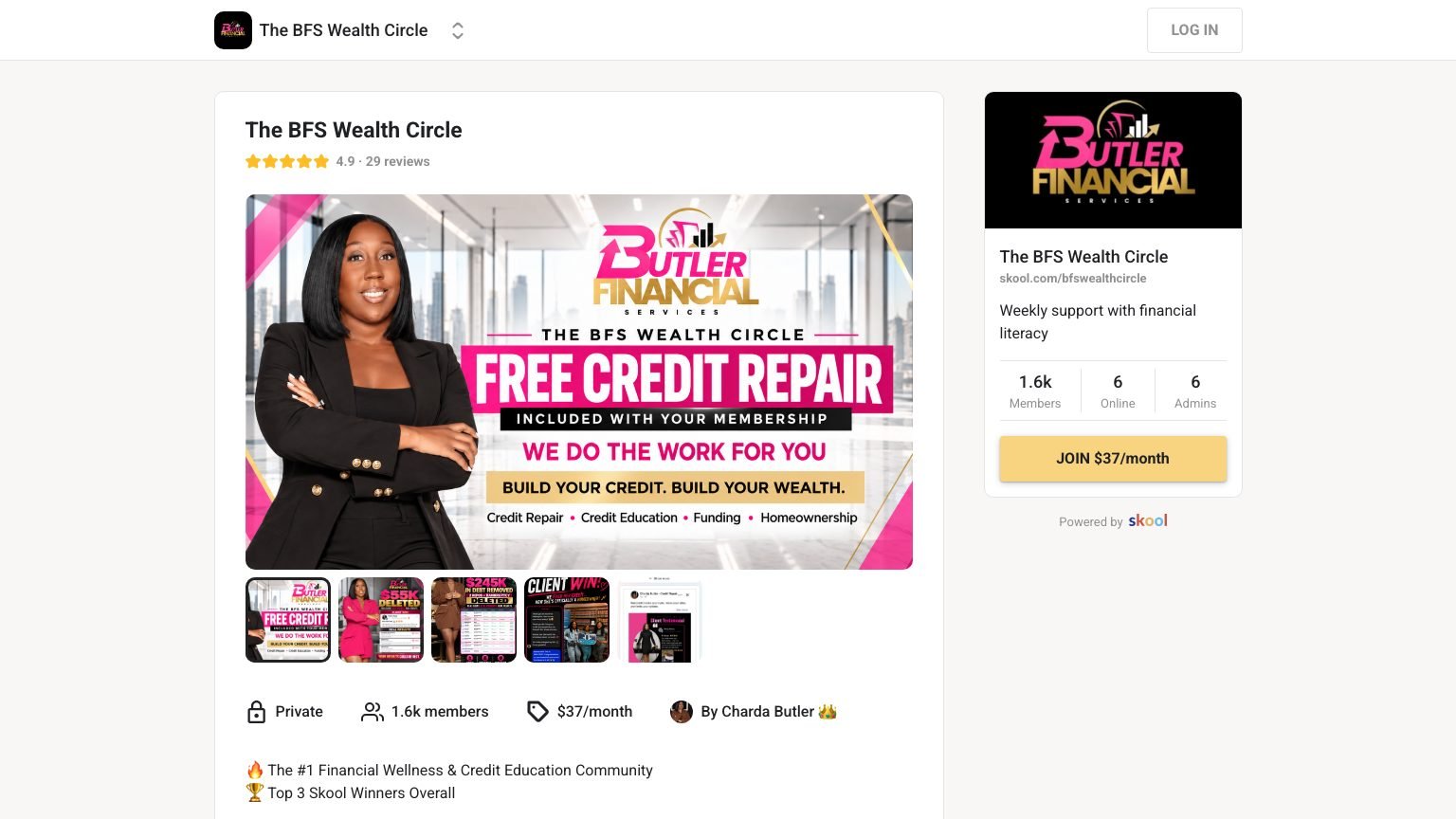
BFS Wealth Circle shows $37 on the button and $67 in the copy, plus a required credit monitoring fee. 1,631 members, 30 modules, 29 reviews.
 By Ray Okafor ·

No score: research review
We only score what we used. The verdict below is built from public sources. Price at review: $37 a month on the button, $67 a month in the sales copy.
$37 on the join button is the lowest entry price among the money communities in this ranking
The button reads $37 a month while the sales copy calls $67 a month the founder price
Source: Skool public About page, captured September 9, 2026
The join button says $37 a month. The sales copy on the same page calls $67 a month the founder price.
Neither number covers the credit monitoring subscription that the listing says you need before any work on your credit can start.
Disclosure before anything else. I am not a member of The BFS Wealth Circle and nothing has been paid to Charda Butler or anyone linked to it. This review was assembled from the community’s public Skool About page, the written reviews Skool shows only from paying members, and the founder’s public profile text, captured on 9 September 2026. Anything from the sales copy is marked as the seller’s own claim.
This community sells a financial outcome. Every result and ranking on the page is the seller’s unverified statement, nothing here suggests a reader will improve a credit score or earn anything, and questions about debt, credit law or tax belong with a licensed professional where you live.
Quick Decision
This fits someone who wants a cheap, busy room focused on credit education and is comfortable paying for a separate monitoring service on top. At $37 on the button it is the lowest entry price among the money communities here, and 6 admins for 1,631 members is decent cover for that money.
It does not fit anyone who needs a fixed total cost before committing. The page publishes two membership prices and a mandatory third-party fee it never quantifies.
It also does not fit a buyer who checks credentials before paying. The founder profile carries no links and no location, which is a hard gap in a category where licensing and company registration matter. You can check the listing yourself on the Skool page.
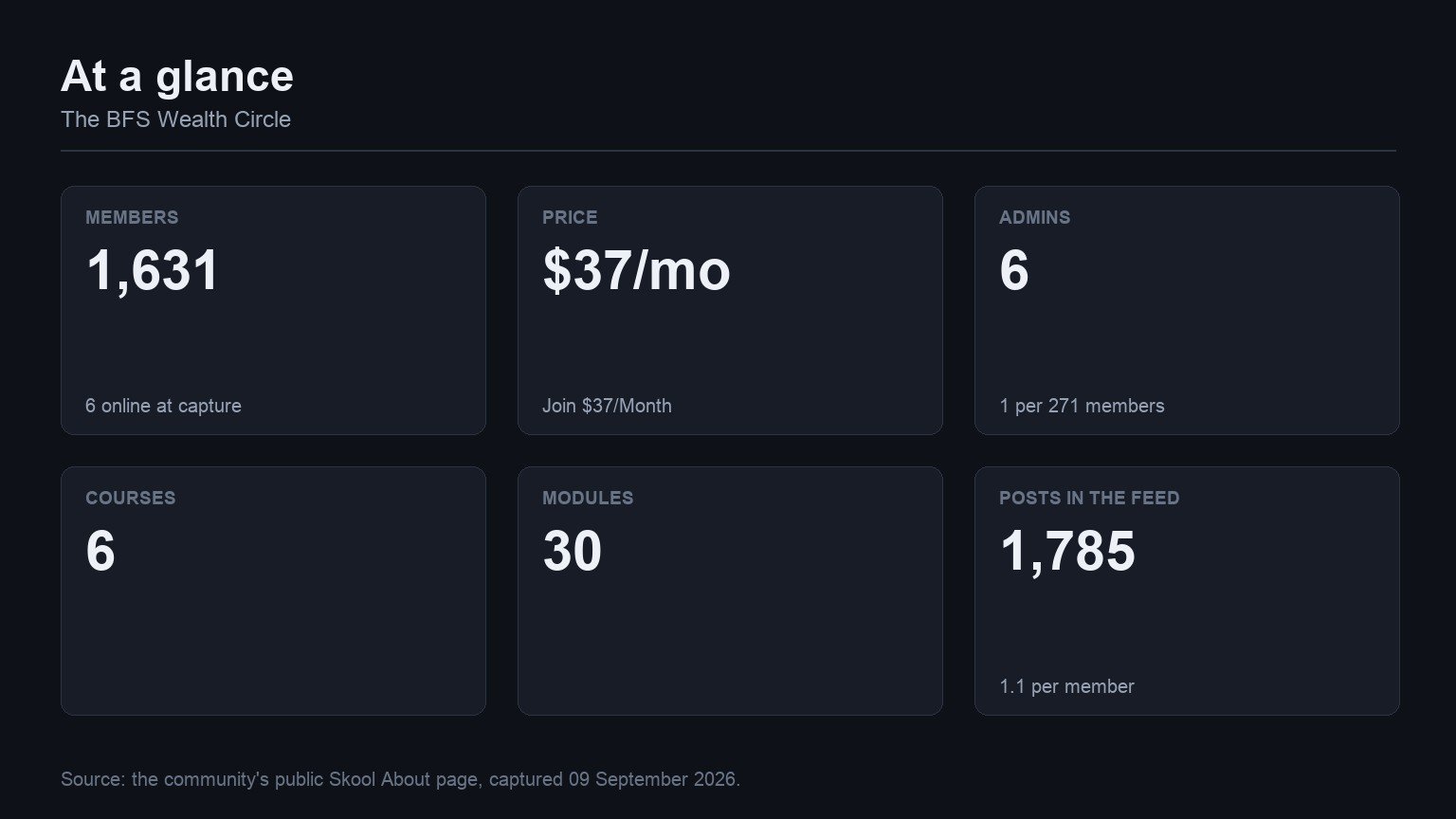
Six Courses, Thirty Modules, 1,785 Posts
| What | Count |
|---|---|
| Members | 1,631 |
| Members online at capture | 6 |
| Admins | 6 |
| Courses | 6 |
| Modules | 30 |
| Posts in the feed | 1,785 |
| Videos on the listing | 0 |
Thirty modules across 6 courses averages 5 modules per course. That is the smallest library among the money communities in this ranking, and it tells you what you are buying.
The product is the room, not the archive. One thousand seven hundred and eighty-five posts against 1,631 members is close to one post each, and the seller describes the offer as weekly support with personalised guidance rather than a course catalogue.
Six admins for 1,631 members is one per 272. At $37 a month that ratio is better than several communities charging four times more.
The number that gives me pause is 6 members online at capture. Out of 1,631, that is 0.4% present at a single moment on a weekday afternoon. Snapshots are unreliable and one reading proves nothing, but it does not describe a room humming with live conversation.
What the seller says is inside
The page lists financial literacy and credit education, personalised credit and financial wellness guidance, homebuyer, funding and business credit education, community challenges, giveaways and referral rewards, and private community access.
It also claims the number one position in financial wellness and credit education, and a Top 3 Skool Winners Overall badge. Neither claim names the ranking, the period or the body that awarded it.
Those are seller statements about the seller’s own product. The referral rewards line is worth a second read, because a community that pays members to recruit will always look more enthusiastic from the outside than it is from the inside.
Charda Butler, And An Empty Links Field
Charda Butler has run this community since 3 July 2025, roughly 14 months before the capture date. Skool marks her account with crown status, which the platform awards on revenue rather than on member results.
Her bio reads as a faith-fuelled entrepreneur working across real estate, credit and taxes, with a scripture reference. It is short and it names three fields she operates in.
Everything a buyer could verify is missing. The location field is null. The links object is completely empty, so there is no website, no Instagram, no LinkedIn and no company page attached to the profile. The listing also carries 0 videos.
That gap is heavier in this category than in most. Credit repair and credit education are regulated differently in different countries, and buyers usually want to see the company behind the guidance, its registration and who holds any relevant licence. None of that is reachable from this page. The listing mentions accredited third-party providers without naming one of them.
Three Prices On One Page
Skool’s structured price field holds $37 per month in US dollars. The price text and the join button agree with it.
The sales copy tells a different story. It calls founder pricing $67 a month for a limited time and warns it may increase to $97 at any time.
That is a $30 gap between the copy and the button, with no note explaining which applies to a new member today. The likeliest reading is that the copy was written at a higher price and never updated, or that $37 is a promotional rate the copy has not caught up with. The page does not say.
There is a third figure implied by the $97 warning, which makes three prices visible in one listing. No refund policy, trial, annual plan or cancellation term appears anywhere.
The practical move is to read the checkout total, screenshot it, and ask in writing what happens to your rate at renewal. A price that is described as rising at any time is a price that can rise on you.
The 20% affiliate cut
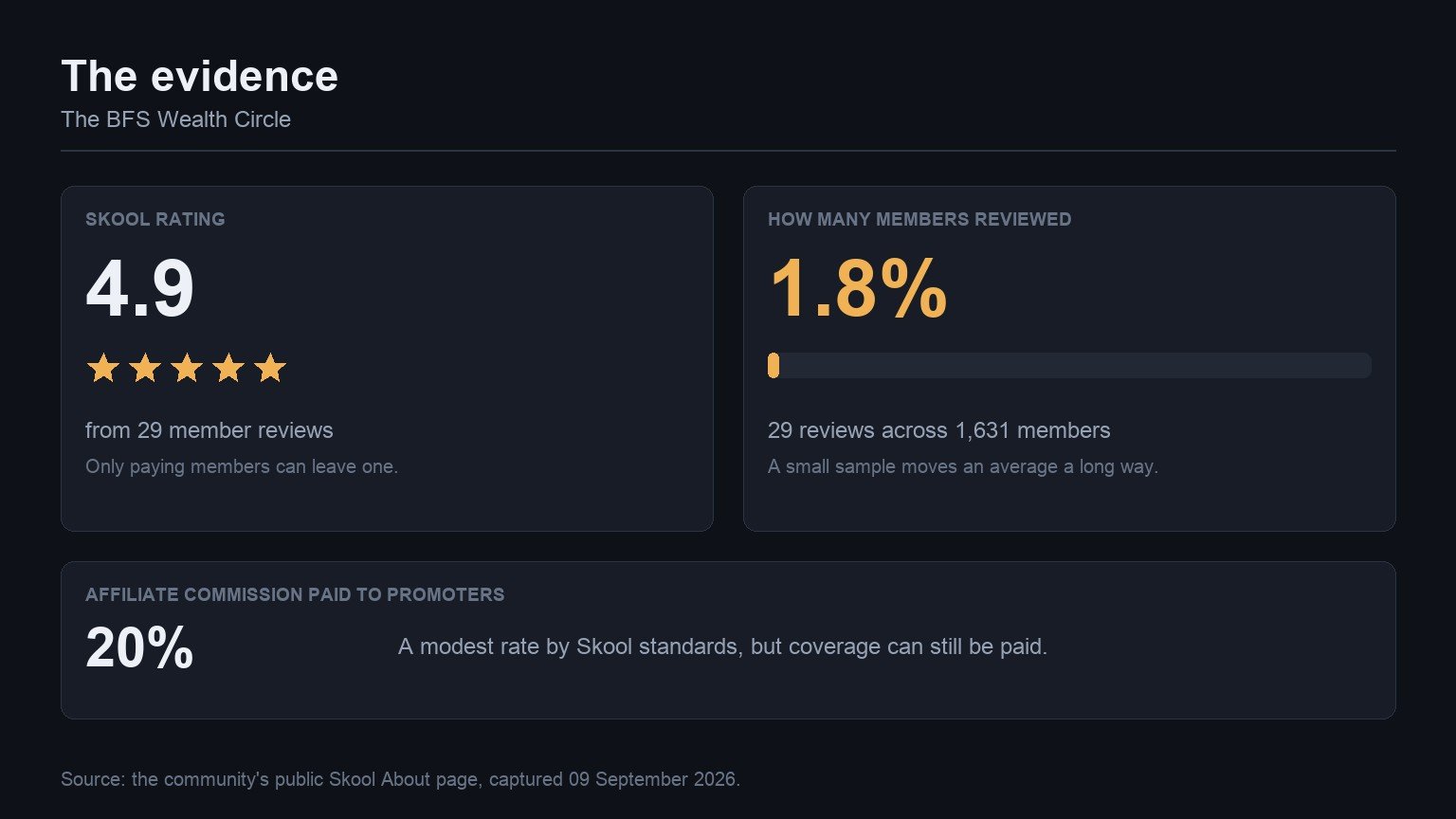
The community pays affiliates 20%. At the $37 rate that is $7.40 per member per month, and at $67 it would be $13.40.
That is the lowest commission rate among the money communities in this ranking, so outside coverage of this one is less financially motivated than most. This review still earns nothing from it.
The Cost The Fee Does Not Cover
The listing carries its own warning, and it deserves credit for printing it. Credit monitoring is required to begin working on your credit. It is purchased separately through one of their accredited third-party providers. It is not included in the membership fee. The provider sets its own pricing.
Four sentences, all of them honest, and none of them a number.
That means the advertised price is not the price. A buyer signing up at $37 takes on a second recurring bill of unknown size before the core promise of the membership can begin. Credit monitoring services in the United States commonly run at monthly subscription rates, and this page names none of them, so the total is unknowable from the listing.
Publishing the requirement openly is better than burying it. Publishing it without a figure, and without naming a single accredited provider, leaves the actual monthly cost of this membership undefined.
Ask which providers qualify and what each charges before you pay the Skool fee. If the answer is one specific partner, ask whether the community earns anything when you sign up for it.
Two Thousand Members, Or 1,631
The sales copy invites you to join 2,000-plus members building stronger credit.
Skool’s own record for the same listing on the same day says 1,631. The gap is roughly 18%, or about 370 people who are described but not counted.
Membership copy going stale in the wrong direction is unusual, since these numbers normally grow. A roster that has fallen below the number in the copy suggests churn the page does not discuss, or a figure that was aspirational when it was written.
Either way it is the third number on this listing that does not match another number on the same listing. That pattern matters more than any single discrepancy.
Twenty-Nine Reviews, And What Three Of Them Say
Twenty-nine reviews at a 4.9 average from 1,631 members is a 1.8% response rate. Skool accepts reviews only from paying members, so none can be bought outright.
Four are publicly visible, and three of those four consist of the words “Joined today” (member reviews on Skool, September 2026). Each carries five stars.
A five-star rating written on the day of purchase measures the sales page, not the product. Three of them in a four-day window, from 4 to 5 September 2026, reads like a prompt in the feed asking new members to leave a review during onboarding.
The fourth is the only one with content. A member praises the patience and kindness of the reps, and says one of them is walking her through a difficult process of gathering her information (a member review on Skool, September 2026). That points at a real support operation with staff, which fits the 6 admin accounts.
What none of the reviews report
Not one visible review names a credit score, a point change, an account removed, a loan approved or a home purchased.
For a community whose headline promise is stronger credit, that is the single most important absence on the page. The reviews establish that the onboarding is friendly and the staff respond. They contain no evidence about outcomes.
Walk Away If
- You need to know the total monthly cost. The required credit monitoring fee is never quantified.
- You want the price settled. The listing shows $37, $67 and a threatened $97.
- You check credentials before paying. The founder profile has no links, no location and no named company.
- You want a course library. Six courses and 30 modules is the smallest archive in this ranking.
My Verdict
What works is the access for the money. Thirty-seven dollars a month with 6 admins for 1,631 members is one staffer per 272, and the only review with any detail describes a support rep patiently walking a member through her paperwork. The feed carries 1,785 posts, close to one per member, and the listing deserves credit for stating outright that credit monitoring costs extra rather than hiding it in a footer.
The weak points are all about numbers that contradict each other. The button says $37 and the copy says $67, with $97 threatened. The copy claims 2,000-plus members while Skool records 1,631. The required monitoring subscription has no published price and no named provider, so nobody can calculate the real cost of joining. The founder profile carries no links and no location in a category where registration and licensing matter. Three of the four visible reviews say nothing beyond “Joined today”, and 6 members were online out of 1,631.
If $37 is genuinely what you will be charged, and you already pay for credit monitoring, the downside is one month of a small fee. Get the total cost and the renewal rate in writing first. For a look at a community that publishes its founder’s full public record, read our AI SEO Rainmakers review, and the Affiliate Marketing Launchpad review covers a cheaper listing with a larger evidence base. The current price can be checked here.
Full pros & cons
- $37 on the join button is the lowest entry price among the money communities in this ranking
- 6 admin accounts for 1,631 members, one per 272, unusually staffed for a $37 product
- 1,785 posts in the feed against 1,631 members, close to one each
- 29 written reviews at a 4.9 average, all from paying members Skool has verified
- The listing states plainly that credit monitoring is a separate purchase, rather than hiding it
- The button reads $37 a month while the sales copy calls $67 a month the founder price
- A third-party credit monitoring subscription is required and is not included in the fee
- The copy says 2,000+ members while Skool records 1,631, a gap of about 18%
- Charda Butler's profile carries no location and no public links at all
- Three of the four visible reviews say only that the member joined that day
Try it yourself
Ready to put it to the test?
We may earn a commission at no extra cost to you. Affiliate disclosure.
Frequently Asked Questions
What does The BFS Wealth Circle cost?
Is credit monitoring included in the membership?
How many members does BFS Wealth Circle have?
Who runs The BFS Wealth Circle?
Will this community fix my credit?
How much content is inside?
Reader feedback
Was this review helpful?
Your feedback helps us write better reviews.
Thanks for your feedback.
Ray Okafor is the analyst behind AI Insider Edge, covering AI tools, online courses, and paid communities in the make-money-online space. Hands-on reviews say so and state what was actually paid for access. Research reviews say that too, and are built from the seller’s own public pages, verified member reviews, and the founder’s public record. Either way the aim is a buyer’s-eye read, not a press release. Reviews are independent and may contain affiliate links, at no extra cost to you.
More reviews: Trading, credit and personal finance

Is Miguel Angel Correa Worth $150/mo? Spanish Trading
Comunidad Crece charges $150 a month for a Spanish trading room with 458 members. No track record and no risk warning appear on the listing.

CGC Credit HQ Skool Review (2026)
CGC Credit HQ lists $99/month for 603 members, 38 modules and 2 admins. Three reviews exist, one member was online, and no price sits on record.

Is Credit to Keys Lab Worth $79/mo?
Credit to Keys Lab charges $79 a month for credit repair training. 155 modules, 1,039 members, 13 reviews, no published credentials and no refund terms.

M71 Trading - AlejandroFx Skool Review (2026)
M71 Trading costs $71 a month and the seller's own copy says there will be no refunds. 933 members, 12,126 posts, 87 reviews, all in Spanish.

Lion Mode Club Review: 1,763 Members, $50/mo
Lion Mode Club runs $50/mo for 1,763 traders, 617 modules and 86,247 posts. The founder's bio is three words. The numbers and the claims, checked.

Robotedge Rocket Camp Skool Review (2026)
Robotedge Rocket Camp costs $99/mo for 983 Spanish-speaking traders. The owner's Skool account is 5 months old. The audit claim and numbers, checked.
The Edge Briefing
One honest review, every Sunday.
One email a week: which AI tools, courses & communities passed the rubric — and which to skip. Built for people funding their own stack.