Volpro Skool Review (2026)
Volpro charges $99/mo for 128 modules and live trading sessions. Only 19 of 755 members have left a review. The numbers and the risk, read plainly.
 By Ray Okafor ·

No score: research review
We only score what we used. The verdict below is built from public sources. Price at review: $99/month.
The price is published on the listing: $99 a month, shown in both the join button and Skool's price record
Only 19 of 755 members have written a review, a response rate of about 2.5%
Source: Skool public About page, captured September 9, 2026
Seven hundred and fifty-five members. Nineteen reviews. Ninety-nine dollars a month.
Those three numbers frame most of what follows.
A disclosure first. I am not a member of Volpro and no money has gone to Cam Narayan or anyone connected to him. This review was assembled from the community’s public Skool About page, the written reviews Skool shows only for paying members, and the founder’s own public channel, all captured on 9 September 2026. Where a figure comes from the sales copy rather than Skool’s own records, I say so.
A second warning belongs at the top of any trading review. Trading futures, and paying evaluation fees to get funded, can lose you money. Nothing on this page is a suggestion that you will profit, and no education product changes the fact that losses are the normal outcome for most retail traders.
Quick Decision
Join if you already trade, you know what volume profile is, and you want a small room with a named teacher running live sessions. At 755 members with 3,402 posts in the feed, your questions will be seen. Ninety-nine dollars a month is a real cost, so it makes sense only if you are trading seriously enough for a repeatable process to matter.
Hold off if you are new to markets and reading this as a way to make money. The page opens with a member’s payout figures, and no verified performance record supports them. Hold off too if 19 reviews from 755 members feels too thin to spend $1,188 a year against, because that is what a full year costs.
The current terms are on the Volpro listing.
Six Courses, 128 Modules, And A 3,402-Post Feed
| What | Count |
|---|---|
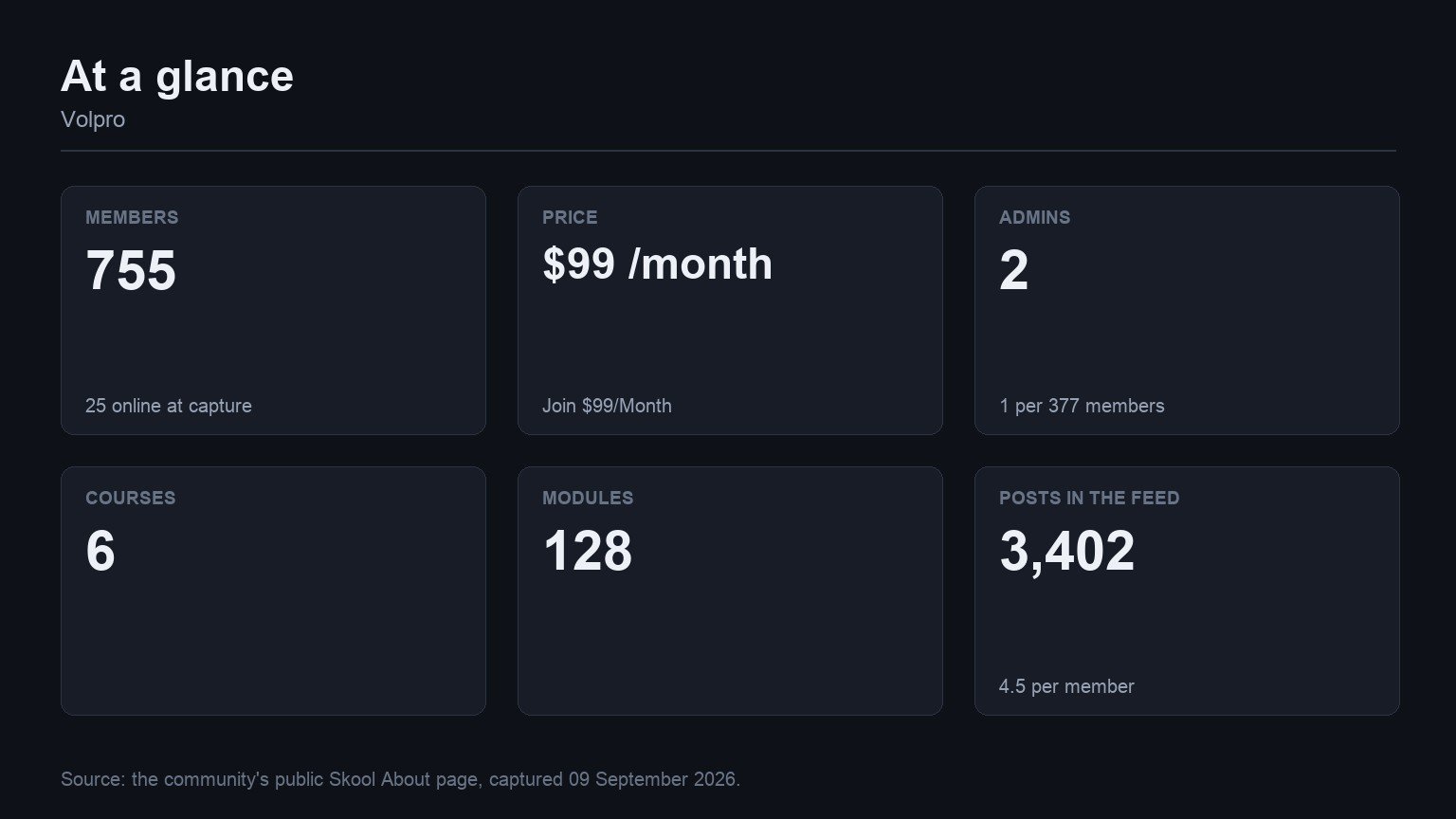
| Members | 755 |
| Members online at capture | 25 |
| Admins | 2 |
| Courses | 6 |
| Modules | 128 |
| Posts in the feed | 3,402 |
One hundred and twenty-eight modules across 6 courses averages 21 modules per course. That is a focused library rather than a sprawling one, which suits a single subject. Volume profile is one method, not a whole curriculum, and 128 modules is plenty of room to teach it.
The feed carries 3,402 posts against 755 members, roughly 4.5 posts each. Twenty-five people were online at capture, about 3% of the membership. For a paid trading room, both figures read as healthy.
Two admin accounts is the number that gives me pause. One staff seat per 378 members is thin, and live sessions plus trade feedback are labour that scales badly. Ask how many sessions run each week and who answers when Cam is asleep, because Australia’s trading hours will not match yours.
What the courses are said to cover
The listing describes a complete volume profile trading system, live trading sessions, ongoing educational content, in-depth trade reviews with feedback, community access and giveaways. It lists four learning outcomes: reading volume profile across any session, the specific setups the community trades, building a repeatable process, and getting funded and taking payouts.
Every line of that is the seller describing the seller’s product. Skool independently records the 6 courses and 128 modules. It records nothing about what happens inside them.
The funding angle matters more than it looks. Getting funded means passing a proprietary trading firm’s evaluation, which you pay for, and which most applicants fail. Those fees sit on top of the $99.
What The Sales Page Claims, And Who Is Making The Claim
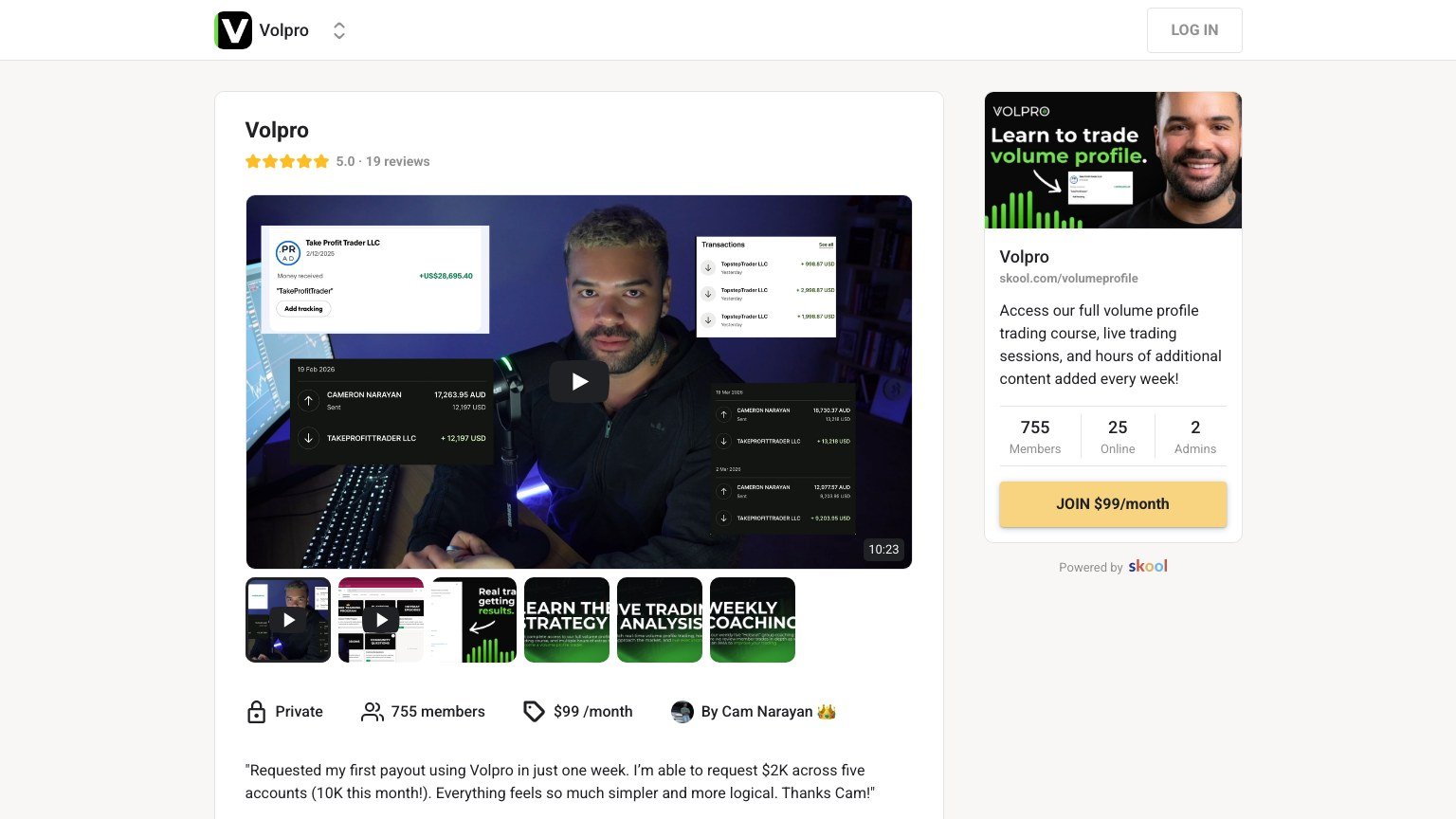
The About page opens with a testimonial. A member named Caleb says he requested his first payout in one week, that he can request $2,000 across five accounts, and that this comes to $10,000 in a month. It carries five stars and no last name.
Read that as marketing, because that is what it is. Nobody outside the community has audited those payouts. There is no date, no firm named, no account statement and no way to check whether Caleb is typical or the single best result the community has produced.
The page also states that members are getting funded for the first time, taking first payouts and seeing real results. Those are claims about outcomes with no numbers attached. How many members? Over what period? Against how many who failed evaluations? The listing does not say, and no trading education listing I have read on Skool does.
The honest reading is simple. You can verify 128 modules and 3,402 posts. You cannot verify a single dollar of member profit.
Cam Narayan, And The Single Public Link
Cam Narayan has run this community since 10 July 2025, about 14 months before capture. He lists Australia as his location, which is more disclosure than most Skool founders offer.
His bio is one sentence: creating better trading education for retail traders. His profile carries a crown badge, which Skool awards on owner earnings and which tells you nothing about how his members did.
One public link sits on his profile, a YouTube channel under the name CammyCapital. That is the useful part. Watch several hours of free material and you will know whether his explanation of volume profile lands for you, before you spend anything. A trader who publishes video is easier to judge than one who does not.
What is absent is a verified track record. No brokerage statement, no third-party audit, no public equity curve appears on the listing. That is normal in this corner of the market and it is still a gap.
Ninety-Nine Dollars A Month, Read Against What You Get
The join button read JOIN $99/month at capture, and Skool’s own price text says the same. Two matching sources is better than many listings manage, and a published price is a genuine mark in Volpro’s favour.
A year costs $1,188. Against 128 modules that is about $9 per module for the first year, though the library is not really what you are paying for after month two. The live sessions and the trade feedback are the recurring product.
The copy says cancel any time and tells you to join now to lock in current pricing. No refund policy appears anywhere. No trial, no annual discount and no lower tier are shown.
The cost nobody puts on the page
Ninety-nine dollars is the smallest number in this plan. Funded account evaluations typically run tens to low hundreds of dollars per attempt, resets cost more, and data feeds and platform fees are separate again. Add a failed evaluation or two and the real first-year cost is well above $1,188.
Budget for that before you join, not after.
Nineteen Reviews, All Five Stars
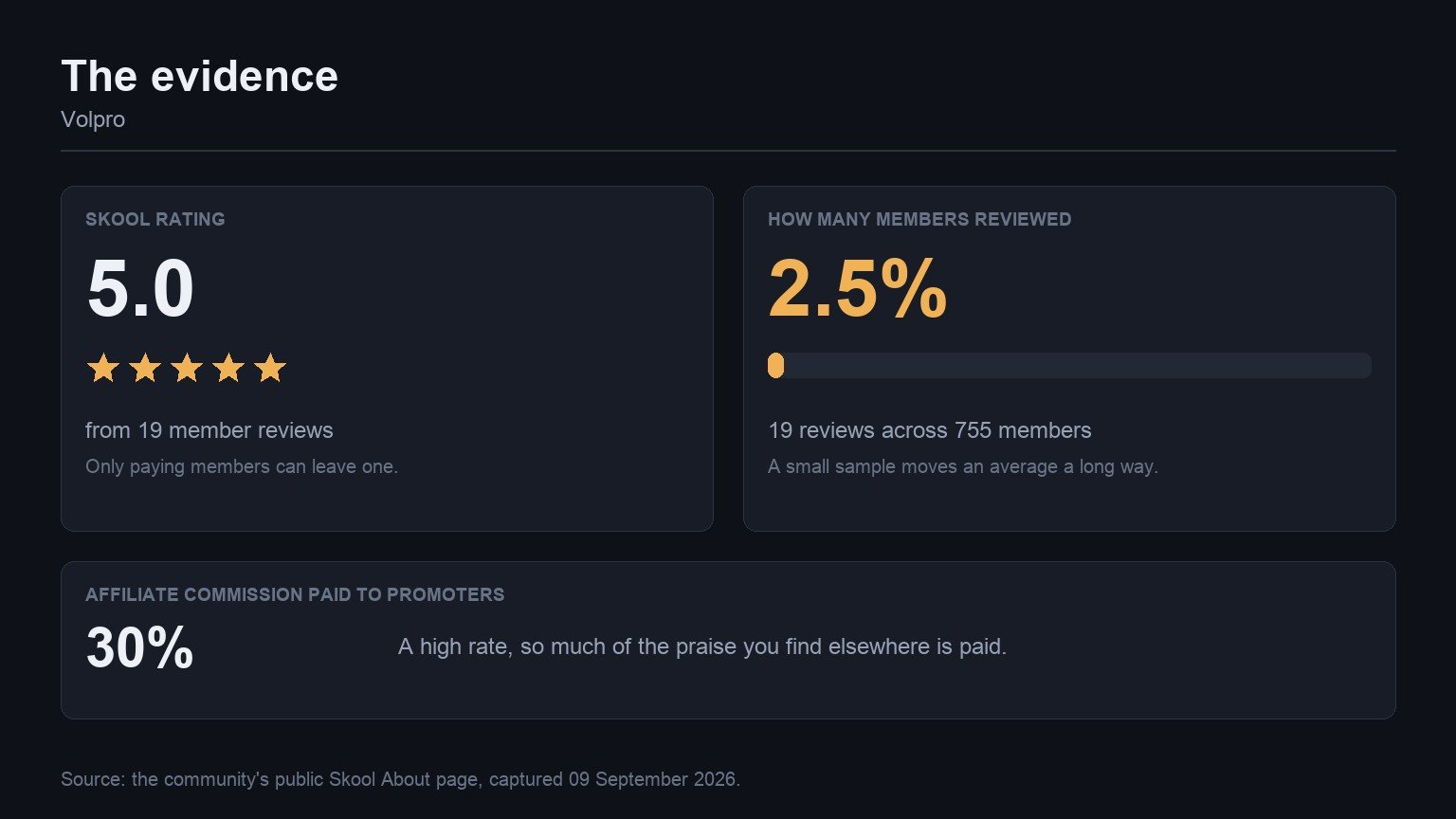
The average is 5.0 across 19 reviews, from a membership of 755. That is a response rate of about 2.5%.
A perfect 5.0 means no member who wrote a review scored it below five. That is a real signal and a small sample at the same time. Nineteen people is not enough to tell you much about a room of 755, and it says nothing at all about the members who left.
Skool only accepts reviews from paying members, so nobody can buy a rating here. The structural blind spot is the one every trading community shares: a member who blows an account and quits does not usually stop to write a review on the way out.
Three reviews are worth reading. One says Cam is honest and open, cares about everyone’s success, and puts a lot of time into the community (a member review on Skool, September 2026). Another says he has learned a great deal, that Cam is the only professional trader he has had direct access to, and singles out the psychology teaching (a member review on Skool, September 2026). A third calls it the best community for traders and praises members helping each other (a member review on Skool, August 2026).
What none of the reviews says
Not one visible review names a profit figure, an account balance, a win rate or a funded payout the writer personally received.
They praise access, teaching quality and the psychology material. Those are real things to praise. They are also the things a member can judge in week one, before their results are in.
For a community whose page leads with a $10,000 month, the absence of first-person profit reports in the reviews is the finding that matters most. It is not evidence the teaching fails. It means the listing gives you no way to check it.
The 30% Affiliate Rate Changes How You Read Praise
Volpro pays affiliates 30%. On $99 a month that is about $29.70 per referral, every month that person stays. A referral who lasts a year returns roughly $356.
That is one of the larger commissions on Skool. It does not make the community bad. It does mean that a good deal of the enthusiastic coverage you find, on YouTube in particular, has money behind it.
This review is paid nothing by anyone. Check the disclosure on any other recommendation you read before you weigh it.
Don’t Join If
- You are trading money you cannot afford to lose. Losses are the normal outcome for most retail traders, whatever the education.
- You need a verified track record. No audited results appear for the founder or the members.
- You expect close personal coaching. Two admins across 755 members is one per 378.
- You cannot trade the sessions taught. The founder is in Australia, and live sessions follow his clock, not yours.
My Verdict
The good parts are concrete. The price is published at $99 and matches in two places, 128 modules sit across 6 focused courses, the feed carries 3,402 posts among 755 members, and the founder names his country and publishes free video you can judge before paying. Nineteen out of 19 reviewers gave it five stars, and Skool only lets paying members rate.
The weak points are about evidence and risk. Nineteen reviews from 755 members is a 2.5% sample. Two admins for 755 people is a thin support ratio for a product built on live feedback. The page opens with one member’s payout numbers and offers nothing verifiable behind them, and nowhere does the listing acknowledge that trading loses money for most people who try it. A 30% affiliate rate means a lot of the outside praise is bought.
Watch the free YouTube channel for a week first. If the volume profile explanations make sense to you there, $99 buys a month of looking around, and you can cancel. Ask in the feed how many members passed a funded evaluation and how many failed, then judge the answer. For a comparison with a community that publishes its guarantee terms in writing, read our AI Profit Boardroom review, and the Affiliate Marketing Launchpad review covers a cheaper room with a much larger review base. The listing is here.
Full pros & cons
- The price is published on the listing: $99 a month, shown in both the join button and Skool's price record
- 128 modules across 6 courses, with live trading sessions run on top of the recorded material
- 3,402 posts across 755 members, about 4.5 posts per member, so the feed is genuinely active
- Cam Narayan names Australia as his base and links a public YouTube channel you can judge for free
- Every review on file rates it 5 stars, and Skool only accepts reviews from paying members
- Only 19 of 755 members have written a review, a response rate of about 2.5%
- Two admins for 755 members is one staff account per 378 people
- The sales page leads with a member's payout figures, which nobody outside the community has verified
- Trading carries a real risk of losing money, and the listing copy does not say so
- The affiliate rate is 30%, about $29.70 a month per referral, so praise elsewhere may be paid for
Try it yourself
Ready to put it to the test?
We may earn a commission at no extra cost to you. Affiliate disclosure.
Frequently Asked Questions
How much does Volpro cost?
How many members does Volpro have?
What is inside Volpro?
Is Volpro's 5.0 rating trustworthy?
Does Volpro guarantee trading profits?
Who runs Volpro?
Does Volpro pay affiliates?
Who should not join Volpro?
Reader feedback
Was this review helpful?
Your feedback helps us write better reviews.
Thanks for your feedback.
Ray Okafor is the analyst behind AI Insider Edge, covering AI tools, online courses, and paid communities in the make-money-online space. Hands-on reviews say so and state what was actually paid for access. Research reviews say that too, and are built from the seller’s own public pages, verified member reviews, and the founder’s public record. Either way the aim is a buyer’s-eye read, not a press release. Reviews are independent and may contain affiliate links, at no extra cost to you.
More reviews: Trading, credit and personal finance

Is Miguel Angel Correa Worth $150/mo? Spanish Trading
Comunidad Crece charges $150 a month for a Spanish trading room with 458 members. No track record and no risk warning appear on the listing.

CGC Credit HQ Skool Review (2026)
CGC Credit HQ lists $99/month for 603 members, 38 modules and 2 admins. Three reviews exist, one member was online, and no price sits on record.

Is Credit to Keys Lab Worth $79/mo?
Credit to Keys Lab charges $79 a month for credit repair training. 155 modules, 1,039 members, 13 reviews, no published credentials and no refund terms.

M71 Trading - AlejandroFx Skool Review (2026)
M71 Trading costs $71 a month and the seller's own copy says there will be no refunds. 933 members, 12,126 posts, 87 reviews, all in Spanish.

Lion Mode Club Review: 1,763 Members, $50/mo
Lion Mode Club runs $50/mo for 1,763 traders, 617 modules and 86,247 posts. The founder's bio is three words. The numbers and the claims, checked.

Robotedge Rocket Camp Skool Review (2026)
Robotedge Rocket Camp costs $99/mo for 983 Spanish-speaking traders. The owner's Skool account is 5 months old. The audit claim and numbers, checked.
The Edge Briefing
One honest review, every Sunday.
One email a week: which AI tools, courses & communities passed the rubric — and which to skip. Built for people funding their own stack.