Is WeScale Accelerator Worth $199/mo?
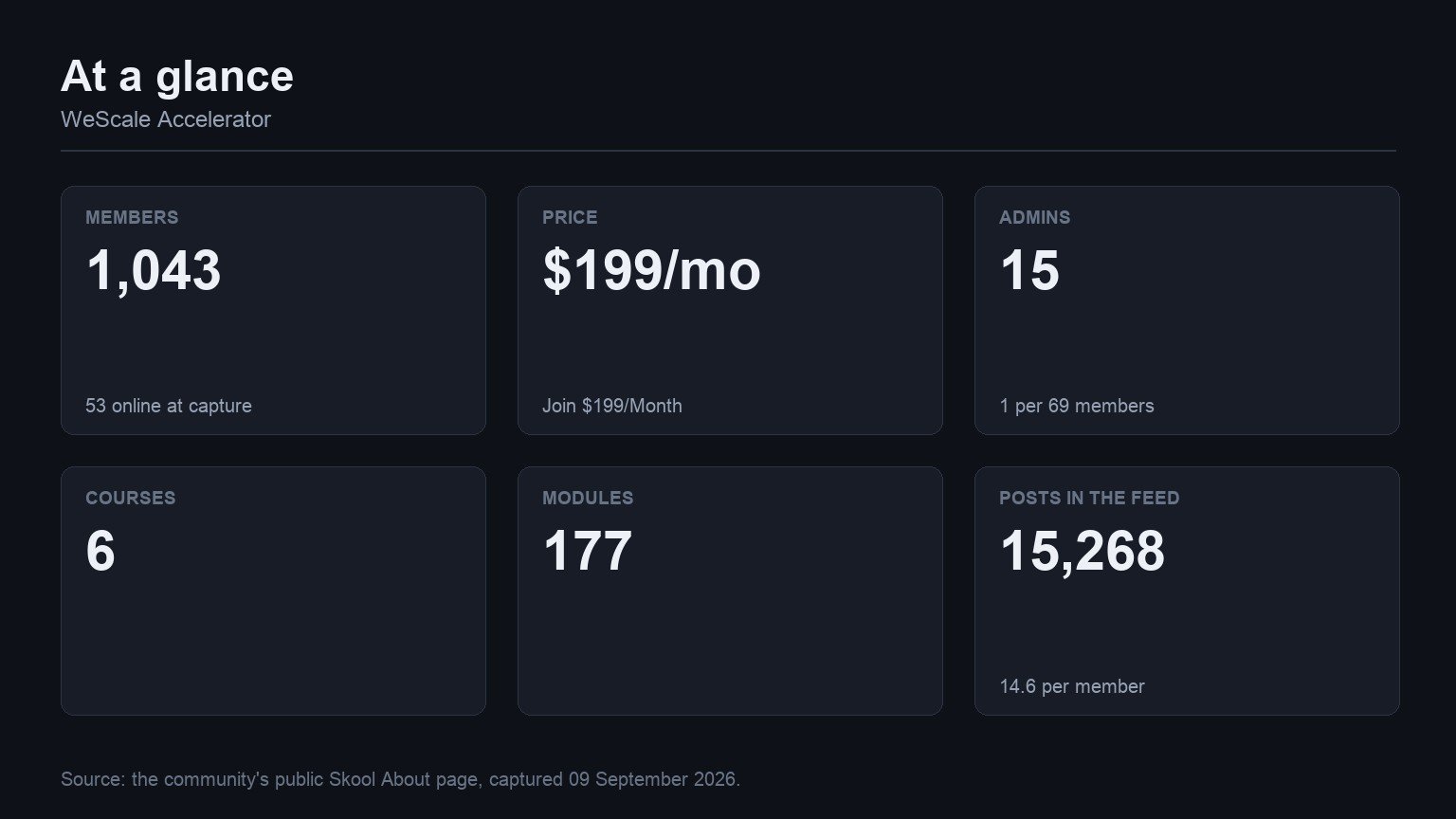
WeScale Accelerator charges $199/month for 1,043 members, 177 modules and 15 admins. The $25M and $50M sales claims carry no source. An outside look.
 By Ray Okafor ·
15 admins for 1,043 members, one per 70, the strongest staffing ratio in this batch
The $25M training program and $50M coach claims carry no source, filing or proof
Source: Skool public About page, captured September 9, 2026
WeScale Accelerator charges $199 a month to teach Shopify print on demand, and it staffs the room better than anything else in this ranking. Fifteen admins cover 1,043 members. What the public page will not do is stand behind the two numbers it leads with.
Nobody at this site has paid the fee or been inside the classroom. This review is assembled from the community’s public Skool About page, the member reviews Skool restricts to paying subscribers, and Chris Heckman’s public profile and channel, captured on 9 September 2026.
Quick Decision
Worth the 14 days if you already run a print on demand store, you have products live and traffic running, and your problem is scaling rather than starting. Two live calls a week with a 15-person coaching bench is genuine access, and $199 is testable against a single month of ad spend.
Walk away if you have no store yet and no budget to test products. Print on demand needs paid traffic to move, so the real monthly cost is $199 plus whatever you feed Meta or TikTok, and the community cannot supply that. Also walk away if unverified sales figures bother you, because the two largest numbers on this page have nothing behind them.
$199 A Month, And A Guarantee Sold Backwards
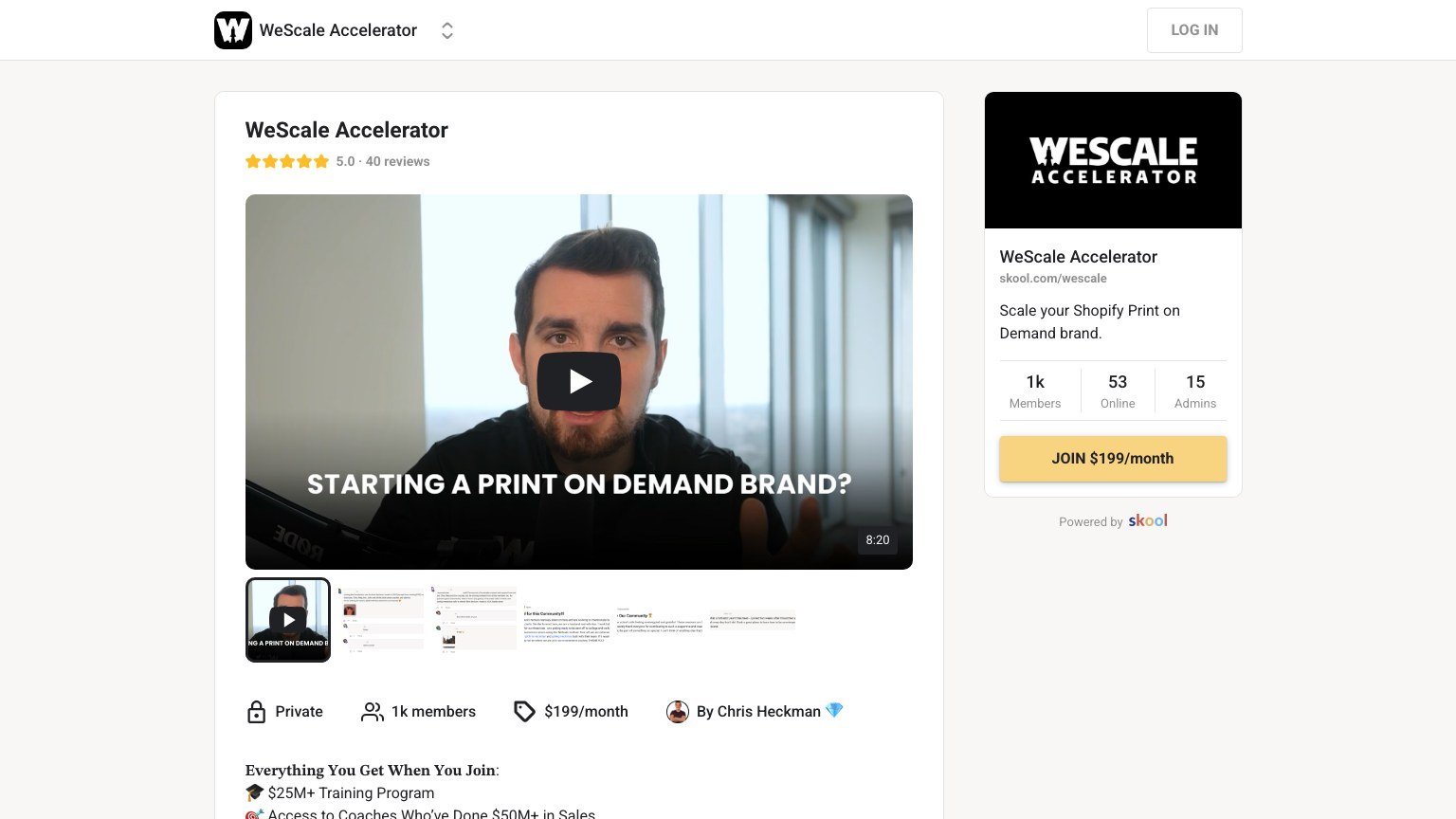
The join button reads JOIN $199/month. No annual plan, no trial, no application and no lower tier appear on the listing.
Two thousand three hundred and eighty-eight dollars a year is the figure that matters. For price context on this site, the AI SEO Rainmakers review covers a $269 a month community and the AI Profit Boardroom review covers a $59 one. WeScale sits between them, which for a coached programme with 15 admins is a defensible position.
Then there is the refund line, and it deserves its own paragraph. The listing advertises a 14-day money back guarantee, and immediately adds that fewer than 1 percent of members use it.
Read what that sentence is doing. A guarantee exists to move the risk from you to the seller. Publishing the rate at which people claim it moves the psychology back: it tells you that asking for your money back puts you in a tiny minority. That is a persuasion device, not a consumer protection, and the percentage is the seller’s own unaudited figure with no method behind it.
The guarantee itself is still a real advantage over communities that publish nothing. No conditions or exclusions appear on the page, so the terms you actually agree to are the ones on the checkout screen. Read them there.
Fourteen days is also a specific window. At two calls a week you get roughly four live sessions before it closes. That is enough time to judge whether the coaching is any good. It is nowhere near enough time to judge whether a store works, so anyone joining to find out if print on demand suits them will be paying past the refund date before they know.
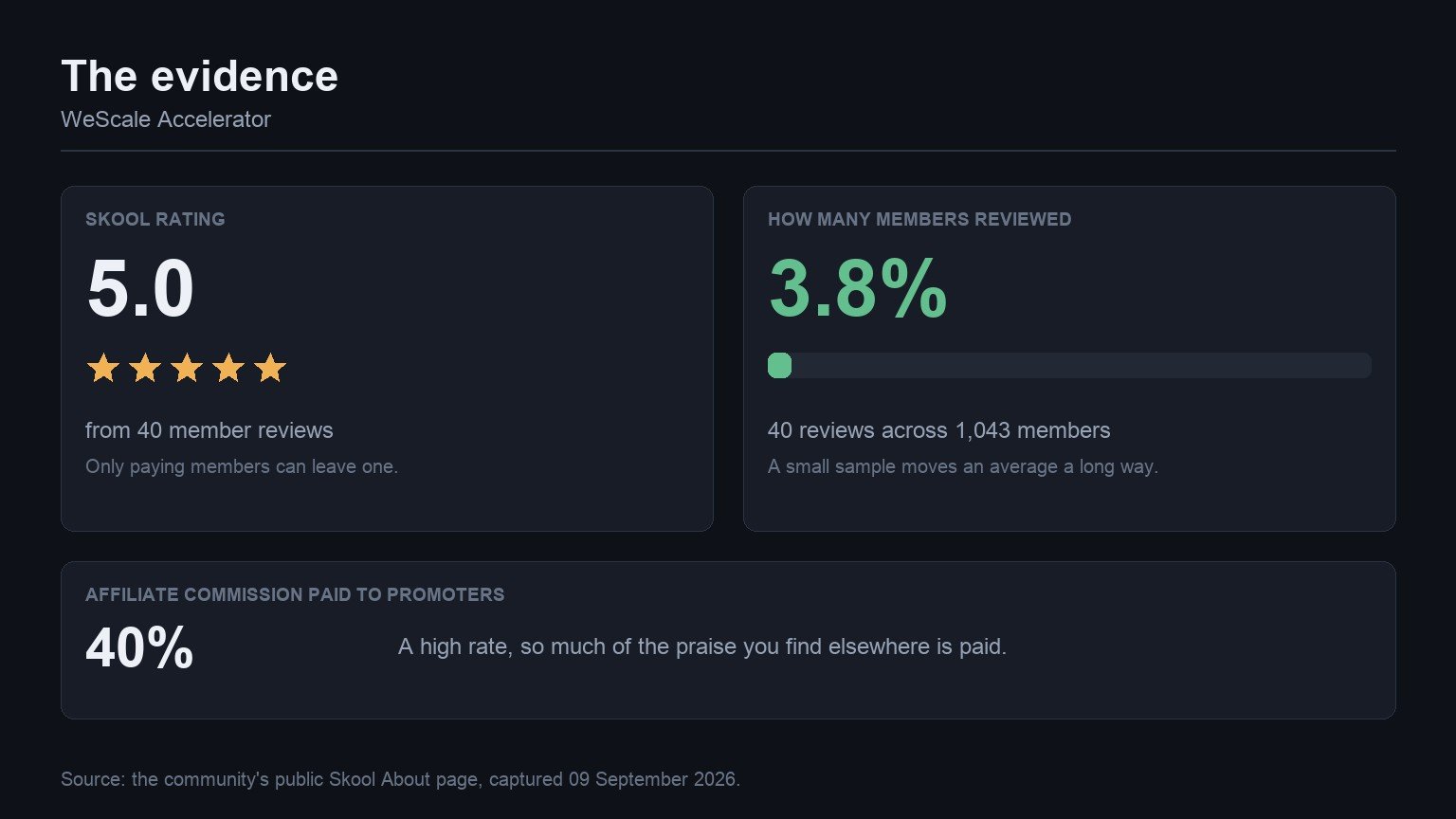
The affiliate rate belongs here too. Forty percent monthly means whoever referred you earns $79.60 every month you stay subscribed. That is one of the highest rates on Skool, and it is the reason searches for this community return so much praise. Nothing on this page is written for a payout, and it is worth knowing that a lot of what you will read elsewhere is.
What 177 Modules And 15,268 Posts Contain
Six courses. One hundred and seventy-seven modules. One video on the About page.
| Metric | Listing value |
|---|---|
| Members | 1,043 |
| Members online at capture | 53 |
| Admins | 15 |
| Posts | 15,268 |
| Courses | 6 |
| Modules | 177 |
| Reviews | 40 |
| Average rating | 5.0 |
| Affiliate commission | 40% |
Start with the number that stands out. Fifteen thousand two hundred and sixty-eight posts across 1,043 members is about 14.6 posts per member, the highest ratio in this batch. Fifty-three people were online at the moment of capture, which is roughly one member in 20 present at a random midweek time.
That density matters more in a small community than a large one. A thousand people posting constantly is a working room. Ten thousand people posting occasionally is a directory.
The listing describes the structure as cohort-based, split into launch, test and scale. A member review from August 2026 backs that up, describing a roadmap from launching to testing to scaling with a separate cohort at each stage. Grouping people by where they actually are is a harder thing to run than one shared feed, and it is the most credible operational detail on the page.
The seller also claims 150 hours of call recordings and 600 curated value posts from fellow sellers. Both are the seller’s counts and neither is visible from outside. The 177 modules figure is Skool’s own, so treat that one as solid and the other two as advertising.
What nobody outside can assess is the teaching quality. No module titles, curriculum outline or sample lesson appears publicly. One hundred and seventy-seven modules is a decent shelf for $199 a month, and against the two weekly calls it is clearly the smaller half of the offer.
The niche is worth weighing separately from the numbers. Print on demand has no inventory and almost no start-up cost, which is why it attracts beginners, and it competes on design and on paid traffic rather than on product. That shape decides what a community can and cannot do for you. It can shorten the time it takes to read a test result correctly. It cannot supply the ad budget those tests need, and nothing on the listing pretends otherwise.
Two calls a week is the number to hold on to. At 1,043 members that is a group setting rather than one-to-one time, so the value depends on whether the format lets people bring specific problems. The member accounts suggest it does, and that is the closest thing to a quality signal available from outside the paywall.
Chris Heckman, $25M, And The Coaches Nobody Names
The Skool profile lists Chris Heckman, joined 10 January 2024, carrying the diamond badge Skool awards at a high monthly recurring revenue tier. The location field is empty.
His bio is one sentence: $25m in e-commerce sales since 2017. That is admirably direct and completely uncheckable. No brand is named, no store is named, no platform is specified and no filing is linked. Two public links appear, chrisheckman.org and a YouTube channel, so there is somewhere to go and look before paying.
Notice what the listing does with that figure. The training is labelled a $25M+ training program, which is the same number as his personal sales claim. The label describes what he says he sold, not what members have sold, and a reader skimming the feature list could easily take it the other way.
The second claim goes further. The page promises access to coaches who have done $50M+ in sales. No coach is named. None is photographed or profiled on the public page, no store is attached to any of them, and the $50M is presented as a combined or individual figure without saying which.
Skool counts 15 admins, so the bench exists. A member review from September 2026 thanks Chris and someone called Meg for starting the community, and Meg appears nowhere on the public listing. Another from September 2026 praises experienced coaches without naming one. Whoever these people are, they are doing the work and getting no public credit, which is a strange choice for a programme whose central selling point is coach experience.
The fix is easy and the absence is the point. Naming five coaches with their stores attached would convert better than an unattributed $50M. Until that happens, treat the sales figures as claims and treat the 15-admin count, which Skool generates, as the fact.
Forty Reviews, And The One Number In Them
Forty reviews at a 5.0 average, all from paying members, because Skool does not let anyone else post one. Forty across 1,043 members is 3.8 percent, so about one member in 26 has written anything.
The visible ones are unusually detailed for Skool. A member review from August 2026 says a year of membership took their store from losing money to $20k months and credits the launch-test-scale roadmap. Another from August 2026 describes bringing a real problem to a coaching call and leaving with a next step on niche, design direction or pricing. A third from August 2026 says the group changed their assumptions about what was possible and praises the testing culture.
That first one is the most valuable sentence on the entire page, and it needs handling carefully. Twenty thousand a month is revenue, not profit, and print on demand carries product cost, platform fees and ad spend before anything reaches the owner. It is one member’s own figure, posted in a review box that nobody audits. It is still more than almost any community in this ranking produces, because it names a before state, an after state and a timeframe.
The second review is the one that describes the mechanism. Bring a problem, leave with a decision. That is what $199 a month is actually buying, and it is consistent with a 15-person admin bench and two calls a week.
There is also a pattern in the dates. Three of the four visible reviews were posted within a twelve-day window in late August and early September 2026, and two of those describe a full year of membership. Long-tenure members writing at the same time usually means the community asked, which is normal practice and worth knowing when you read a run of glowing entries together.
What the 40 reviews do not contain is a profit figure, an ad spend number, a store name or a single account of something not working. A 5.0 average across every review ever left is a distribution with no bottom, which happens in small samples and in rooms where people like each other. Read it as a measure of satisfaction with the coaching rather than a measure of results.
Do Not Join If
- You have no store and no ad budget. Print on demand needs paid testing, and $2,388 a year buys coaching rather than traffic.
- You need the sales claims verified before you pay. The $25M and $50M figures carry no source, and no coach is named on the public page.
- You are relying on the guarantee to decide. Fourteen days covers about four live calls, which tests the coaching and not the business.
- You want a large course library. One hundred and seventy-seven modules is mid-sized, and the live calls are the real deliverable.
My Verdict
I score WeScale Accelerator 3.9 out of 5, the strongest score in this batch, and the staffing is why. Fifteen admins for 1,043 members is one per 70, which no other community here comes close to. Add 15,268 posts, cohort groups split by stage, two live calls a week and a published refund window, and the operational side looks like a real programme rather than a course with a chat attached.
The deductions are all about proof. The two biggest numbers on the page, $25M and $50M, have nothing behind them, and the coaches those figures belong to are not named. Advertising that under 1 percent claim the refund turns a consumer protection into a pressure line. The 40 percent affiliate rate means most of the praise you find elsewhere carries a $79.60 monthly interest in your subscription.
If you have a store running, the 14 days are a fair test. Before you press the join button, ask which coaches take the calls and which stores they built. Then use the first fortnight behind the Skool listing on the live calls rather than the recordings, because the calls are what you are paying for.
Full pros & cons
- 15 admins for 1,043 members, one per 70, the strongest staffing ratio in this batch
- 15,268 posts across 1,043 members, roughly 14.6 posts per member
- A 14-day money back guarantee is published on the listing rather than hidden
- One member review names a specific outcome, moving a store to $20k months
- 177 modules across 6 courses, plus a stated 150 hours of call recordings
- The $25M training program and $50M coach claims carry no source, filing or proof
- The listing advertises that under 1 percent use the refund, which sells the guarantee backwards
- A 40 percent affiliate rate means most third-party coverage earns $79.60 a month from you
- Not one of the 15 coaches is named or profiled on the public page
- Forty reviews across 1,043 members is a 3.8 percent response rate
Try it yourself
Ready to put it to the test?
We may earn a commission at no extra cost to you. Affiliate disclosure.
Frequently Asked Questions
How much does WeScale Accelerator cost?
What do you get inside WeScale Accelerator?
Who is Chris Heckman?
Is the $25M training program claim verified?
How many coaches does WeScale Accelerator have?
What does the 14-day guarantee actually cover?
Are the 40 reviews credible?
Does WeScale Accelerator pay affiliate commissions?
Reader feedback
Was this review helpful?
Your feedback helps us write better reviews.
Thanks for your feedback.
Ray Okafor is the analyst behind AI Insider Edge, covering AI tools, online courses, and paid communities in the make-money-online space. Hands-on reviews say so and state what was actually paid for access. Research reviews say that too, and are built from the seller’s own public pages, verified member reviews, and the founder’s public record. Either way the aim is a buyer’s-eye read, not a press release. Reviews are independent and may contain affiliate links, at no extra cost to you.
More reviews: Ecommerce

MASTER Skool Review (2026)
MASTER lists itself as currently closed. Skool records $197/mo while the button reads $10,000/mo. 529 members, 1,069 modules, 26 reviews in one week.

Origins Ecommerce Review: 1,742 Members, $98/mo
Origins Ecommerce charges $98/month for Shopify and Facebook ads coaching. 13 admins, 164 modules, and a 50% affiliate rate worth reading about.

Evolve Review: 807 Members, $1,700/mo
Evolve charges $1,700 a month for Shopify and Meta scaling. 807 members, 743 modules, and a feed with only 42 posts. What that means.

Is God Tier Ecom Worth $199/mo? 423 Members
God Tier Ecom charges $199/mo or $999/year for 253 modules. The 7-day guarantee only covers annual members. The numbers and the claims, checked.

AB Inner Circle Review: 388 Members, $249/mo
AB Inner Circle charges $249/month for 388 members and 147 modules. Only 7 reviews exist, and the main room sits on Discord, off Skool.

Dropship Unlocked Review: 313 Members, Price Hidden
Dropship Unlocked Masterclass publishes no price on Skool. 313 members, 392 modules, 7,900 posts and 2 reviews. An outside look at an application-only program.
The Edge Briefing
One honest review, every Sunday.
One email a week: which AI tools, courses & communities passed the rubric — and which to skip. Built for people funding their own stack.