Origins Ecommerce Review: 1,742 Members, $98/mo
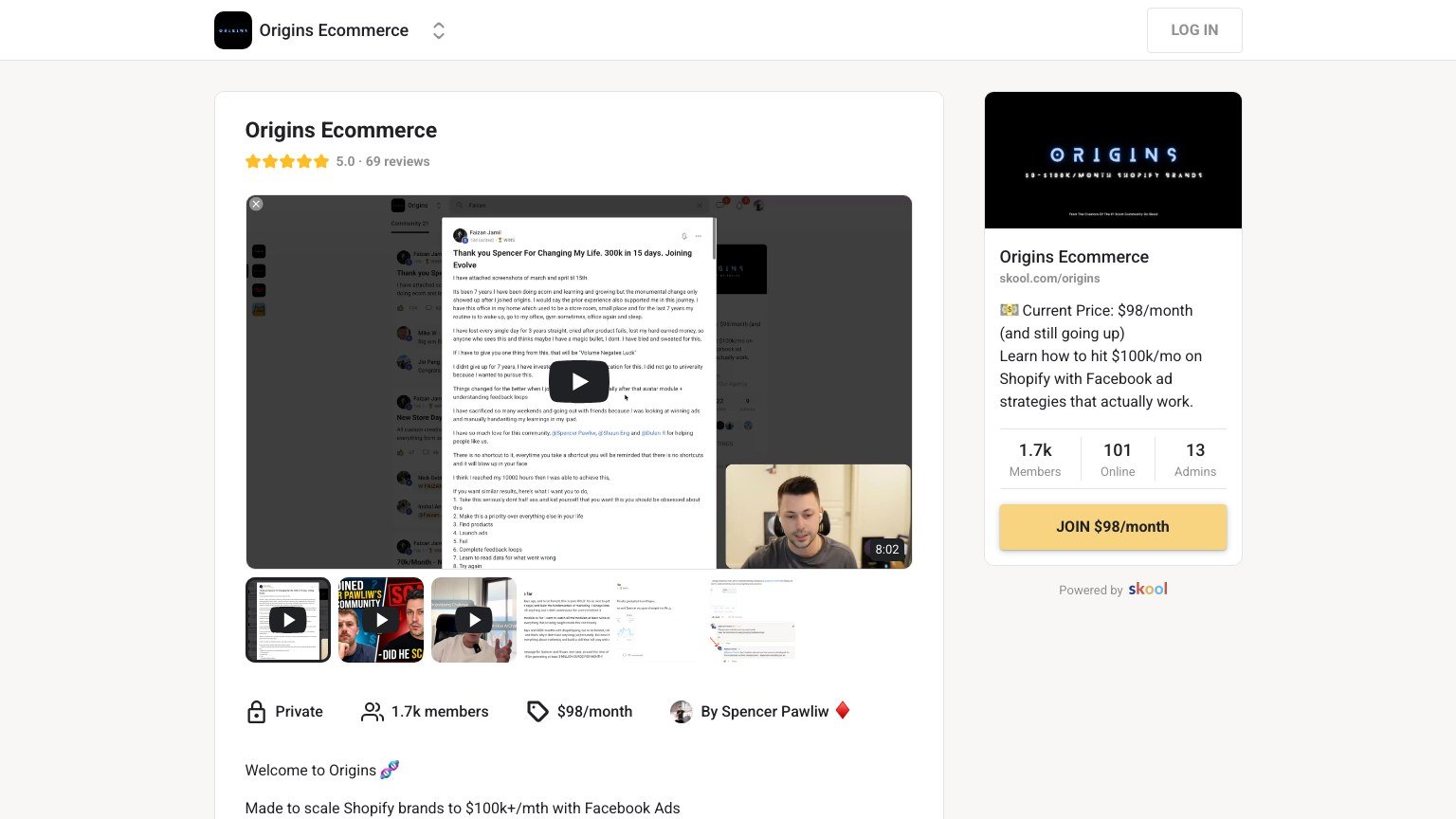
Origins Ecommerce charges $98/month for Shopify and Facebook ads coaching. 13 admins, 164 modules, and a 50% affiliate rate worth reading about.
 By Ray Okafor ·
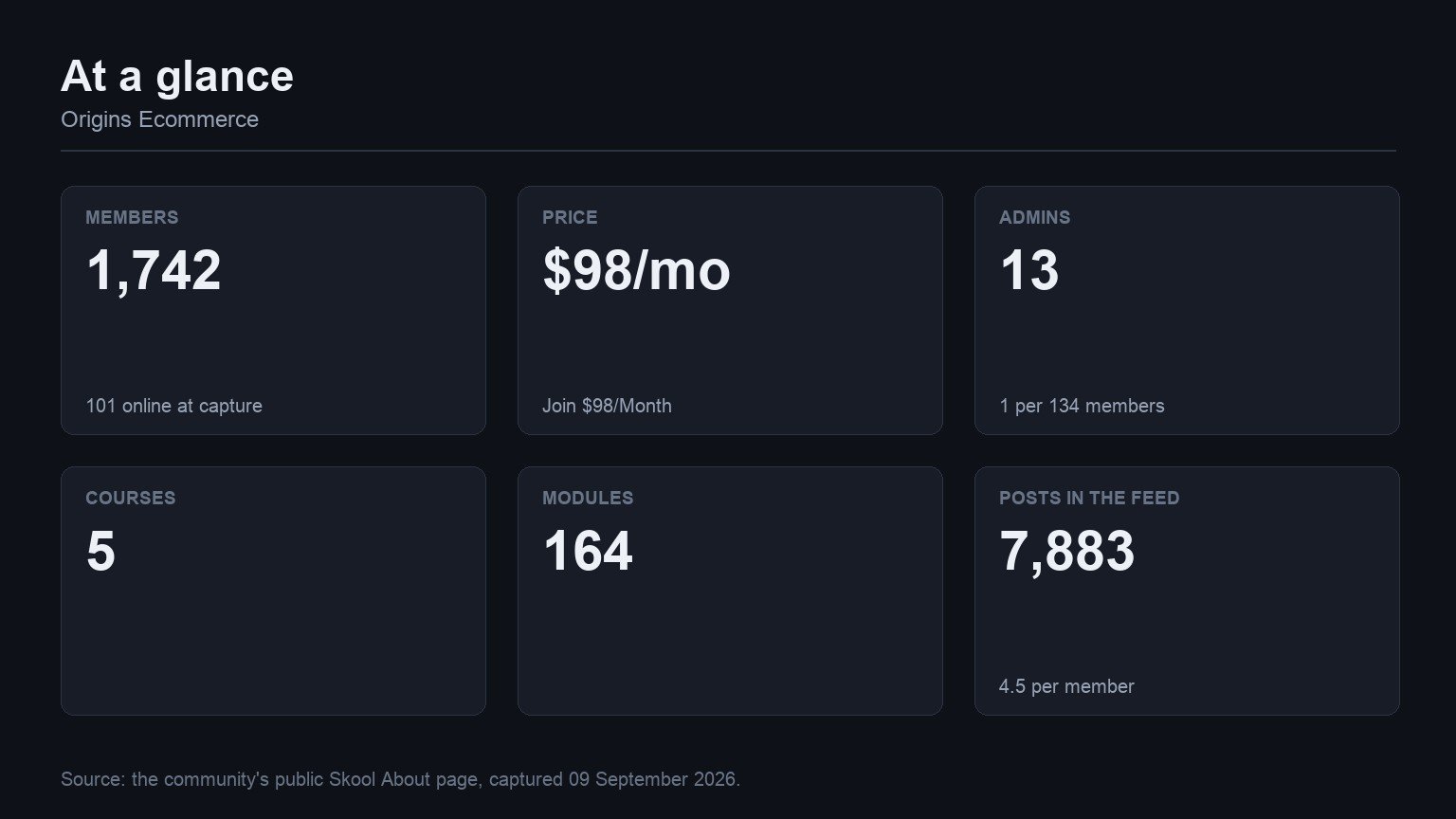
13 admins for 1,742 members works out at one per 134 people
164 modules across 5 courses is the thinnest library in this price bracket
Source: Skool public About page, captured September 9, 2026
One hundred and one members online at the moment of capture, out of 1,742. That is a room where somebody is always talking.
Origins sells Shopify scaling with Facebook ads at $98 a month, and it has the busiest feed and the thinnest course library in its price bracket. Both of those are deliberate.
This is a research review written from the outside. No membership was bought and no fee was paid. It draws on the public Skool About page, the review data Skool restricts to paying members, and the founder’s public profiles, captured on 9 September 2026.
Quick Decision
Buy it if you already run a Shopify store, already spend on Facebook ads, and want live eyes on your creative from people currently running eight-figure brands.
Walk away if you have no ad budget. A $98 membership plus $0 in media spend produces nothing here, and 164 modules will not fill the gap.
Spencer Pawliw, Checkable In Five Places
Spencer Pawliw founded it, is listed in Scottsdale, Arizona, and has been on Skool since February 2023. His bio names his company, Easy A Media.
His profile publishes five public links: Instagram, LinkedIn, X, YouTube and a company website. That is the fullest founder record in this ranking, and it matters more than it sounds. Most founders selling money-making programmes publish nothing you can verify. Here you can read a LinkedIn history and watch years of output before spending anything.
One caveat on the platform badge. His profile carries Skool’s fire marker rather than the diamond badge that indicates $100,000 or more in monthly recurring revenue. Several smaller communities in this ranking hold the higher badge.
The page also credits co-founder Shaun Eng and puts a combined $200M+ on Shopify behind the two of them. That is the sellers’ own figure with nothing external attached.
The Coaching Bench Is The Product
Three coaches are named on the page with specific backgrounds: Mike, described as a dropshipper who built a seven-figure technical fashion brand; Shanil, credited with scaling PetLabCo’s Amazon business to $100M a year and now running an eight-figure supplement brand; and Miika, described as lead creative strategist at Shanil’s brand.
Named people with stated specialisms beat an anonymous support queue. You know who is answering.
Miika’s ad reviews are the item worth the most at this price. Creative feedback from someone who buys media daily is genuinely hard to source, and the page specifies it happens in the community rather than in DMs, which means everyone reads the critique.
The claim that all three coaches are former EVOLVE students who did it around families, school or full-time jobs is the seller’s framing. It is also good marketing, because it sells the upper programme while describing the lower one.
What $98 A Month Costs You
Ninety-eight dollars a month, billed monthly, cancel it yourself.
The description labels that as the current price and adds that it is still going up. Price-increase notices are a standard urgency device on Skool, and there is no published schedule behind it. If the number rises after you join, existing members are usually grandfathered, but the page does not promise that.
There is no published refund policy. Self-serve cancellation stops your next charge and does not return the last one. At $98 the exposure is one month, which is a reasonable risk to take.
One bonus is listed: a free copy of Alex Hormozi’s $100M Money Models book. Pleasant, and worth about thirty dollars.
The Price Ladder Above $98
Origins Launchpad is named on the same page at $598 per month, with a note that it sold out in four days. EVOLVE sits above that as the founders’ flagship.
So $98 buys the first rung. That is not hidden, and giving the higher price on the public page is more honest than most ladders manage. It does change how you should plan. Decide before you join whether $98 is your ceiling or your starting point, because the ladder will be presented to you from inside.
The sold-out note has a second function. Scarcity on the tier above makes the tier you can buy feel like a bargain.
Half Your Fee Goes To Whoever Sent You
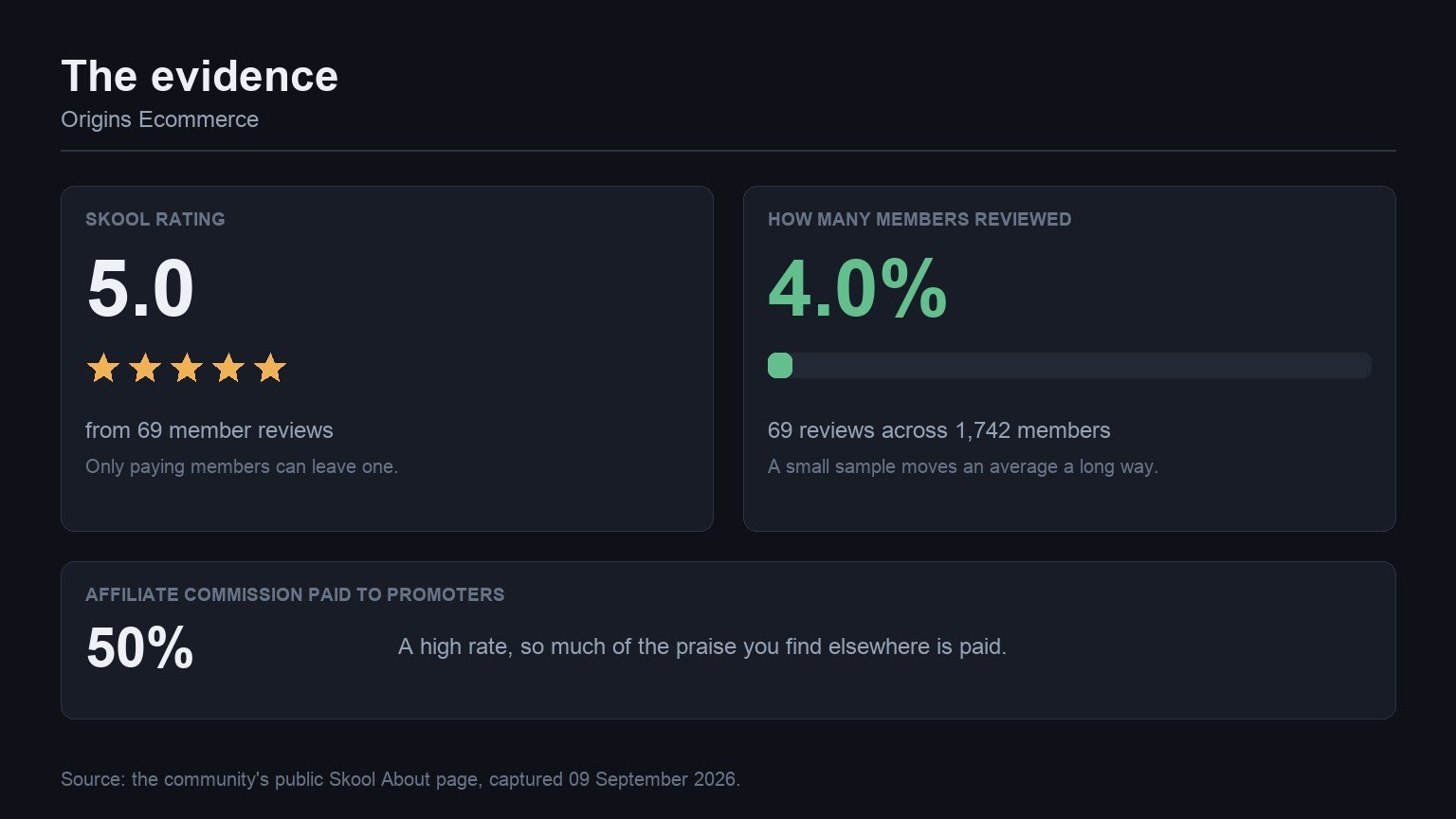
Skool records a 50 percent affiliate share on Origins. On a $98 membership that is $49 a month, recurring for as long as you stay.
That is the highest referral rate encountered in this ranking, and it explains a lot about how you found the community. A creator reviewing Origins on YouTube earns $588 a year from a single signup that sticks for twelve months.
It does not follow that the product is bad. It does follow that any enthusiastic third-party review of Origins should be read with the payout in mind, including the free comparison videos that rank for the community’s name. The 69 reviews on Skool are the cleaner source, because the platform only accepts them from paying members.
Inside: 164 Modules And A 7,883-Post Feed
| What | Count |
|---|---|
| Members | 1,742 |
| Courses | 5 |
| Modules | 164 |
| Posts in the feed | 7,883 |
| Admins | 13 |
| Members online at capture | 101 |
Five courses. That is the smallest library of any community reviewed here at this price, and roughly a tenth of what the largest offers.
The feed is where the balance shifts back. Nearly 7,900 posts across 1,742 members is one of the highest post-per-member figures in the ranking, and 101 people online at a single moment of capture backs it up. Thirteen admins gives one staff member per 134 members.
Read those numbers together and the design becomes obvious. Origins sells access to people who will look at your specific ads this week. The curriculum is a supporting document. If you want structure and a syllabus, 164 modules will feel thin by month two.
The Claims That Carry No Source
Four numbers appear on the page with nothing behind them: 43 wins in the last 30 days, $200M+ on Shopify between the founders, 53 EVOLVE students past $100k a day, and the $100k a month target in the community description.
None of those is impossible. All of them are self-reported. There is no audit, no named third party, no screenshot with an account ID attached, and a win is not defined anywhere on the page.
The verifiable figures are the boring ones: 1,742 members, 13 admins, 69 reviews, 5.0 average. Those come from the platform rather than the seller. Build your expectations on that set.
Two Visible Reviews Out Of 69
Sixty-nine reviews, 5.0 average, paying members only.
Only two have visible text, and they are an odd pair. The first is written entirely in capitals, is heavily profane, and is pure enthusiasm with no detail you could check (a member review on Skool, September 2026). The second says the member is ready to move up to EVOLVE after reaching £170,000 a month (a member review on Skool, September 2026).
That second one is the more interesting. It is a specific figure, it is self-reported, and it describes someone leaving for the higher-priced programme. Read as evidence, it says the ladder works as a ladder.
What no visible review mentions is the course material, the framework or the 164 modules. Sixty-nine reviews also covers about four percent of 1,742 members.
Don’t Join If
- You have no ad spend available. Facebook strategy without a media budget is a hobby.
- You want a complete curriculum. Five courses and 164 modules will not carry you alone.
- You react badly to upsells. A $598 tier is named on the public page and will be present inside.
- You need verified revenue proof before paying. Every performance number here is self-reported.
My Verdict
Origins Ecommerce scores 4.0 out of 5. The founder is the most publicly checkable person in this ranking, the coaching bench is named with real specialisms, and the feed is busy enough to justify a monthly fee on its own.
The deductions come from three places. Content depth is genuinely thin at 164 modules, so a self-directed learner gets poor value. The 50 percent affiliate rate means most of what you will read about Origins elsewhere is paid for. And the $598 tier above the $98 one makes this an entry point rather than a destination, which is worth knowing before rather than after.
At $98 with monthly cancellation, one month is a cheap way to test whether the ad reviews are as useful as they look. For a comparison with the same 50 percent referral economics in a different niche, our Story Hacker AI review works through that maths. If you want a route that needs no ad budget at all, our Affiliate Marketing Launchpad review is the better fit.
You can read the listing on Skool here before deciding whether to take the first month.
Full pros & cons
- 13 admins for 1,742 members works out at one per 134 people
- 7,883 posts on a 1,742-member base is one of the busiest feeds in this ranking
- The founder publishes five verifiable public profiles including LinkedIn and a company site
- Named coaches with stated specialisms rather than an anonymous support team
- Monthly billing with self-serve cancellation, no annual lock-in
- 164 modules across 5 courses is the thinnest library in this price bracket
- The 50 percent affiliate rate pays a referrer $49 every month you stay
- A $598 per month tier sits above the $98 entry, so this is a price ladder
- Every performance figure on the page is self-reported with no external source
- Only 2 of the 69 reviews have visible text, and one contains no verifiable detail
Try it yourself
Ready to put it to the test?
We may earn a commission at no extra cost to you. Affiliate disclosure.
Frequently Asked Questions
How much does Origins Ecommerce cost?
Is there an upsell above the $98 membership?
Who runs Origins Ecommerce?
How much material is inside?
What does the 50 percent affiliate rate mean for me?
Are the results claims verified?
How active is the community day to day?
Do you need an existing Shopify store to join?
Reader feedback
Was this review helpful?
Your feedback helps us write better reviews.
Thanks for your feedback.
Ray Okafor is the analyst behind AI Insider Edge, covering AI tools, online courses, and paid communities in the make-money-online space. Hands-on reviews say so and state what was actually paid for access. Research reviews say that too, and are built from the seller’s own public pages, verified member reviews, and the founder’s public record. Either way the aim is a buyer’s-eye read, not a press release. Reviews are independent and may contain affiliate links, at no extra cost to you.
More reviews: Ecommerce

Evolve Review: 807 Members, $1,700/mo
Evolve charges $1,700 a month for Shopify and Meta scaling. 807 members, 743 modules, and a feed with only 42 posts. What that means.

Is God Tier Ecom Worth $199/mo? 423 Members
God Tier Ecom charges $199/mo or $999/year for 253 modules. The 7-day guarantee only covers annual members. The numbers and the claims, checked.

MASTER Skool Review (2026)
MASTER lists itself as currently closed. Skool records $197/mo while the button reads $10,000/mo. 529 members, 1,069 modules, 26 reviews in one week.

Is WeScale Accelerator Worth $199/mo?
WeScale Accelerator charges $199/month for 1,043 members, 177 modules and 15 admins. The $25M and $50M sales claims carry no source. An outside look.

AB Inner Circle Review: 388 Members, $249/mo
AB Inner Circle charges $249/month for 388 members and 147 modules. Only 7 reviews exist, and the main room sits on Discord, off Skool.

Dropship Unlocked Review: 313 Members, Price Hidden
Dropship Unlocked Masterclass publishes no price on Skool. 313 members, 392 modules, 7,900 posts and 2 reviews. An outside look at an application-only program.
The Edge Briefing
One honest review, every Sunday.
One email a week: which AI tools, courses & communities passed the rubric — and which to skip. Built for people funding their own stack.