F The GuRUs Sales Review: 1,150 Members, $69/mo
Matt Ryder's sales community charges $69/mo after a 7-day trial. 1,150 members, 693 modules, 10 admins, 74 reviews. Where the value claim breaks.
 By Ray Okafor ·

No score: research review
We only score what we used. The verdict below is built from public sources. Price at review: $69/month after a 7-day free trial.
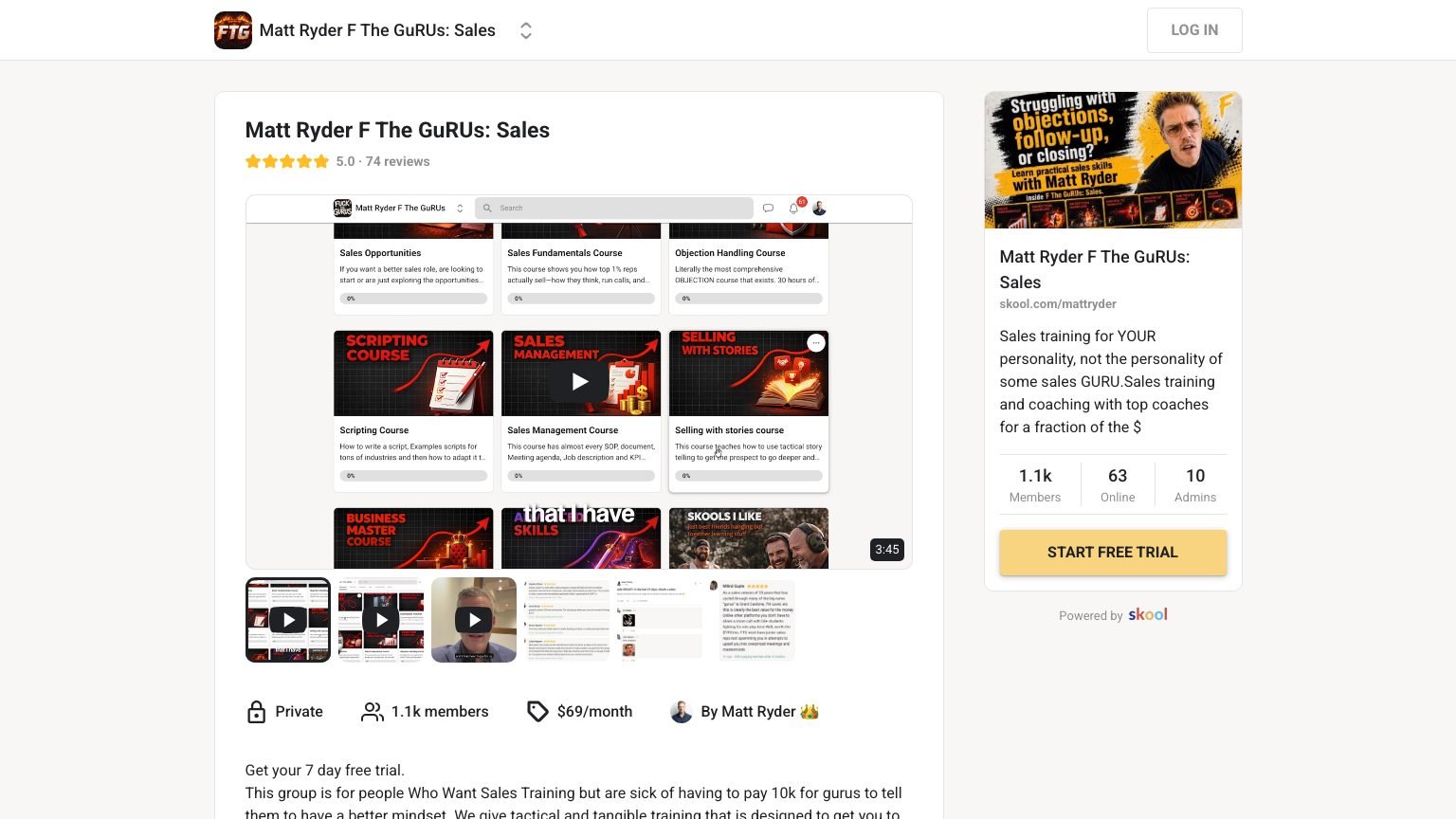
693 modules across 46 courses for $69 a month, one of the largest libraries per dollar on Skool
The founder's own profile states he does not check DMs, so private access is ruled out up front
Source: Skool public About page, captured September 9, 2026
Six hundred and ninety-three modules for $69 a month. One founder who states in writing that he will not read your messages.
Both of those facts sit on the same public page, and a fair judgement of this community needs to hold them together.
The disclosure first. I am not a member here and nothing has been paid to Matt Ryder or his team. What follows was built from the community’s public Skool About page, the written reviews Skool restricts to paying members, and the founder’s own public channels, captured on 9 September 2026. Anything drawn from the sales copy is marked as the seller’s claim rather than a verified fact.
Quick Decision
Start the trial if you sell for a living, you want tactical call material rather than mindset coaching, and you are happy to learn from a large library and a peer feed. At $69 a month with 693 modules behind a free week, the downside is close to zero and the volume of material is real.
Skip it if you want a coach who answers you personally. The founder’s profile rules that out on its face, and ten admins cannot cover 1,150 members individually. Skip it too if you dislike blunt, profane sales culture, because the page tells you plainly that the room is not built for you.
You can open the trial from the community listing and read the whole library before deciding.
Matt Ryder’s Record, And The Line About DMs
Matt Ryder’s profile describes a former special forces sniper who became a sales rep and then a CEO. He founded dialer.io and was previously chief executive of 7th Level and Sales Sniper. He lists Sydney, Australia as his location, which is more than most Skool owners publish.
Four public links sit on the profile: YouTube, Facebook, Instagram and dialer.io. That is a strong transparency position. You can watch hours of his material before the trial even starts, which is exactly how I would spend the first evening.
His account carries a crown badge, Skool’s marker for a high-earning community owner. That measures sales, not member results.
The sentence most buyers skip
The profile bio ends with a parenthetical: he does not check DMs.
I rate that as honest rather than dismissive. Plenty of founders imply personal access and then vanish. This one tells you before you pay.
It also sets your expectations correctly. Whatever you buy here, it is not a private line to the founder. It is a library, a feed and a set of coaches.
Under a year of history
He joined Skool in November 2025, so at capture the community was about ten months old.
That matters for a specific reason. Ten months is not long enough to see whether a library keeps getting updated, whether the coaches stay, or whether the feed survives its founding cohort. The 693 modules exist now. Nobody outside can yet say what the second year looks like.
The Software Behind The Training
The sales copy contains a line worth reading twice. Ryder writes that he was a seven-figure earning sales rep and that he is still on the tools selling his own software, so the material is current rather than years old.
The freshness argument is fair. Someone actively making calls will teach differently from someone recalling a job they left in 2019.
The part the page does not flag is the conflict. The software he sells is dialer.io, which is also the website link on his Skool profile. A sales community run by the founder of a dialling product is, among other things, a captive audience of people who make calls for a living.
I am not alleging anything improper. No pitch appears in the public material and the price makes no mention of software. But you should join knowing that the teacher has a commercial interest in the tool category he teaches you to use, and you should notice if tool recommendations start pointing one way.
$69 A Month, And The Seven-Day Trial
The listing carries a structured price record of $69 per month in US dollars, and the join button reads START FREE TRIAL. Both agree, which is better than many Skool pages manage.
Seven free days is the most useful thing on this listing. With 693 modules available, a determined buyer can assess the actual teaching quality inside the trial window rather than guessing from a sales page. Very few paid communities let you do that.
Twelve months costs $828. That is real money, though it sits far below the $10,000 coaching programmes the page positions itself against.
What the price does not cover
No annual plan is shown. No refund policy is published anywhere on the listing.
Cancellation terms are not described either, though Skool memberships generally run month to month and the trial gives you a clean exit before the first charge. Diary the trial end date on the day you start. A free week is only free if you remember it.
The 30% commission behind the mentions
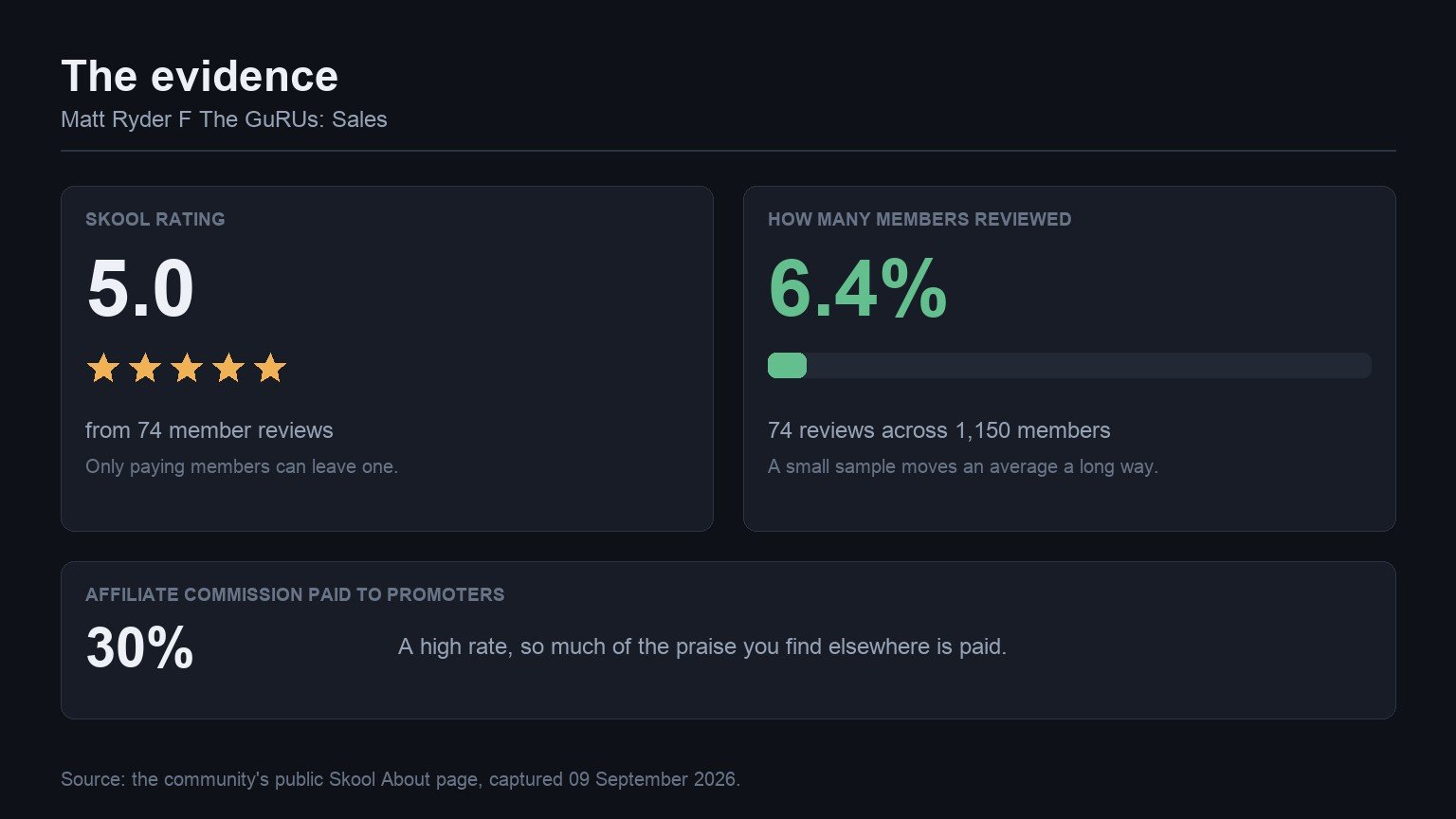
The community pays affiliates 30%. On $69 that is $20.70 per member per month, recurring.
A referral who stays a year returns about $248. That is enough to explain the volume of casual recommendations and not enough to fund detailed ones, which is roughly what you find when you search. Weigh accordingly.
Doing The Maths On The “1% The Cost” Claim
The page states the value proposition directly: $10,000 of value for one percent of the cost.
One percent of $10,000 is $100. The membership is $69 a month.
So the claim holds for six weeks and then stops holding. By month two you are at $138. By month twelve you are at $828, which is 8.3% of the figure being compared against, not 1%. The comparison quietly assumes you buy one month of a subscription product and then leave.
None of that makes the price bad. Eight hundred and twenty-eight dollars for 693 modules and a live feed is defensible on its own terms, and the page does not need the arithmetic trick to sell it.
It is worth naming because the same page criticises gurus for overpromising. A community built on calling out inflated claims should be careful with its own.
The other unsourced numbers
The copy states Ryder was a seven-figure earning sales rep. It states the group is the best sales training on Skool. Neither carries a source, a date or a comparison method.
The last line of the description also stacks bare keywords: sales training, sales coaching, get better at sales, Matt Ryder, sales, money, best sales training. That is search engine padding rather than information, and it tells you something about how the listing was written.
Forty-Six Courses And 693 Modules
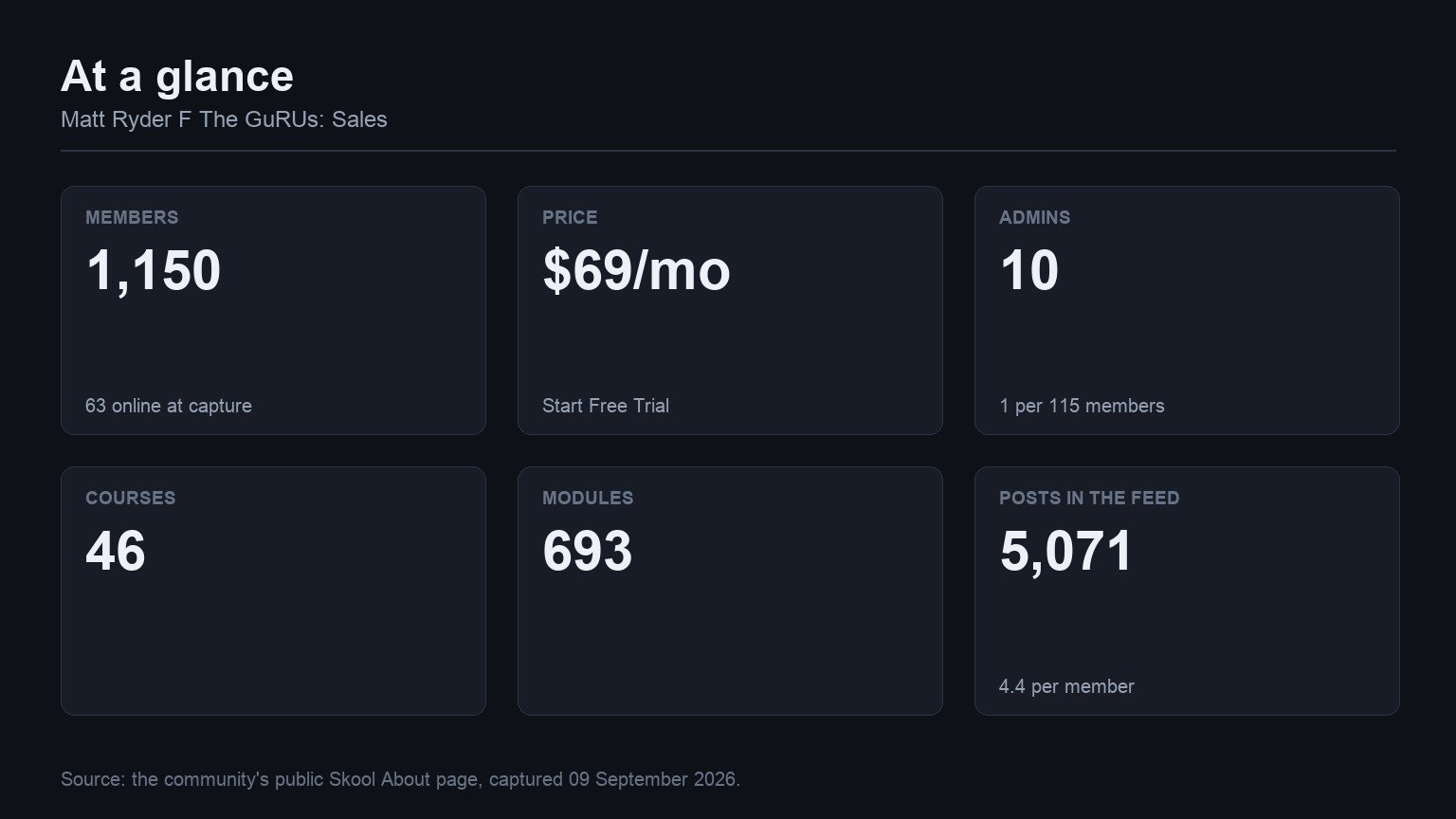
| What | Count |
|---|---|
| Members | 1,150 |
| Members online at capture | 63 |
| Admins | 10 |
| Courses | 46 |
| Modules | 693 |
| Posts in the feed | 5,071 |
Six hundred and ninety-three modules across 46 courses averages about 15 modules per course. At $69 a month, that is roughly ten cents per module per month.
The seller describes the teaching approach as tactical: what to say, when to say it, and why. Sales training splits fairly cleanly between mindset material and script-level material, and this page positions itself firmly in the second camp. The volume of modules supports that. Mindset courses do not usually need 693 pieces.
The trial is the real test
Forty-six courses is also a discovery problem. A new member facing that many tracks with no guided path can spend a week deciding where to start and learn nothing.
Use the free seven days for exactly that. Find the onboarding path, check whether courses are sequenced or stacked, and see how recent the newest modules are. If the library turns out to be well ordered, $69 is cheap. If it is a pile, the number stops meaning much.
Ten Admins, 1,150 Members
Ten admin accounts serve 1,150 members. That is one per 115 people.
By the standards of this category it is a middling ratio, better than the communities running one admin per thousand and far behind small application-only groups. The page mentions top coaches in the plural, and ten admin seats is consistent with an actual coaching bench rather than one person and a moderator.
Set your expectation at group-level help. Post in the feed, get answers from coaches and peers, and do not count on being singled out.
What 5,071 Posts Look Like
Five thousand and seventy-one posts across 1,150 members works out at 4.4 posts each.
That is a moderate feed. Compare it with communities carrying 20 or more posts per member and this one looks quieter than its size suggests, which usually means a library-first product where members watch more than they write.
Sixty-three people were online at capture, about 5.5% of the membership. A question posted in the middle of the day will find someone.
Why a quiet feed matters in sales
Sales skills improve through review of your actual calls. That needs other people willing to listen to a recording and tell you what went wrong.
A feed averaging under five posts per member is a weaker engine for that than the raw member count implies. Check during the trial whether call reviews actually happen, and how often the coaches join them.
Seventy-Four Reviews, Three Visible
Seventy-four reviews at a straight 5.0 average, from 1,150 members. That is a 6.4% response rate, normal for a community of this size.
Skool only accepts reviews from paying members, so none can be bought or automated. That makes the 5.0 more meaningful than a public star rating, though members who quit tend to leave without writing anything.
Three are visible on the listing. One calls it the best Skool community for improving at sales and says the same value usually costs $10,000 to $25,000 (a member review on Skool, September 2026). Another says they would have paid ten times more to join (a member review on Skool, September 2026). A third calls it the best sales training on the planet (a member review on Skool, September 2026).
What the reviews never mention
Not one names a close rate, a deal size, a quota hit, or a commission figure before and after.
For sales training, those are the only outcomes that matter, and they are absent from every visible review. Two of the three reviews also repeat the page’s own $10,000 comparison back at it, which suggests the framing has landed rather than that it has been tested.
The reviews establish that members rate the teaching highly. They do not establish that anyone sold more because of it.
Don’t Join If
- You want personal coaching. The founder’s own profile says he does not read DMs.
- Blunt, profane sales culture bothers you. The page says outright that the room is not for the easily offended.
- You will not work through the library. Six hundred and ninety-three modules reward a schedule and punish browsing.
- You need a proven multi-year track record. This community opened in November 2025.
My Verdict
The library and the trial carry it. Six hundred and ninety-three modules across 46 courses at $69 a month is one of the better volume-per-dollar positions on Skool, and a seven-day free trial means you can verify the teaching before spending anything, which almost no competitor at any price allows. The founder publishes across four public channels and names his city, so his record is checkable. Ten admins for 1,150 members is a genuine coaching bench rather than a solo act.
The weak points are three. Access is capped by design, with no DMs and one admin per 115 members, so anyone buying attention is buying the wrong product. The headline value claim of one percent of $10,000 stops being true after six weeks of billing, which is a careless number on a page that attacks other people’s numbers. And the founder sells dialling software in the same market he teaches, a conflict the listing never mentions.
Use the free week properly. Check the onboarding path, watch how recent the newest modules are, and see whether call reviews happen in the feed. If those hold up, $69 is a fair price. For a different reading of what a cheap Skool community can deliver, see our Affiliate Marketing Launchpad review, and the La Tribu Divisual review shows how a larger non-English community handles the same library-plus-feed structure. The trial itself starts from the listing.
Full pros & cons
- 693 modules across 46 courses for $69 a month, one of the largest libraries per dollar on Skool
- A 7-day free trial means you can read the whole library before any money moves
- Matt Ryder publishes on YouTube, Facebook, Instagram and his own software site, so his teaching is checkable
- 63 members were online at capture out of 1,150, so the room is populated through the day
- 74 written reviews at a 5.0 average, all from paying members Skool has verified
- The founder's own profile states he does not check DMs, so private access is ruled out up front
- 10 admins serve 1,150 members, one per 115 people, so most answers come from peers
- The '$10k of value for 1% the cost' line does not survive twelve months of billing at $69
- The founder sells dialer.io and says he is still selling that software daily, which is an unflagged conflict
- The community opened in November 2025, so there is under a year of track record to judge
Try it yourself
Ready to put it to the test?
We may earn a commission at no extra cost to you. Affiliate disclosure.
Frequently Asked Questions
How much does Matt Ryder's sales community cost?
How much training is inside?
Can you message Matt Ryder directly?
Who is Matt Ryder?
Does the community pay affiliates?
Reader feedback
Was this review helpful?
Your feedback helps us write better reviews.
Thanks for your feedback.
Ray Okafor is the analyst behind AI Insider Edge, covering AI tools, online courses, and paid communities in the make-money-online space. Hands-on reviews say so and state what was actually paid for access. Research reviews say that too, and are built from the seller’s own public pages, verified member reviews, and the founder’s public record. Either way the aim is a buyer’s-eye read, not a press release. Reviews are independent and may contain affiliate links, at no extra cost to you.
More reviews: Marketing, ads and sales

Affiliate Marketing Launchpad Review: 5 Skools, 1 Real
I joined Affiliate Marketing Launchpad and worked through the classroom. Five Skools share this name, so here's the real one and what $29 vs $49 buys.

Is Angel Media Worth $109/mo? Chinese Only, No Refunds
Angel Media charges $109 a month for 22 courses and 52 modules taught in Chinese. The listing states refunds stop the moment billing starts.

Is BAMx | Real Estate Worth $197/mo?
BAMx charges $197 a month for 1,315 modules and 21 admins across 2,137 members. Only 4 reviews exist and the free trial length is never published.

Disrupter Academy Review: 1,326 Members, $29/mo
Disrupter Academy lists $29 a month for 1,326 members and 508 modules. The page flags a price rise, and the Premium tier has no published price.

AAAgency US Skool Review (2026): $1,000/mo, 57 Members
AAAgency US charges $1,000 a month for 3 courses, 12 modules and a feed with 1 post. 57 members, 8 admins, 1 review. What the public listing shows.

Email Marketing Mastery Review: 328 Members, $247/mo
Email Marketing Mastery costs $247/mo for 119 modules and 250+ templates. Just 16 of 328 members have reviewed it. The numbers and the $250M claim, checked.
The Edge Briefing
One honest review, every Sunday.
One email a week: which AI tools, courses & communities passed the rubric — and which to skip. Built for people funding their own stack.