Is Skool Kourse Worth $250/mo?
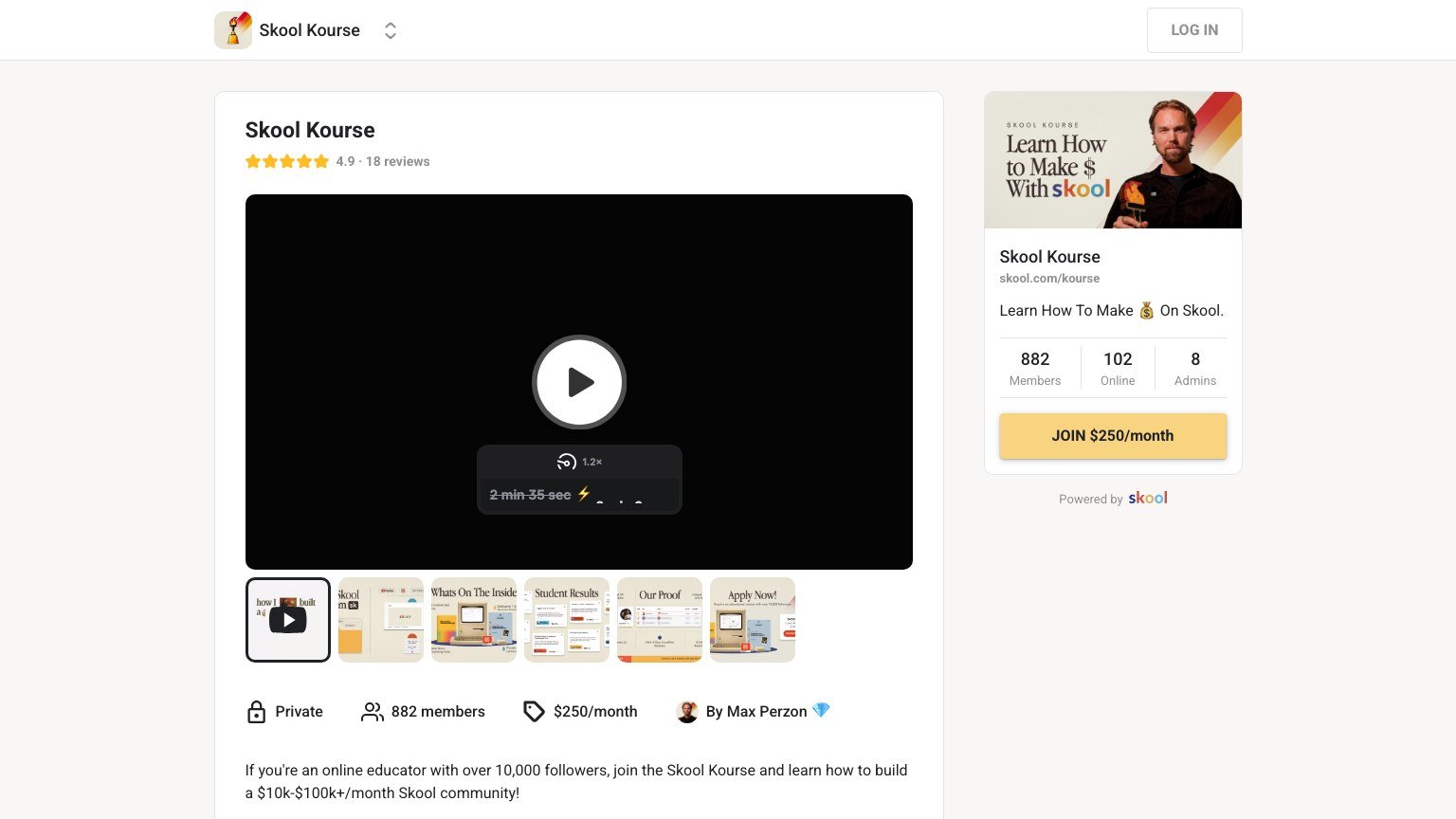
Skool Kourse lists at $250 a month, but the page advertises $1,500 and $2,500 tiers above it. 882 members, 21,035 posts, only 18 reviews.
 By Ray Okafor ·
21,035 posts across 882 members, about 24 posts each, so the feed is not a ghost town
Only 18 reviews from 882 members, a 2% response rate
Source: Skool public About page, captured September 9, 2026
Eight hundred and eighty-two members. Twenty-one thousand and thirty-five posts. That is 24 posts per member, and the room is clearly busy.
Eighteen people have reviewed it.
That gap is the story of this listing, and it took me a while to work out which side of it matters more.
How this was put together: I have not joined Skool Kourse and no money has changed hands. Everything below comes from the community’s public About page, the reviews Skool restricts to paying members, and Max Perzon’s public profile, all captured on 9 September 2026. Where a number comes from the sales copy rather than Skool’s own data, I say so.
Quick Decision
Join if you already publish to an audience, you want to turn that audience into a paid community, and $250 a month is a line item you will not notice. The library is real, the feed moves, and the entry price is low enough that a wasted month costs you less than a dinner out.
Skip it if you have no audience yet. The page asks for 10,000-plus followers and it means it. Skip it too if you expect the $250 tier to include coaching, because the coaching sits in the $1,500 and $2,500 products the page advertises separately.
You can read the current terms yourself on the Skool Kourse listing, which publishes the base price without an application.
The $250 Is A Doorway, Not The Product
The Skool price record and the join button agree: $250 per month, US dollars, billed monthly. That is $3,000 a year and it is the honest, checkable number.
Then the description sells two things that cost far more.
The page lists a Skool Masterclass at $1,500 a month, described as everything in the standard tier plus masterclass training, a one-to-one success coach and daily Q&A calls. Above that sits a Skool Mastermind at $2,500 a month, described as everything in premium plus mastermind training, one-to-one coaching with Max, and mastermind calls and events.
Neither of those runs through Skool. The page points you to kourse.com/apply to reach them.
What this means for your budget
Work the annual figures out before you decide. The $250 tier is $3,000 a year. The Masterclass is $18,000 a year. The Mastermind is $30,000 a year.
I do not read the ladder as a trick. The base tier gets you the material and the room, and plenty of people will want nothing else. But you should walk in knowing that the version of this product with a coach attached costs six to ten times what you are about to pay, and that the sales conversation exists.
The terms nobody published
No refund policy appears on the listing. No trial, no minimum term, no cancellation statement.
At $250 a month that is a smaller problem than it would be at $2,500, because you can leave after one billing cycle and lose very little. Ask anyway if you plan to climb the ladder later, since the higher tiers are where an unclear refund policy actually hurts.
What 882 People Are Actually Doing In There
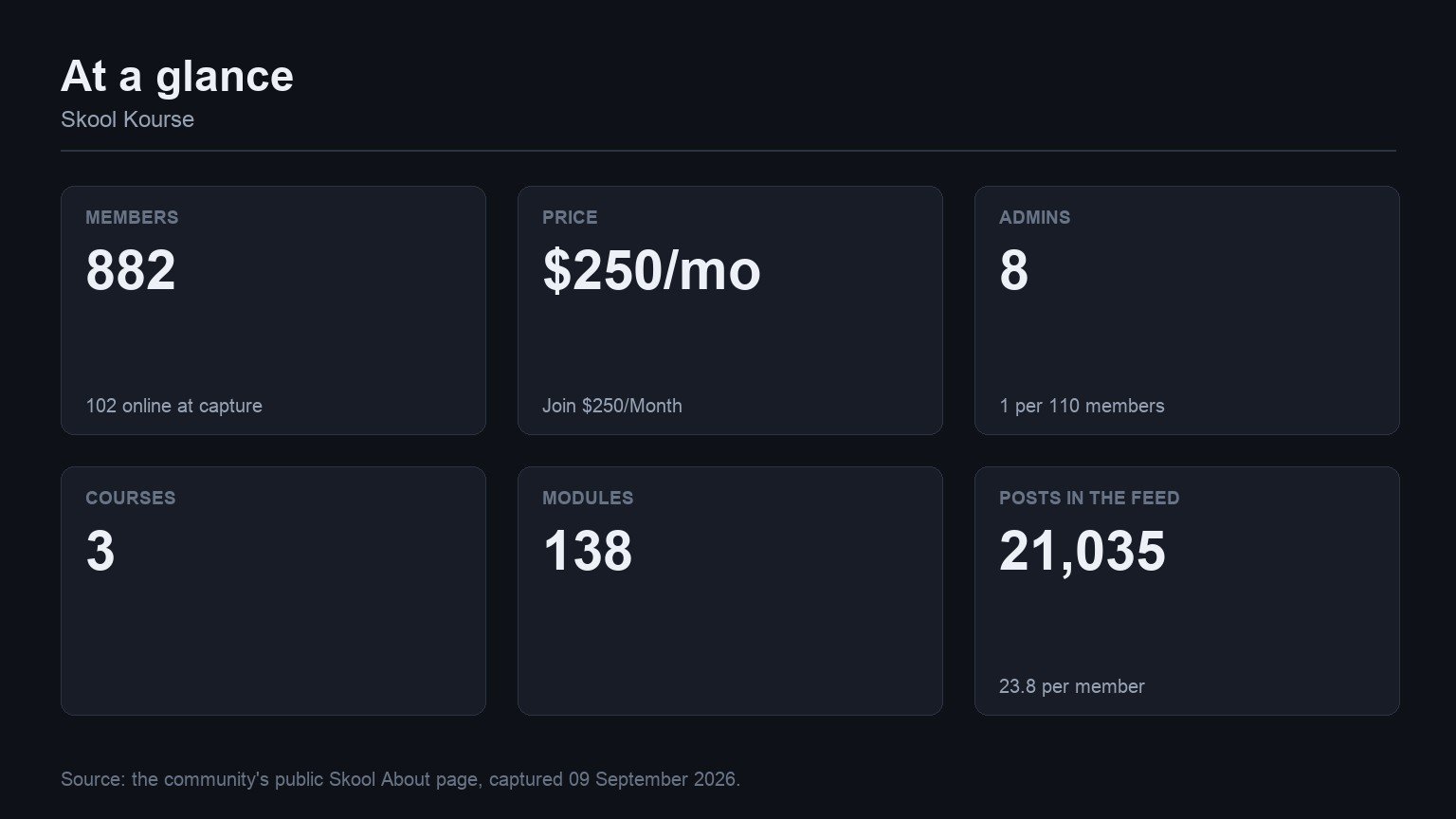
| What | Count |
|---|---|
| Members | 882 |
| Members online at capture | 102 |
| Admins | 8 |
| Courses | 3 |
| Modules | 138 |
| Posts in the feed | 21,035 |
The activity numbers are strong. One hundred and two of 882 members were online at the moment of capture, which is 11.5% of the community present at the same time. Twenty-one thousand posts across 882 people is 23.8 each. Eight admins covers roughly one per 110 members.
Three courses holding 138 modules is a decent library for $3,000 a year. It is not enormous, but it is a body of material rather than a slide deck bolted onto a call schedule.
The one number Skool cannot see
Post volume tells you people are typing. It does not tell you they are earning.
That distinction matters more here than in most communities, because the product is about building a paid community yourself. A room of 882 people who all want the same outcome will generate posts whether or not the method works. Twenty-four posts per member is evidence of engagement and nothing more, and I would not let it stand in for proof.
What the seller claims, separately from all that
The page states that Max Perzon built a $230,758 a month Skool community in 30 days, that he won a $100,000 check from the Skool team, and that he has generated more than $5 million from Skool across two years.
None of that is verified by Skool or by anyone else. There is no audit, no linked source and no date range. It may all be true. It is still a seller describing his own results, and it should carry exactly the weight you give any unaudited income claim.
Max Perzon’s Public Trail
Max Perzon has been on Skool since August 2020, which is early, and his profile bio is a single line: he helps people make money on Skool. His listed location is Miami.
Two public links sit on the profile: an Instagram account and a YouTube channel. No website, no company page, no LinkedIn.
That is a thinner trail than I expected from someone selling a $30,000 a year mastermind, but it is meaningfully better than nothing. A YouTube channel is inspectable. Watch an hour of it before you pay anything, because free video is the cheapest possible sample of how somebody teaches.
His Skool account carries a diamond MRR badge, which is Skool’s own marker for the top revenue band on the platform. That one is platform-issued rather than self-reported, and it is the strongest verification in this listing.
The eight admins are invisible
Eight admin accounts run this community. Not one of them appears on the About page with a name, a bio or a link.
The $1,500 tier promises a one-to-one success coach. If you go that route, find out which of those eight it will be and what their own results are, because right now the page tells you nothing about the people you would actually spend your time with.
Four Reviews You Can Read, 864 Members You Cannot Hear
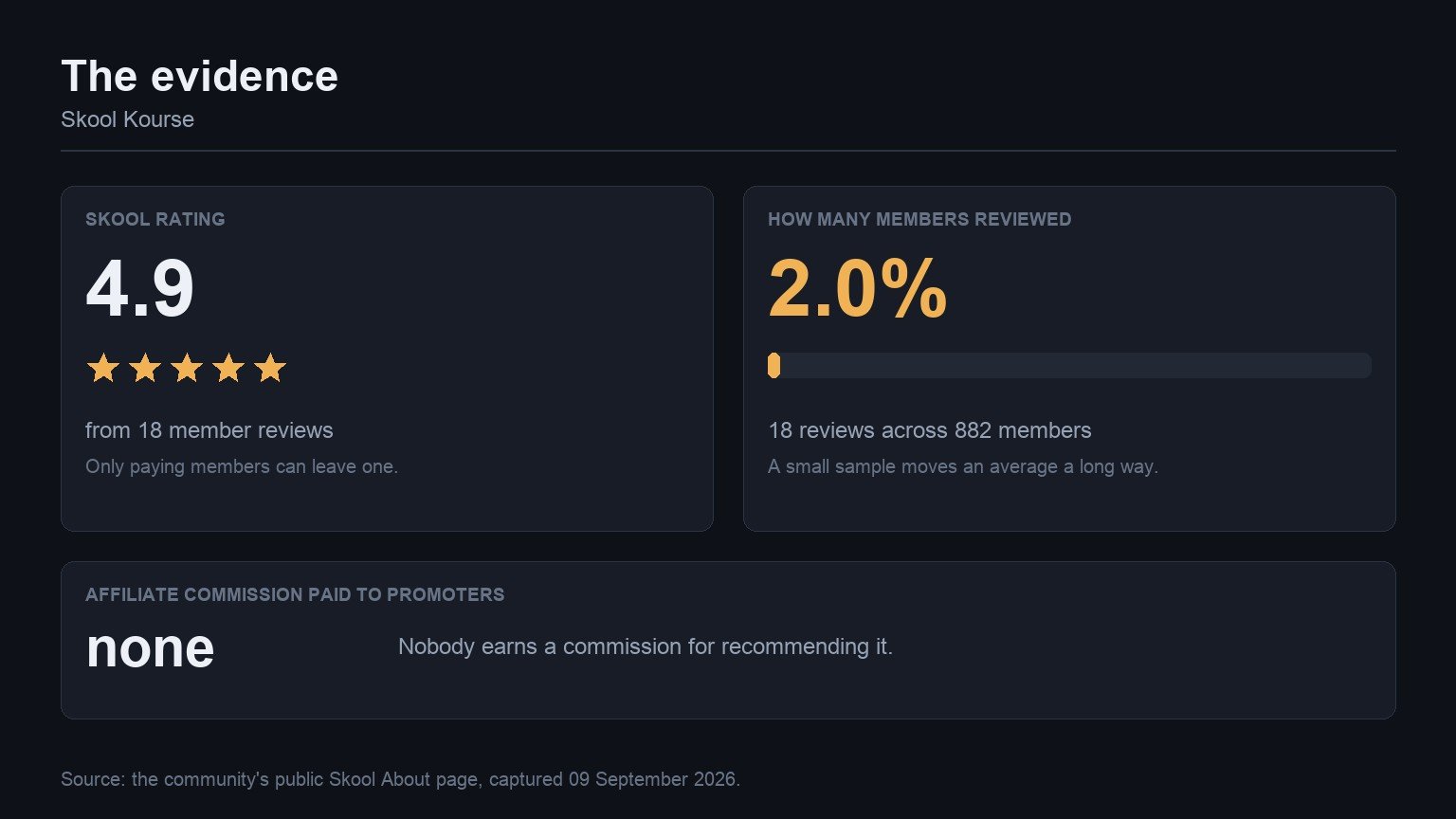
Eighteen reviews from 882 members at a 4.9 average. Four review bodies were visible at capture.
Start with the response rate: 2%. Most paid Skool communities land under 5%, so this is not unusual, but it is a small evidence base for a room this size. Skool blocks non-paying accounts from reviewing, so the 4.9 is real in the sense that no bot produced it. It is simply the opinion of eighteen people.
One member writes that they went from under $10,000 a month in their business to over $50,000 a month through working with Max, calls the courses the best they have seen in more than ten years in the space, and describes the team as friends who care about what they are building (a member review on Skool, August 2026). A second says that anyone in the online community business needs a mentor, and that Max and the team are the best option for it (a member review on Skool, August 2026). A third is one line of praise about the team with no detail attached (a member review on Skool, August 2026).
One further review is written in Spanish and calls the content gold, which tells you the room reaches past English speakers.
What none of them mention
Not one visible review names a price tier. Nobody says whether they bought at $250, $1,500 or $2,500, which makes it impossible to tell which product the praise is aimed at.
Nobody describes a month that went nowhere. No refund, no cancellation, no plateau appears anywhere in the visible feedback.
That pattern is normal on Skool, where unhappy members cancel silently instead of writing. Read the reviews as evidence of what happens to people who stay, not as a measure of your own odds. And note the $50,000 a month figure for what it is: one member’s account of their own business, unverified by anyone.
Don’t Join If
- You have no audience yet. The page asks for 10,000-plus followers and the material assumes one.
- You are buying the $250 tier expecting coaching. Coaching sits in the $1,500 and $2,500 products.
- You need a large review sample before you commit. Eighteen opinions from 882 members is thin.
- You want published refund terms. None appear anywhere on the listing.
My Verdict
I score Skool Kourse 3.9 out of 5.
The strengths are easy to state. At $250 a month this is the cheapest way into a room of 882 people who are all trying to build the same thing, with 138 modules behind it and a feed carrying 21,035 posts. One hundred and two members were online at once. The affiliate rate is 0%, so nobody online earns a commission for pointing you here, which removes a layer of noise you normally have to filter out. The founder’s diamond MRR badge is issued by Skool rather than claimed by him.
The deductions are three. Eighteen reviews from 882 members is a 2% response rate and the weakest evidence in the listing. The $250 price is the bottom rung of a ladder that runs to $30,000 a year, and the page sells the upper rungs inside the same description you read before buying. And every financial claim on the page, including the $230,758 a month and the $5 million, comes from the seller with nothing attached to check it against.
Buy one month, work through the 138 modules, and decide from inside whether the upsell conversation is one you want. For a cheaper community aimed at the same search-and-audience problem, our AI SEO Rainmakers review covers what that path costs, and the Affiliate Marketing Launchpad review looks at monetising an audience without building a community at all.
Full pros & cons
- 21,035 posts across 882 members, about 24 posts each, so the feed is not a ghost town
- $250 a month is the cheapest entry point among the Skool-about-Skool communities at this rank
- 138 modules across 3 courses, a real library rather than a call schedule
- 8 admins for 882 members, roughly one per 110 people
- Affiliate rate is 0%, so nobody earns a commission for recommending it
- Only 18 reviews from 882 members, a 2% response rate
- The $250 tier is the bottom rung; the page sells $1,500 and $2,500 tiers above it
- The $230,758/mo and $5 million figures are the seller's own claims with no source
- The page asks for 10,000-plus followers, which most buyers will not have
- No refund window, trial or cancellation term appears on the listing
Try it yourself
Ready to put it to the test?
We may earn a commission at no extra cost to you. Affiliate disclosure.
Frequently Asked Questions
How much does Skool Kourse cost?
How many members does Skool Kourse have?
Why does Skool Kourse have only 18 reviews?
Do I need 10,000 followers to join?
Is the $230,758 a month figure verified?
Reader feedback
Was this review helpful?
Your feedback helps us write better reviews.
Thanks for your feedback.
Ray Okafor is the analyst behind AI Insider Edge, covering AI tools, online courses, and paid communities in the make-money-online space. Hands-on reviews say so and state what was actually paid for access. Research reviews say that too, and are built from the seller’s own public pages, verified member reviews, and the founder’s public record. Either way the aim is a buyer’s-eye read, not a press release. Reviews are independent and may contain affiliate links, at no extra cost to you.
More reviews: Online business and community building

Is Synthesizer Scaling Worth $1,950/mo?
Synthesizer Scaling costs $1,950 a month for 146 modules and 339 members. The feed runs at 17 posts per member. Here is what that trade buys.

Monetise Bonus (2026): What's Real and What's Recycled
What bonuses actually come with Monetise at the Side Hustle Summit, how to judge affiliate bonus stacks, and the four things we hand out ourselves.

Monetise Discount & Coupon Codes: The Honest Answer (2026)
There is no published Monetise discount. What the $1,995 price has actually been, why coupon sites show fake codes, and the one legitimate way to pay less.

Monetise vs Skool (2026): One's a Course, One's a Platform
Monetise is Iman Gadzhi's $1,995 program for building digital products. Skool is a $99/month community platform. Which you need depends on what you're missing.

Monetise Refund Policy: The 7-Day Window, Explained (2026)
Monetise 2.0 carries a 7-day no-questions refund window per partner documentation. What that covers, what it doesn't, and what to verify at checkout.

Pay It Forward Learning Center Review: 2,665 Members, $25/mo
Pay It Forward Learning Center gives 1,627 modules for $25/mo. But the owner record carries no human name, no location and no links. The numbers.
The Edge Briefing
One honest review, every Sunday.
One email a week: which AI tools, courses & communities passed the rubric — and which to skip. Built for people funding their own stack.