Is Synthesizer Scaling Worth $1,950/mo?
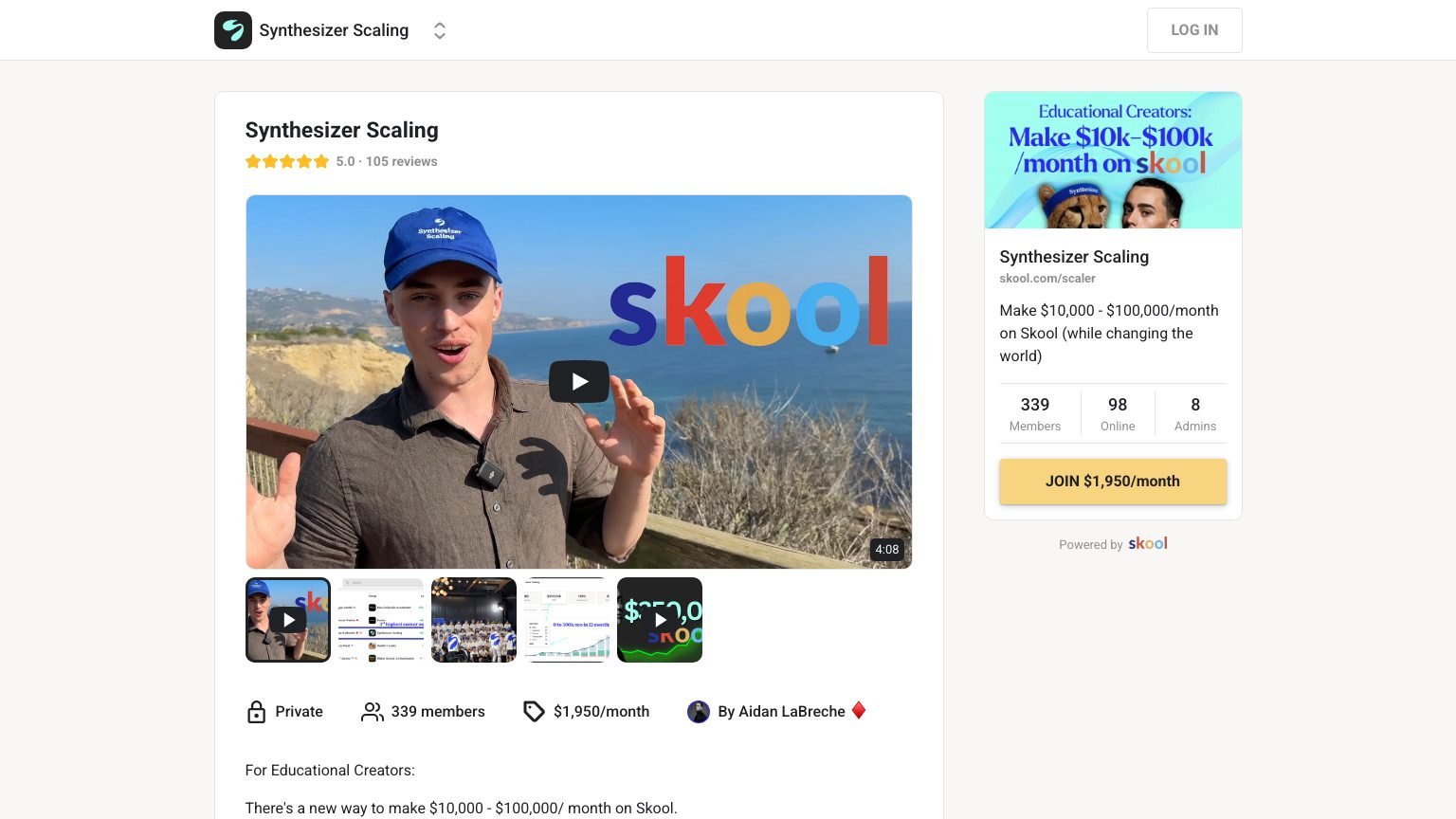
Synthesizer Scaling costs $1,950 a month for 146 modules and 339 members. The feed runs at 17 posts per member. Here is what that trade buys.
 By Ray Okafor ·
105 reviews from 339 members, a 31% response rate that almost no paid community reaches
Only 146 modules across 7 courses, small for $23,400 a year
Source: Skool public About page, captured September 9, 2026
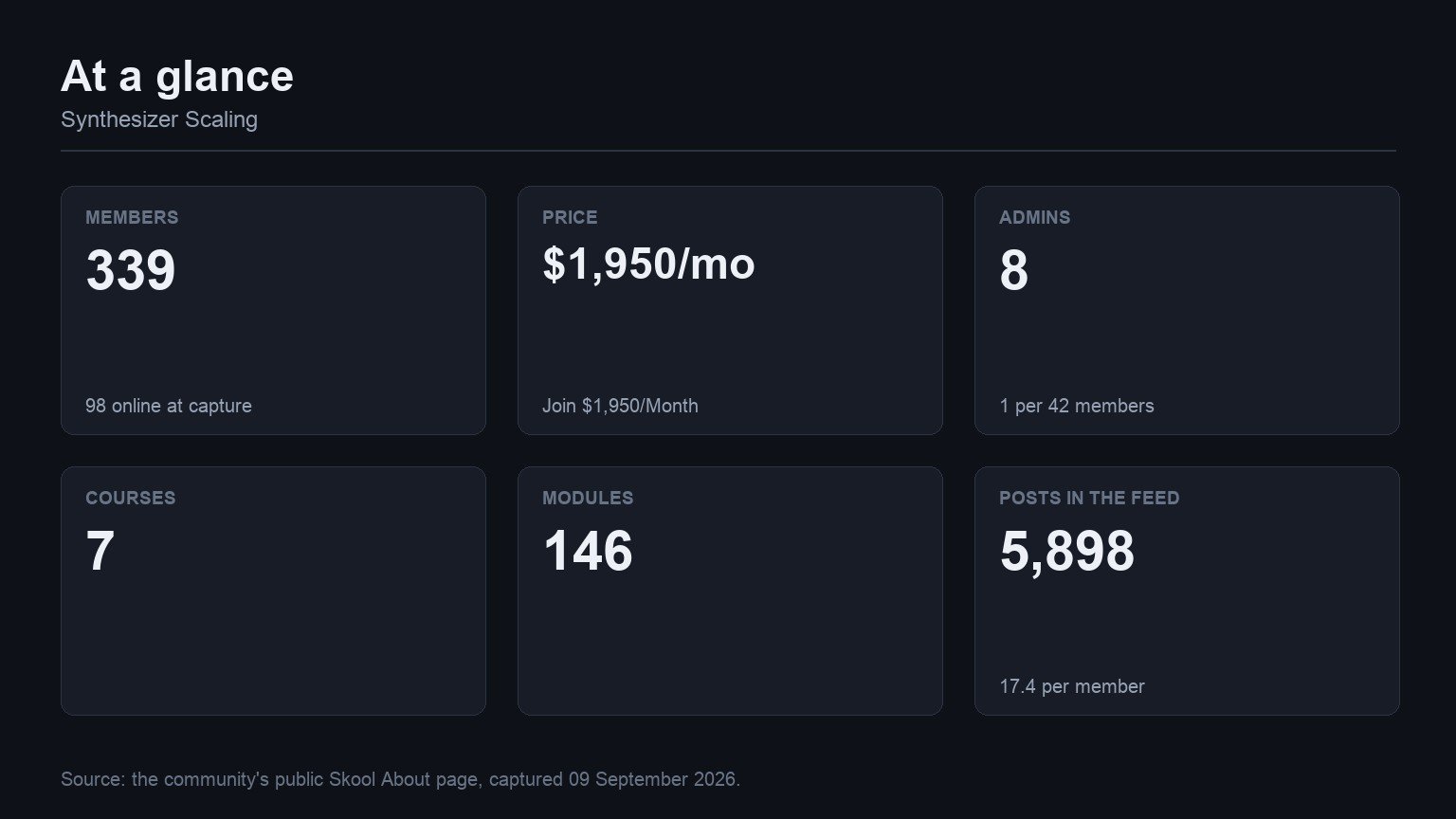
Three hundred and thirty-nine members. Five thousand, eight hundred and ninety-eight posts. That is 17 posts per member, and it is the most active room per head I have looked at on Skool.
It also costs $1,950 a month, and the entire course library is 146 modules.
Both of those facts matter, and they point in opposite directions.
A note on how this was put together. I have not joined Synthesizer Scaling and no money has changed hands. This review is assembled from the public About page on Skool, the member reviews that only paying members can leave, and Aidan LaBreche’s public profile, all captured on 9 September 2026. Anything taken from the sales copy is labelled as the seller’s claim rather than a verified fact.
Quick Decision
Apply if you already run a Skool community with paying members, you have hit a ceiling you cannot diagnose yourself, and $1,950 a month is a business expense rather than a personal stretch. The evidence that members get help here is stronger than almost anything else at this price.
Do not apply if you have no community yet, if you need a library to work through at your own pace, or if you want to look inside before committing. There is no browse-first option and the material on its own does not justify the cost.
The listing is public if you want the current terms in front of you: the Synthesizer Scaling page on Skool publishes the price without requiring the call first.
Where The $1,950 Goes
The price is the same in both places the listing records it. The join button reads $1,950 per month and the underlying price record holds $1,950, monthly, in US dollars. No discrepancy, no hidden annual lock. That sounds like a low bar until you see how many communities at this tier fail it.
Over a year that is $23,400.
The door is an application, not a checkout
The page routes you to SynthesizerScaling.com and a Calendly application rather than a join button. You talk to someone before you are allowed to pay.
Application gating cuts both ways. It keeps out people who would waste the room’s time, which protects the thing you are paying for. It also means you cannot see the material, the feed or the calls before you decide, so your entire pre-purchase evidence base is the About page, the reviews and whatever the call tells you.
What is missing from the terms
No refund policy appears anywhere on the listing. No trial. No minimum term, and no statement about how cancellation works.
At $1,950 a month those are not small omissions. Get them answered in writing on the application call, before the card goes in. Ask specifically what happens if you cancel in week two, because the answer is not published and nobody is obliged to volunteer it.
Who the offer is aimed at
The page names the categories it works for: hobbies, music, money, spirituality, tech, health, sports, self-improvement and relationships. The common thread is that you already teach something and you already have an audience.
Read that as the qualification. This is a scaling programme, not a starting programme, and the seller does not pretend otherwise.
Seven Courses, 5,898 Posts, 339 People
| What | Count |
|---|---|
| Members | 339 |
| Members online at capture | 98 |
| Admins | 8 |
| Courses | 7 |
| Modules | 146 |
| Posts in the feed | 5,898 |
Start with the good number. Ninety-eight of 339 members were online at the moment of capture, which is 29 percent of the entire community present at once. Five thousand, eight hundred and ninety-eight posts across 339 members works out at 17.4 posts each. Eight admins covers roughly one per 42 members.
Those three figures together describe a small, expensive, heavily staffed room where people actually talk. That is what you are buying.
146 modules is the weak spot
Seven courses and 146 modules is a thin library for $23,400 a year.
Put it next to the rest of Skool’s top five and the gap is stark. Communities charging a tenth as much carry 700-plus modules. Even allowing that video count means little on its own, 146 modules is a few weeks of watching, not a curriculum you grow into.
I do not think that makes the price wrong. It makes the price contingent. If the coaching, the feedback on your funnel and the room full of people who already did it are worth $1,950 a month to you, the library is a bonus. If you were hoping to get value by consuming material, this is the wrong product and a cheaper one will serve you better.
The claims Skool does not verify
Skool’s data confirms member count, admin count, posts, courses, modules and reviews. Nothing else.
Everything financial on the page belongs to the seller. The page states that a cohort of 100 Skool owners averaged $70,021 in 90 days, that the team scaled from $0 to $300k MRR in 12 months with proof in an image, that this is the third highest earning group across more than 200,000 Skool communities, and that the founder is the only person publishing the results of every customer rather than the best ones.
That last claim is the interesting one, because it is a claim about transparency rather than about money. If it holds up, ask to see the full results set on the call. A programme that publishes every customer’s outcome should be able to hand it over in a minute. If it cannot, the claim is doing marketing work it has not earned.
One small mismatch worth noting: the page advertises 103 perfect 5.0 reviews while the listing recorded 105 on the capture date. That is almost certainly the page copy lagging behind, and it is the kind of gap that reassures rather than worries me.
Aidan LaBreche, And The Link That Goes Nowhere
Aidan LaBreche has run this community since December 2023 and describes himself as the host of Synthesizer, helping educators scale to $10,000 to $100,000 a month on Skool.
His public trail is thinner than the price suggests.
The profile lists two links. One is a YouTube channel. The other is described as his website and points back to his own Skool about page, which is the page you are already reading when you see the link. His location field is not a place at all; it reads as a Skool URL.
So the only independent material you can inspect before applying is a YouTube channel. There is no company site, no LinkedIn, no long public record outside the platform he sells on.
I want to be fair about what that does and does not mean. Plenty of people who make real money on Skool live entirely on Skool, and a founder does not owe you a LinkedIn. But at $23,400 a year, a circular website link is a transparency gap, and it is the single thing I would want closed before applying.
The coaches are not on the listing
Three member reviews name other people. One thanks Aidan LaBreche, Andrew Kirby, Matt Rice and Olga Medina for what they have built. Another says the “Scaling coaches are the best of all”.
Eight admin accounts exist, so a team clearly runs this. None of them appear on the About page with a bio or a link. If you are buying coaching, find out on the call which of those eight you will actually work with, and how often.
A 31 Percent Review Rate, And Its Blind Spot
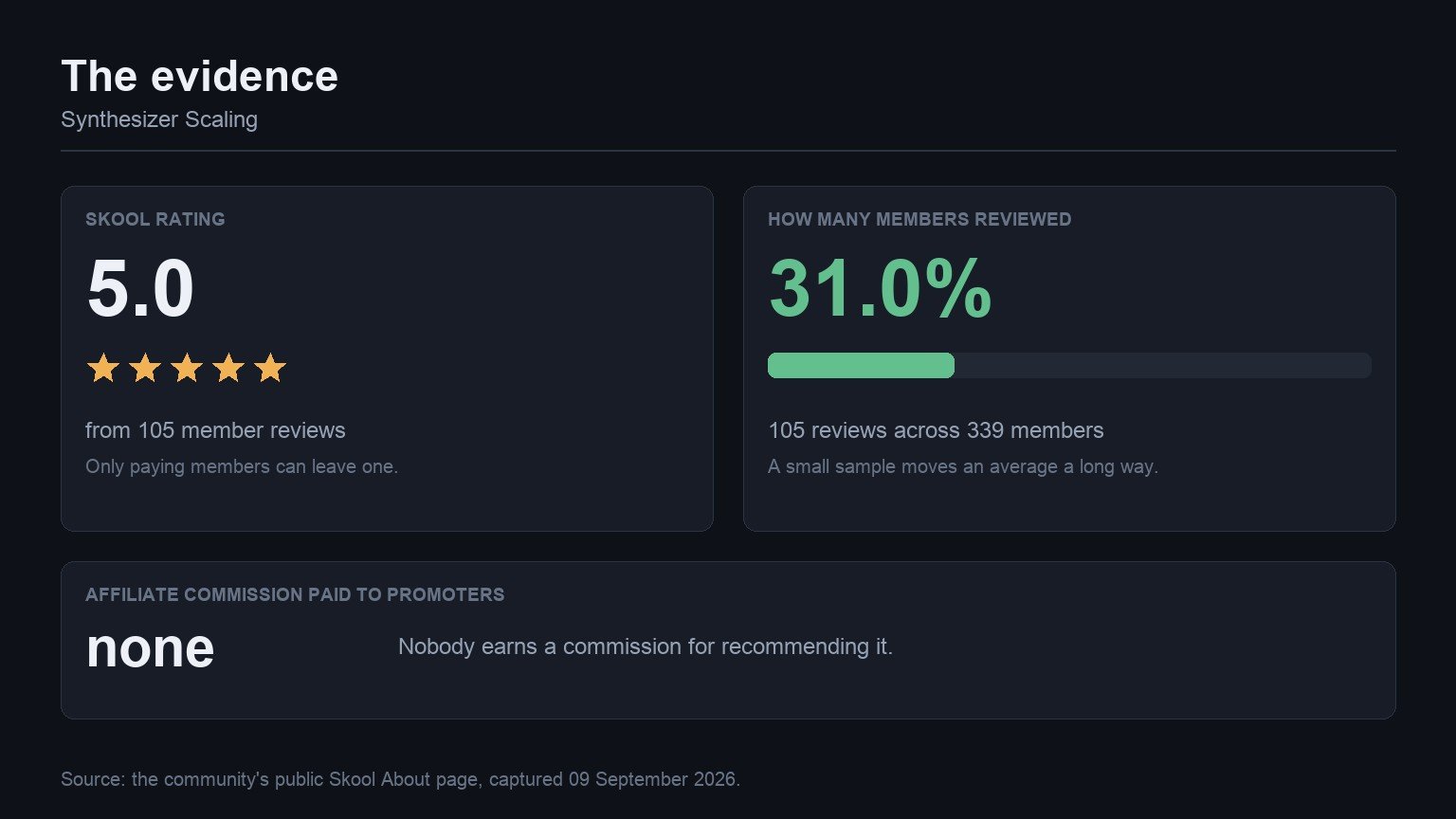
One hundred and five reviews from 339 members is a 31 percent response rate at a straight 5.0 average.
That number deserves attention on its own. Most paid Skool communities collect reviews from under five percent of members. Thirty-one percent is six times that. Skool restricts reviewing to paying members, so there is no route for a purchased review or a bot, which makes the volume real even if the average looks too clean.
A rate that high almost always means the community asks. That is not dishonest, but it does mean the star average is partly a measure of how well the room runs its review request, so the bodies matter more than the score.
Three of them, read closely.
One member says they tripled their investment within the first three weeks and calls it a no-brainer for anyone looking to scale (a member review on Skool, September 2026). Another describes a $185,000 launch for an artists’ coaching programme, achieved in one month after joining with a partner, after years of having the vision without the method (a member review on Skool, September 2026). A third says they joined with zero sales or marketing experience and found it useful to learn from other members while running their community alone (a member review on Skool, September 2026).
What the reviews never say
Nobody describes a month where nothing worked. Nobody names a refund, a cancellation or a plateau. Across every visible review there is no account of the programme failing to move someone, which is statistically improbable in a room of 339 people.
That is normal for Skool. Unhappy members cancel and leave rather than write, so the review panel of any community is a survivors’ record. Read it as evidence that the programme works for people who stay, not as evidence about your odds.
The $185,000 launch is also worth handling carefully. It is a member’s own account of their own business, unverified by anyone, and it is one launch by two people who already had an audience since 2014. It tells you the ceiling exists. It tells you nothing about the median.
Don’t Join If
- You do not have a community with paying members yet. This programme scales something that exists.
- You want to browse the material first. Entry is by application and there is no preview.
- You need refund protection. No refund, trial or cancellation term is published on the listing.
- You are buying for the library. One hundred and forty-six modules will not carry a $23,400 year on their own.
My Verdict
I score Synthesizer Scaling 4.2 out of 5.
The activity data is the strongest I have seen in this ranking. Ninety-eight of 339 members online at once, 17 posts per member across the feed, one admin per 42 people, and 105 reviews at a 31 percent response rate. Skool blocks non-paying accounts from reviewing, so that volume cannot be manufactured. A zero percent affiliate rate means nobody online earns money for sending you there, which is rare enough at this price to count as a mark in its favour.
The deductions are three. The library is thin at 146 modules for $23,400 a year, so the value rests entirely on the coaching. The founder’s public record outside Skool is one YouTube channel, with a website link that loops back to the page you started on. And no refund, trial or cancellation term is published anywhere, which at this price should not be something a buyer has to ask for.
Take the application call and treat it as your due diligence rather than a sales meeting. Ask for the full customer results set the page says exists, ask which of the eight admins coaches you, and ask what happens if you leave in month one. For a high-ticket comparison in ecommerce rather than communities, our Evolve review covers a $1,700 a month room with a far larger library and a much quieter feed, and the AI SEO Rainmakers review looks at a cheaper route into the same build-an-audience problem.
Full pros & cons
- 105 reviews from 339 members, a 31% response rate that almost no paid community reaches
- 5,898 posts across 339 members, about 17 posts each, so the room is genuinely working
- No affiliate programme at all, so nobody earns a commission for recommending it
- 8 admins on 339 members, roughly one per 42 people
- The price is published openly rather than hidden behind the application call
- Only 146 modules across 7 courses, small for $23,400 a year
- The founder's only website link points back to his own Skool page
- The $70,021 cohort average is the seller's own figure with no external source
- Entry is by application, so you cannot look inside before deciding
- No refund window, trial or cancellation terms appear anywhere on the listing
Try it yourself
Ready to put it to the test?
We may earn a commission at no extra cost to you. Affiliate disclosure.
Frequently Asked Questions
How much does Synthesizer Scaling cost?
How many modules does Synthesizer Scaling have?
Is the $70,021 average real?
Who is Aidan LaBreche?
Why does it have 105 reviews from only 339 members?
Does Synthesizer Scaling pay affiliates?
Reader feedback
Was this review helpful?
Your feedback helps us write better reviews.
Thanks for your feedback.
Ray Okafor is the analyst behind AI Insider Edge, covering AI tools, online courses, and paid communities in the make-money-online space. Hands-on reviews say so and state what was actually paid for access. Research reviews say that too, and are built from the seller’s own public pages, verified member reviews, and the founder’s public record. Either way the aim is a buyer’s-eye read, not a press release. Reviews are independent and may contain affiliate links, at no extra cost to you.
More reviews: Online business and community building

Lifestyle Founders Skool Review (2026)
Lifestyle Founders charges $1,500 a month for a room of 84 members and 3 admins. Eight reviews exist, and entry runs through a phone application.

Is Skool Kourse Worth $250/mo?
Skool Kourse lists at $250 a month, but the page advertises $1,500 and $2,500 tiers above it. 882 members, 21,035 posts, only 18 reviews.

Monetise Bonus (2026): What's Real and What's Recycled
What bonuses actually come with Monetise at the Side Hustle Summit, how to judge affiliate bonus stacks, and the four things we hand out ourselves.

Monetise Discount & Coupon Codes: The Honest Answer (2026)
There is no published Monetise discount. What the $1,995 price has actually been, why coupon sites show fake codes, and the one legitimate way to pay less.

Monetise vs Skool (2026): One's a Course, One's a Platform
Monetise is Iman Gadzhi's $1,995 program for building digital products. Skool is a $99/month community platform. Which you need depends on what you're missing.

Monetise Refund Policy: The 7-Day Window, Explained (2026)
Monetise 2.0 carries a 7-day no-questions refund window per partner documentation. What that covers, what it doesn't, and what to verify at checkout.
The Edge Briefing
One honest review, every Sunday.
One email a week: which AI tools, courses & communities passed the rubric — and which to skip. Built for people funding their own stack.