Is Creative Owners Club Worth $25/mo?
Creative Owners Club charges $25/month for a real estate mentorship with 10,024 members. The 4.8 rating and 6 admins deserve a closer look.
 By Ray Okafor ·
$25 a month is the lowest entry price of any community in this ranking
6 admins for 10,024 members is one staff member per 1,671 people
Source: Skool public About page, captured September 9, 2026
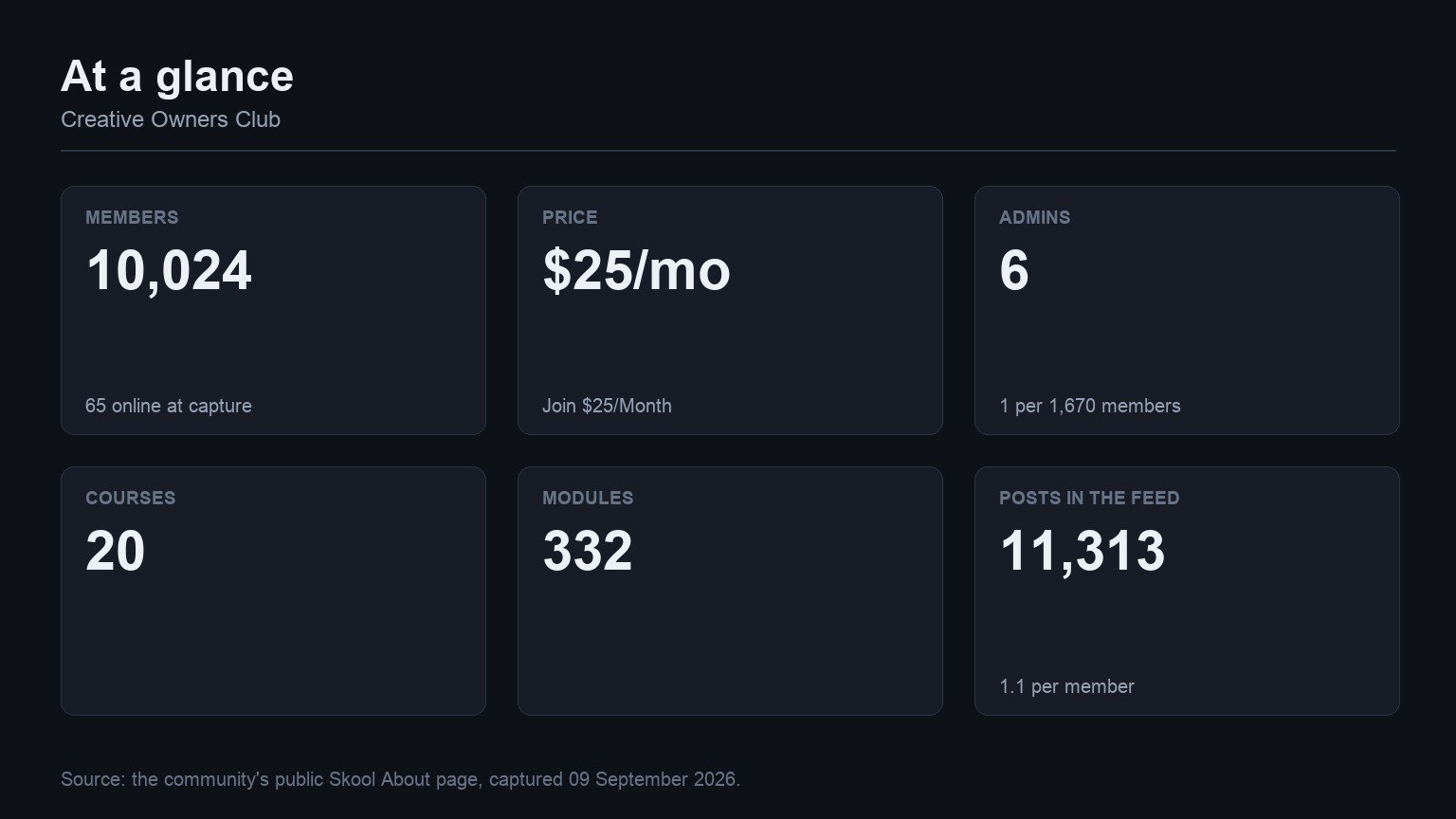
Ten thousand members. Twenty-five dollars a month. Six admins.
Those three numbers explain most of what Creative Owners Club is and most of what it is not going to do for you.
This is a research review. No membership was bought and nothing was paid. It is assembled from the community’s public Skool About page, the review scores Skool restricts to paying members, and the founder’s public profiles, all captured on 9 September 2026.
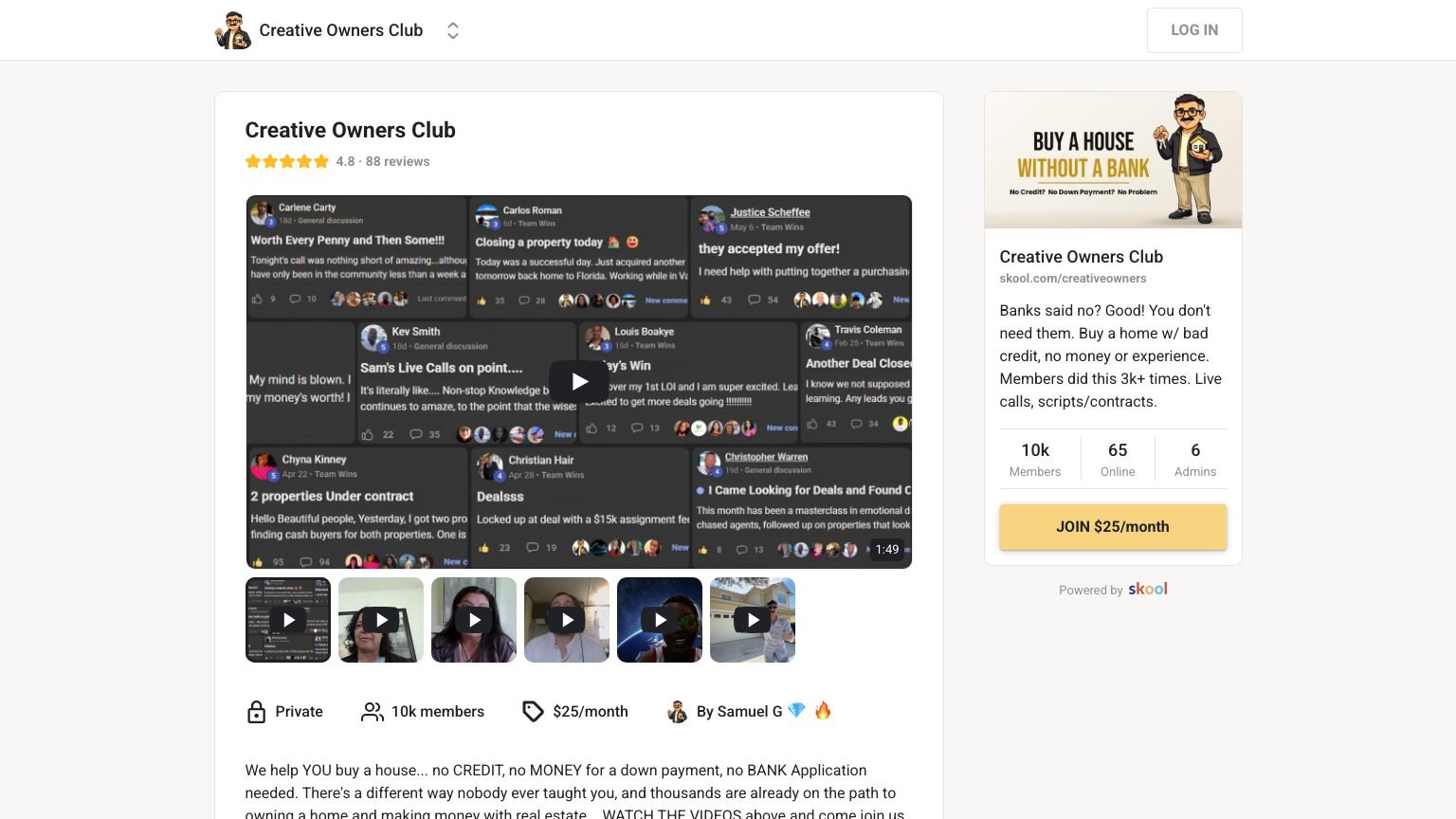
Quick Decision
Good fit if you want cheap, constant exposure to creative real estate financing, you already have some deal appetite, and you will post your own questions in a busy feed.
Bad fit if you want a mentor who knows your name. At 10,024 members with 6 admins, attention is something you take rather than something you receive.
What $25 A Month Actually Covers
The listing price was $25 per month at capture, and the join button carried the same figure. There is no annual plan, no premium tier and no application.
The description makes two commitments in capitals: no upcharges, and cancel any time. Both are worth something. Plenty of communities at this price run a $997 backend and treat the monthly fee as a lead magnet.
What the page does not do is publish a refund policy. Cancel-any-time and money-back are different promises. Cancelling stops the next $25. It does not return the last one. Before you pay, assume the first month is spent.
At $300 a year, that is a low bar to clear. The seller frames the product as a mentorship with weekly meetings rather than a recorded course, and says the team holds your hand through the process. Read that against the staffing numbers below before you decide how literally to take it.
The Numbers Behind 10,024 Members
| What | Count |
|---|---|
| Members | 10,024 |
| Courses | 20 |
| Modules | 332 |
| Posts in the feed | 11,313 |
| Admins | 6 |
| Members online at capture | 65 |
Start with the ratio nobody advertises. Six admins across 10,024 members is one staff member per 1,671 people. In this ranking, that is the thinnest coverage encountered so far.
The feed partly compensates. Eleven thousand posts across a decently sized membership means questions get answered by other members, and creative finance is a subject where a peer who closed a similar deal last month is often more useful than a coach.
Content volume sits in the middle. Twenty courses and 332 modules is enough to learn a strategy properly and not enough to get lost in. The description mentions scripts and contracts as part of the package, which is the most practically useful item on the list for anyone actually calling sellers.
One absence stands out. The About page carried no gallery images and no videos at capture, even though the copy tells you to watch the videos above. For a community selling a visual, proof-heavy pitch, there was nothing on the page to look at.
Samuel G, And The Half-Name Problem
Samuel G founded the community and has been on Skool since October 2024. He carries the diamond badge, Skool’s marker for $100,000 or more in monthly recurring revenue, which is a platform-verified figure rather than a claim.
His bio makes three assertions: millionaire at 24, more than 3,000 deals, and buying real estate with no money. None of those carry an external source. The 3,000-deal number appears again in the community description as something members have done collectively, which is a different claim from the same figure. Take it as marketing until somebody shows the paperwork.
Where he does better than most founders in this category is public presence. Facebook, Instagram and YouTube profiles are all published on his Skool profile under the handle ownwithsam. That means you can watch a few hours of his teaching before you spend a cent, which is the single most useful thing you can do with a $25 decision.
The transparency gap is the name. His surname appears as the letter G. No location is published either. For a founder selling property transactions, a subject where counterparties check who they are dealing with, publishing one initial is a strange choice. It does not make the teaching wrong. It does make him harder to check in public records than a full name would.
The 4.8 That Is Not A 5.0
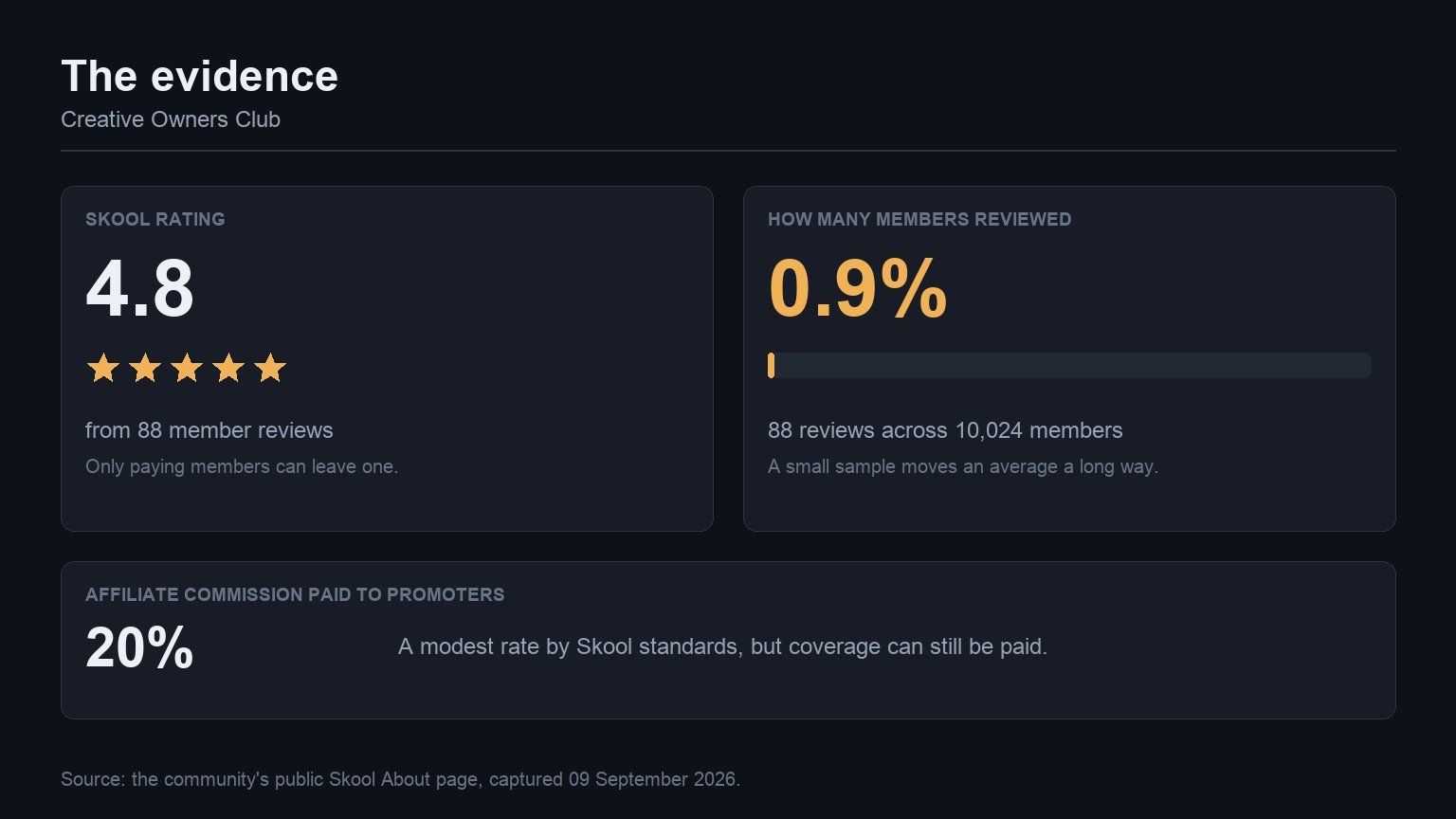
Eighty-eight reviews, 4.8 average, restricted to paying members.
That last part matters. Skool will not let a non-member leave a review, so the score cannot be seeded by an outreach campaign. What it can be shaped by is a 20 percent affiliate rate, which pays a referrer $5 a month for as long as you stay subscribed. That affects what you read on YouTube, not what you read on Skool.
The visible reviews from September 2026 are warm and general. One member praises the strategy as a genuine alternative to the standard route and notes it works if you apply yourself (a member review on Skool, September 2026). Another says they are learning a lot and never feel alone in it (a member review on Skool, September 2026). A third credits the presenters specifically rather than the founder (a member review on Skool, September 2026).
Now the part that matters more. A 4.8 average across 88 reviews means a meaningful number of people rated this below five stars, and Skool does not publish the text of every one. You can see the score but not the complaint.
Notice also what nobody in the visible reviews mentions: a closed deal, a keys-in-hand purchase, a dollar figure. They praise the teaching, the team and the atmosphere. For a community whose pitch is buying a home without a bank, the absence of a single specific outcome in the public reviews is the finding worth carrying into your decision.
Don’t Join If
- You need one-to-one attention. Six admins cannot cover 10,024 members, and the maths does not care how motivated you are.
- You expect a refund if it disappoints. No refund window is published anywhere on the listing.
- You are outside the United States. The strategy leans on American seller-financing and mortgage structures, and the page does not address other markets.
- You want verified outcome data before you pay. The 3,000-deal claim is the seller’s own count.
My Verdict
Creative Owners Club scores 3.8 out of 5. At $25 a month with 332 modules, 11,313 posts and a founder whose teaching you can sample free on YouTube first, the downside risk is genuinely small.
The deductions are specific. One point of the shortfall is the support ratio: 6 admins across 10,024 members is the thinnest staffing in this ranking, and a mentorship pitch sits awkwardly on top of it. The rest comes from the transparency gaps, a surname reduced to an initial, a headline deal count with no source, and a 4.8 average whose critical reviews are not readable.
If you want a smaller room where the founder can plausibly know who you are, our La Tribu Divisual review covers a $99-a-month community at a fraction of the size. For a cheaper money-making route that does not involve property at all, our Affiliate Marketing Launchpad review is the closer comparison.
Ready to look for yourself? The listing is on Skool here, and the free public content is the right place to start before you pay the first $25.
Full pros & cons
- $25 a month is the lowest entry price of any community in this ranking
- 10,024 members and 11,313 posts make the feed genuinely busy
- 332 modules across 20 courses for the price of two coffees
- The founder publishes three public profiles, so his output can be checked
- The page commits to cancel any time with no upsell tiers
- 6 admins for 10,024 members is one staff member per 1,671 people
- The 4.8 average means sub-five-star reviews exist, and their text is not visible
- The owner's surname is published as a single letter
- The 3,000-deal figure is the seller's own count with no external source
- No refund policy is published, only a cancel-any-time promise
Try it yourself
Ready to put it to the test?
We may earn a commission at no extra cost to you. Affiliate disclosure.
Frequently Asked Questions
How much does Creative Owners Club cost?
How big is Creative Owners Club?
Is the 4.8 rating a good sign?
Who is Samuel G?
Can you really buy a house with no money and bad credit?
How much material is inside?
What is the affiliate rate on this community?
Is $25 a month enough to get results?
Reader feedback
Was this review helpful?
Your feedback helps us write better reviews.
Thanks for your feedback.
Ray Okafor is the analyst behind AI Insider Edge, covering AI tools, online courses, and paid communities in the make-money-online space. Hands-on reviews say so and state what was actually paid for access. Research reviews say that too, and are built from the seller’s own public pages, verified member reviews, and the founder’s public record. Either way the aim is a buyer’s-eye read, not a press release. Reviews are independent and may contain affiliate links, at no extra cost to you.
More reviews: Real estate

Is Group Home Cash Flow Club Worth $67/mo?
Group Home Cash Flow Club charges $67/mo for 143 modules. The founder's own bio calls her 8 group homes non licensed. What that means for you.

Is Wholesailors Worth $25/mo?
Wholesailors charges $25/mo for 758 modules and a 14,719-post feed. But only 36 of 3,795 members have reviewed it. The numbers, read honestly.

RAMP REI Skills Academy Skool Review (2026)
RAMP REI lists $9/mo, but says plans are priced for teams and solo pricing is by email. 601 modules, 564 members, 1 review. What to check before joining.

Is Reverse Selling Inner Circle Worth $1,600/mo?
Reverse Selling Inner Circle costs $1,600 a month, or $19,200 a year. It holds 1,108 modules, 13,148 posts and just 8 member reviews.

Programa Investir Imobiliário Skool Review (2026)
A Portuguese property mentorship at $3,000 a year, 1,235 members and 12 admins. The 5.0 rating rests on 33 reviews, none in English.
The Edge Briefing
One honest review, every Sunday.
One email a week: which AI tools, courses & communities passed the rubric — and which to skip. Built for people funding their own stack.