Is Wholesailors Worth $25/mo?
Wholesailors charges $25/mo for 758 modules and a 14,719-post feed. But only 36 of 3,795 members have reviewed it. The numbers, read honestly.
 By Ray Okafor ·
758 modules across 20 courses for $25 a month, about $300 for a full year of access
Only 36 of 3,795 members have written a review, a response rate under 1%
Source: Skool public About page, captured September 9, 2026
Three thousand, seven hundred and ninety-five members. Thirty-six reviews.
That gap is the first thing worth understanding about Wholesailors, and the sales page never mentions it.
A disclosure before the detail. I am not a member of this community and nothing has been paid to Maximilian Dier or his team. What follows was assembled from the community’s public Skool About page, the written reviews Skool restricts to paying members, and the founder’s own public channels, captured on 9 September 2026. Where a number comes from the seller’s marketing rather than Skool’s records, I label it that way.
One more thing to be clear about at the top. This community sells a business income outcome. Every earnings figure on the page is the seller’s unverified claim, and nothing here should be read as a suggestion that a member will make money.
Quick Decision
Join if you want a low-cost entry into wholesale real estate education, you can absorb $25 a month without noticing it, and you are content to learn from a large library and a busy feed. At this price the risk is $25 and the material on offer is substantial.
Hold off if you are treating this as a route to a specific income by a specific date. The page promises a first $10,000 deal in 90 days, and there is no verified data behind that anywhere on the listing. Hold off too if you need a strong review record before you buy, because 36 reviews from 3,795 members is not one.
You can read the current terms on the Wholesailors listing before deciding.
The $25 Price, And The $50 Behind It
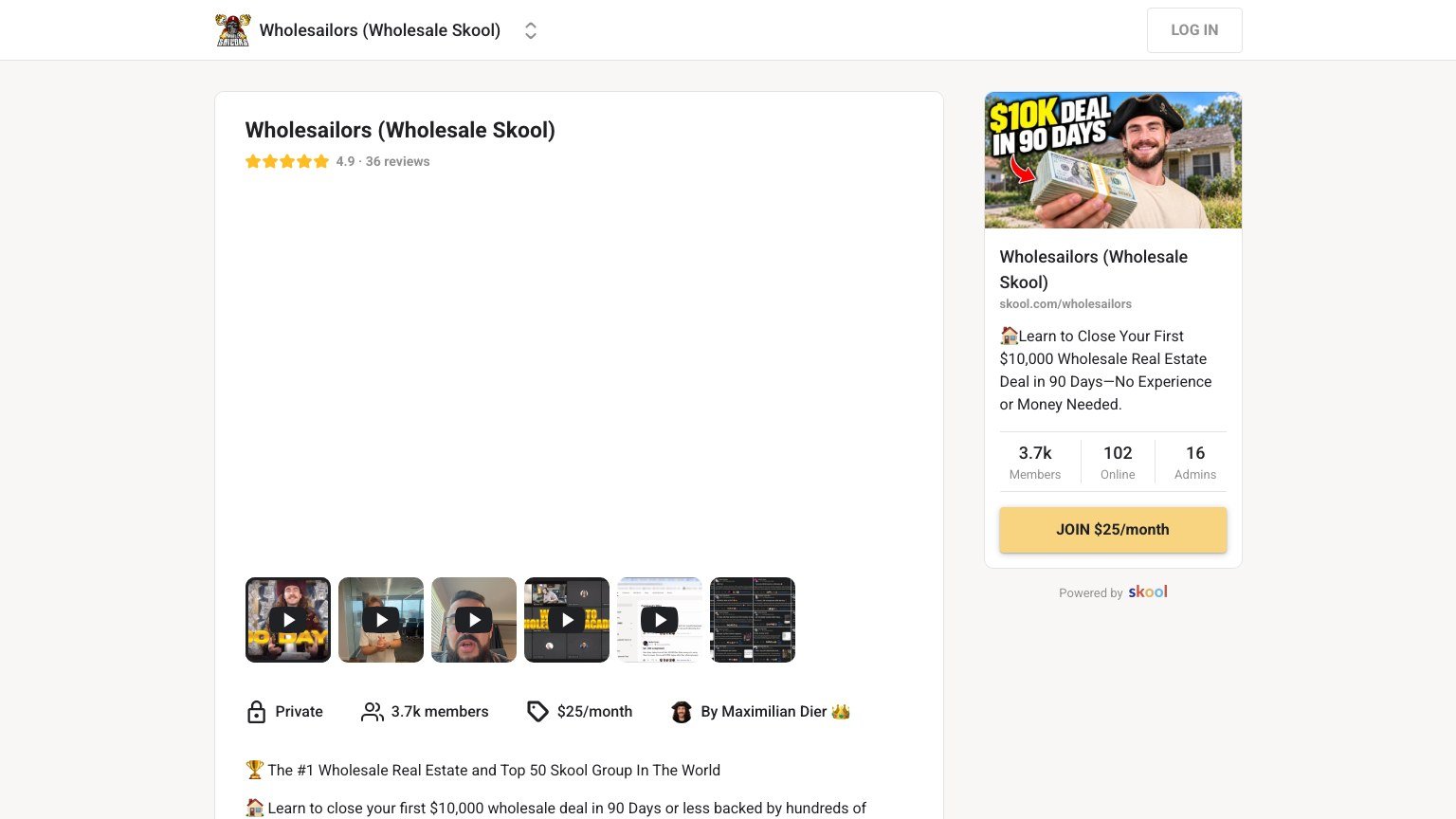
The join button read JOIN $25/month on the capture date, and Skool’s structured price record agrees at $25 monthly in US dollars. Two sources matching is better than many listings manage.
The copy frames that as a summer sale with limited spots left, and states that new members pay $50 a month once a member cap is reached.
Look at what is missing. No cap number. No date. The community already holds 3,795 members, so whatever the cap is, it has not bitten yet. Scarcity language without a published threshold is a persuasion device, not a term you can rely on.
The page does say cancel anytime, which is worth something. No refund policy appears anywhere on the listing, and no annual plan or trial is shown.
The $10,000 value stack
The listing itemises its own worth: contracts at $700, scripts at $300, skiptraced leads at $500, AI software at $2,500, seven weekly livestreams at $4,000, an accountability coach at $1,000 and a full-time underwriter at $1,000. Total value $10,000-plus, described as less than Netflix.
Those are prices the seller assigned to the seller’s own goods. Nobody outside set them and nothing on the page shows anyone paying them separately.
Ignore the arithmetic and judge the deliverables. Seven livestreams a week and access to an underwriter are real, checkable things. Ask about both before you assume they run as described.
Twenty Courses, 758 Modules, 14,719 Posts
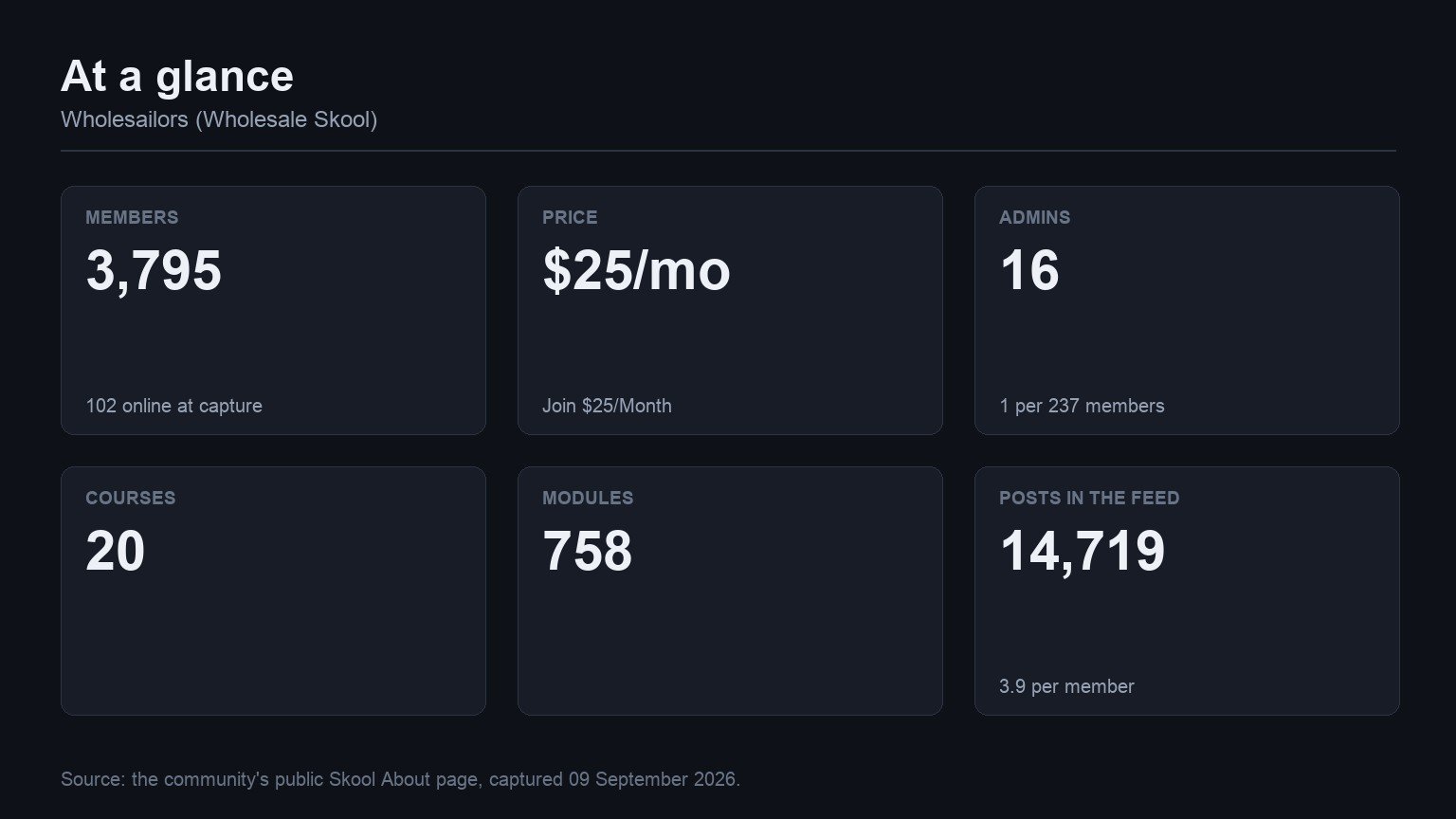
| What | Count |
|---|---|
| Members | 3,795 |
| Members online at capture | 102 |
| Admins | 16 |
| Courses | 20 |
| Modules | 758 |
| Posts in the feed | 14,719 |
Seven hundred and fifty-eight modules across 20 courses averages 38 modules per course. At $25 a month that is roughly three cents per module per month, which is as much material per dollar as anything in this ranking.
Sixteen admin accounts is the number that surprised me. That is one staff seat per 237 members, and communities charging seven times as much frequently run worse ratios. Whatever else is true, this is not a one-person operation.
The feed carries 14,719 posts, about 3.9 per member, with 102 people online at capture.
What the courses cover
The seller organises the teaching around the Arbitrage Flipping System, described as a 10-step process he built after closing hundreds of deals. It splits into three routes: house arbitrage, land arbitrage and creative arbitrage.
Both the deal count and the seven-figure business behind it are the founder’s own claims, with no source or date attached. Treat them as background, not evidence.
Maximilian Dier, The Wholesale Pirate
Maximilian Dier has run this community since May 2024, roughly 15 months at capture. He lists Dallas, Texas as his location, which more Skool founders should do and few bother to.
Three public links sit on his profile: Instagram, YouTube and his own website. That is enough to research him properly before spending anything, and watching his free YouTube material is the cheapest test of whether his teaching suits you.
His Skool bio is four words of substance and a joke about liking pirates. His account carries a crown badge, which marks a high-earning owner on the platform and says nothing about member outcomes.
The nickname running through the branding is the Wholesale Pirate. It is memorable, and it also sets the tone for a room where at least one reviewer answers in pirate noises.
Thirty-Six Reviews From 3,795 Members
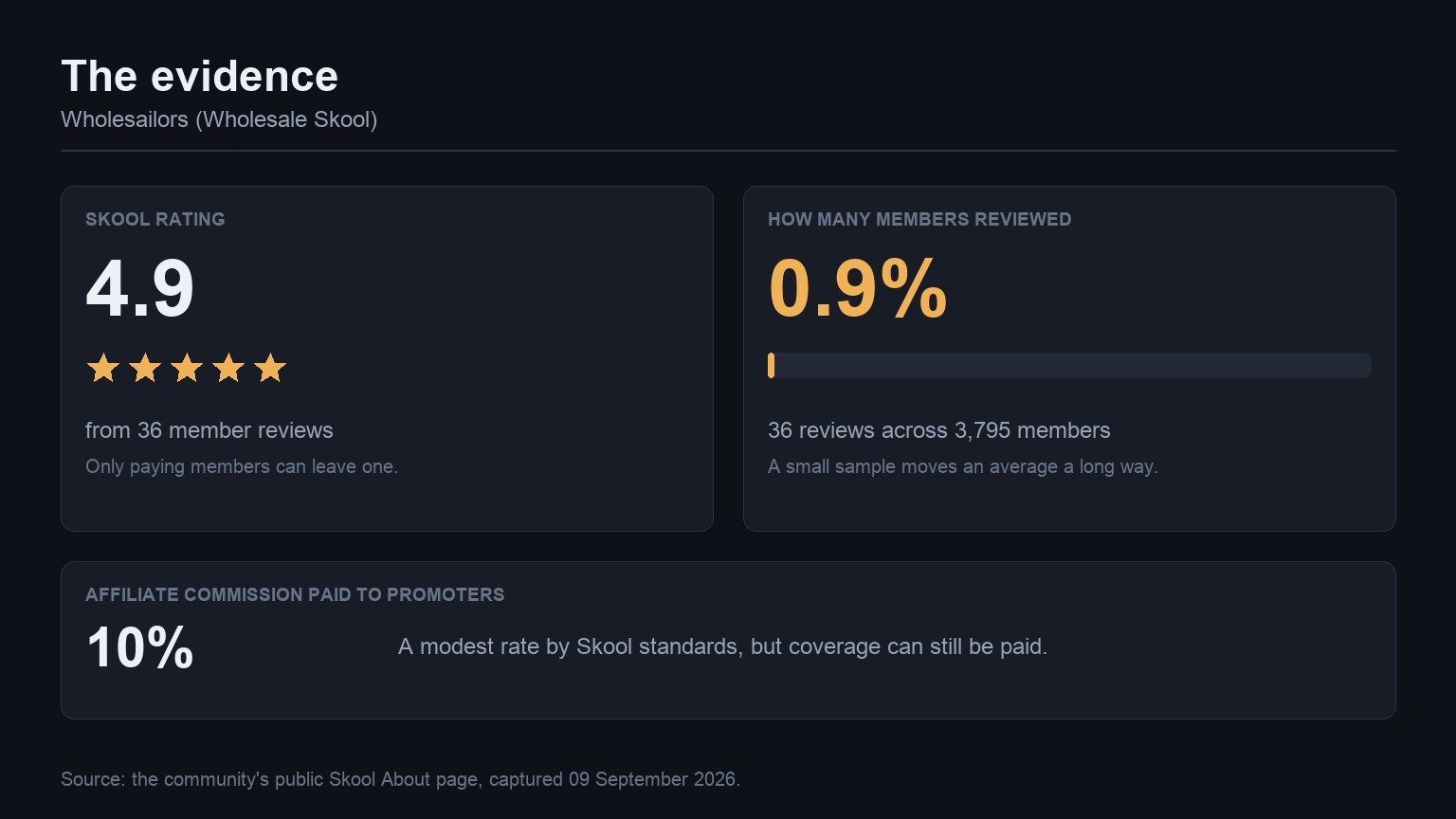
The average is 4.9 across 36 reviews. Out of 3,795 members, that is a response rate below 1%.
Two things follow. The sample is too small to carry much weight for a community this size, and a 4.9 rather than a 5.0 means at least one member scored it below five stars. That review is not among the four the listing shows.
Skool only accepts reviews from paying members, so nothing here can be bought. The blind spot is the usual one: people who quit rarely write on the way out.
Three of the visible four are worth reading. One calls it the best wholesaling community on the planet (a member review on Skool, September 2026). Another praises the team and administrators, says the value exceeds the price, and states that people close deals weekly (a member review on Skool, September 2026). A third is more honest than most: the member says family matters kept them away for a month, they have not got deep into the material yet, and what they did read seemed legitimate (a member review on Skool, September 2026).
What the reviews do not contain
Not one visible review names a deal the writer personally closed, a contract value, or a timeline from joining to first payday.
The closest is a second-hand mention that people close deals weekly. For a community whose headline promise is a $10,000 deal within 90 days, first-person proof is the evidence a buyer needs, and none is visible.
That is not proof the promise fails. It means the listing gives you no way to check it, and at $25 a month you are effectively paying to find out yourself.
Don’t Join If
- You need the income promise to hold. No verified result data supports the 90-day claim.
- You want a deep review record. Thirty-six reviews from 3,795 members is under 1%.
- You expect one-to-one coaching. Sixteen admins across 3,795 members is one per 237.
- You will not work the leads. Wholesaling is outreach and negotiation, and no library replaces the calls.
My Verdict
I score Wholesailors 3.9 out of 5.
The price does most of the work. Seven hundred and fifty-eight modules across 20 courses, a 14,719-post feed and 16 admin seats for $25 a month is a lot of product per dollar, and a 10% affiliate rate paying $2.50 a member means almost none of the coverage you find is bought. The founder names his city and links three public channels, so you can judge his teaching for free first.
The deductions come from evidence, not from price. Thirty-six reviews from 3,795 members is a sample under 1%, the 4.9 average points to a lower-scored review the listing does not show, and the $10,000 value stack is the seller’s own pricing of the seller’s own goods. The headline promise of a first $10,000 deal in 90 days sits on the page with no verified outcome data of any kind behind it.
Watch the free YouTube material, then decide whether $25 is worth a month of looking around. Ask in the feed what the underwriter and accountability coach actually do day to day. For a comparison with a community that publishes more outcome detail at a similar entry price, read our Affiliate Marketing Launchpad review, and the AI Agents Course review covers what a technical, non-income-claim community looks like. The listing itself is here.
Full pros & cons
- 758 modules across 20 courses for $25 a month, about $300 for a full year of access
- 16 admin accounts, more staff seats than most communities twice this size carry
- 14,719 posts in the feed and 102 members online at capture, so questions get seen
- Maximilian Dier names Dallas as his base and links Instagram, YouTube and his own site
- A 10% affiliate rate pays only $2.50 a month, so there is little money behind third-party hype
- Only 36 of 3,795 members have written a review, a response rate under 1%
- The 4.9 average means at least one member rated it below five, and that review is not visible
- The $10,000 value stack is the seller's own arithmetic, with no market price behind any line
- The scarcity offer names no member cap and no end date, while the listing already holds 3,795 people
- The headline promise is an income outcome in 90 days, and no verified result data supports it
Try it yourself
Ready to put it to the test?
We may earn a commission at no extra cost to you. Affiliate disclosure.
Frequently Asked Questions
How much does Wholesailors cost?
How many members does Wholesailors have?
What is inside Wholesailors?
Is the $10,000 value stack real?
How good are the reviews?
Does Wholesailors pay affiliates?
Reader feedback
Was this review helpful?
Your feedback helps us write better reviews.
Thanks for your feedback.
Ray Okafor is the analyst behind AI Insider Edge, covering AI tools, online courses, and paid communities in the make-money-online space. Hands-on reviews say so and state what was actually paid for access. Research reviews say that too, and are built from the seller’s own public pages, verified member reviews, and the founder’s public record. Either way the aim is a buyer’s-eye read, not a press release. Reviews are independent and may contain affiliate links, at no extra cost to you.
More reviews: Real estate

Is Group Home Cash Flow Club Worth $67/mo?
Group Home Cash Flow Club charges $67/mo for 143 modules. The founder's own bio calls her 8 group homes non licensed. What that means for you.

Is Creative Owners Club Worth $25/mo?
Creative Owners Club charges $25/month for a real estate mentorship with 10,024 members. The 4.8 rating and 6 admins deserve a closer look.

RAMP REI Skills Academy Skool Review (2026)
RAMP REI lists $9/mo, but says plans are priced for teams and solo pricing is by email. 601 modules, 564 members, 1 review. What to check before joining.

Is Reverse Selling Inner Circle Worth $1,600/mo?
Reverse Selling Inner Circle costs $1,600 a month, or $19,200 a year. It holds 1,108 modules, 13,148 posts and just 8 member reviews.

Programa Investir Imobiliário Skool Review (2026)
A Portuguese property mentorship at $3,000 a year, 1,235 members and 12 admins. The 5.0 rating rests on 33 reviews, none in English.
The Edge Briefing
One honest review, every Sunday.
One email a week: which AI tools, courses & communities passed the rubric — and which to skip. Built for people funding their own stack.