Is Group Home Cash Flow Club Worth $67/mo?
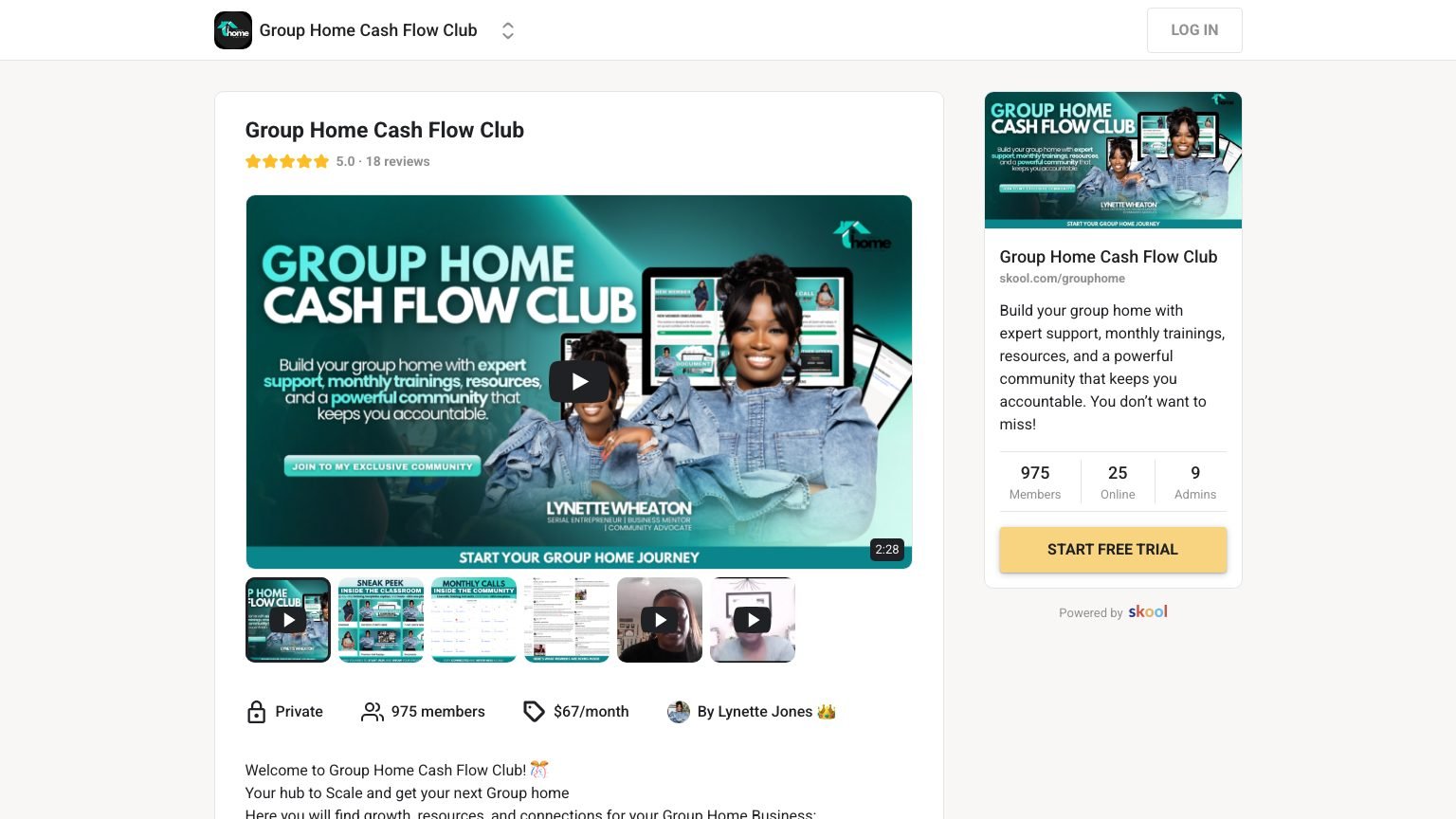
Group Home Cash Flow Club charges $67/mo for 143 modules. The founder's own bio calls her 8 group homes non licensed. What that means for you.
 By Ray Okafor ·
143 modules across 11 courses for $67 a month, about 47 cents per module per month
The founder's own bio describes her 8 group homes as non licensed, and licensing rules vary by state
Source: Skool public About page, captured September 9, 2026
Nine hundred and seventy-five members. Eighteen reviews. And a founder bio that uses the words “non licensed” about her own eight properties.
That last detail is where this review has to start.
A disclosure first. I am not a member of this community and nothing has been paid to Lynette Jones or her team. What follows was assembled from the community’s public Skool About page, the written reviews Skool shows only to paying members, and the founder’s own public channels, captured on 9 September 2026. Anything taken from the sales copy is labelled as the seller’s claim.
One more thing to be clear about up front. Group homes are regulated. Whether a home needs a licence depends on your state, sometimes your county or city, and on who lives there and what care you provide. Rules differ, they change, and they are enforced by agencies with the power to shut a house down. No training community substitutes for checking your own local requirements with the regulator that governs them.
Quick Decision
Join if you are already working toward a group home business in the United States, you want monthly training and a room of operators to ask questions in, and you will do your own licensing homework separately. At $67 a month with 143 modules and a staffed feed, the material-per-dollar case is strong.
Hold off if you expect the community to tell you what your state requires. It cannot, and the founder’s own model is described as non licensed, which is a different business from a licensed care facility. Hold off too if you want documented member outcomes, because 18 reviews from 975 members is not a record you can lean on.
The current terms are on the listing if you want to check them yourself.
Sixty-Seven Dollars, And A Trial With No Stated Length
Skool’s price record stores $67 monthly in US dollars. The join button does not show that figure at all. It reads START FREE TRIAL.
A trial is a genuine advantage. You can see the courses, the feed and the admins before money moves, which is more than most communities in this ranking allow.
Then look at what is not published. The trial length is missing. So is any refund policy. So is an annual plan, which at $804 a year would be the normal place a seller offers a discount for commitment.
Set a calendar reminder the day you start the trial. An unstated trial length is the kind of gap that turns into a charge you did not plan for.
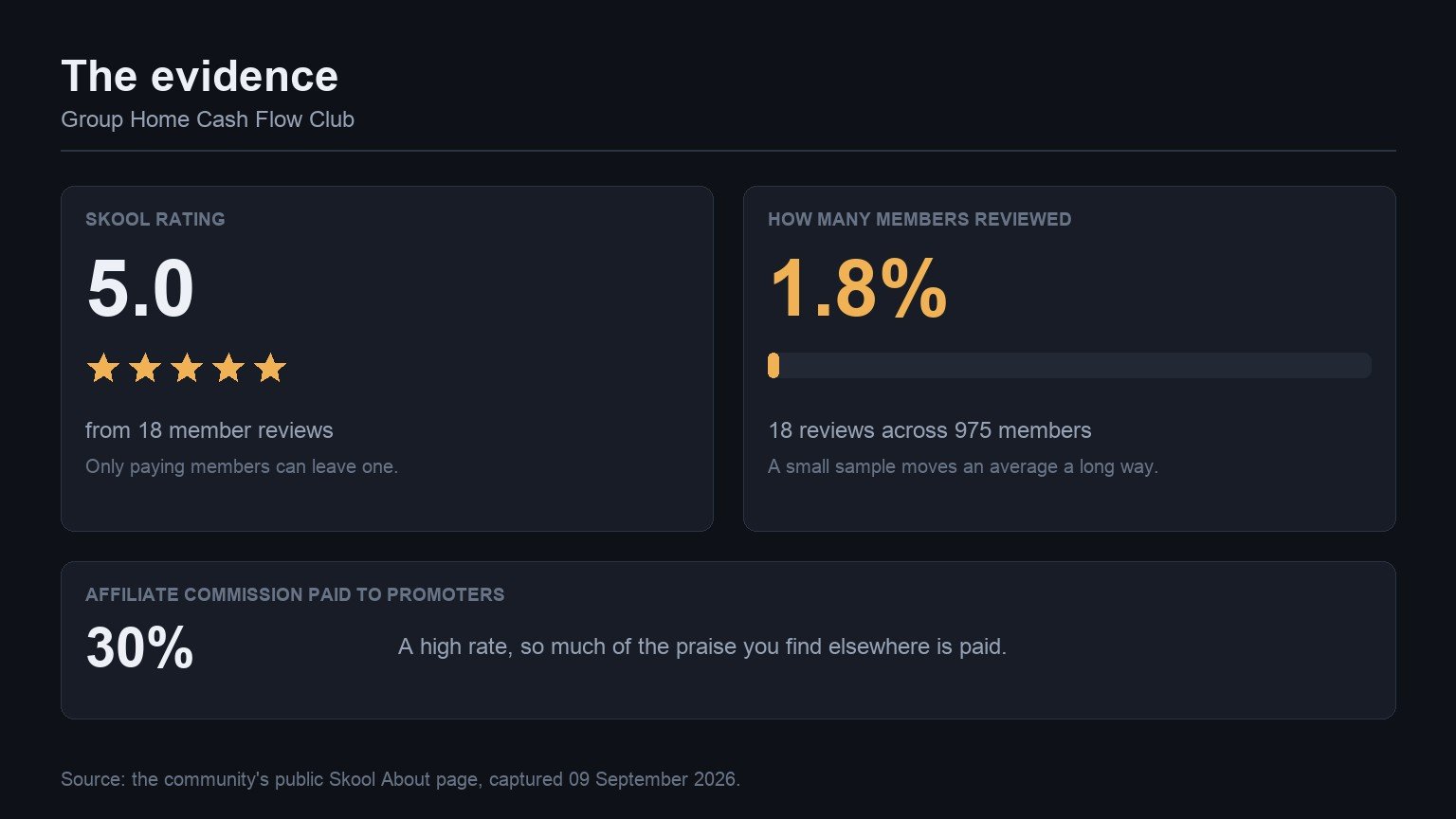
There is one number worth knowing before you read anyone else’s opinion of this community. The affiliate rate is 30%. That pays $20.10 a month for every referred member who stays, about $241 over a year. Enthusiastic write-ups elsewhere may be earning that. This one earns nothing.
Eleven Courses, 143 Modules, 4,839 Posts
| What | Count |
|---|---|
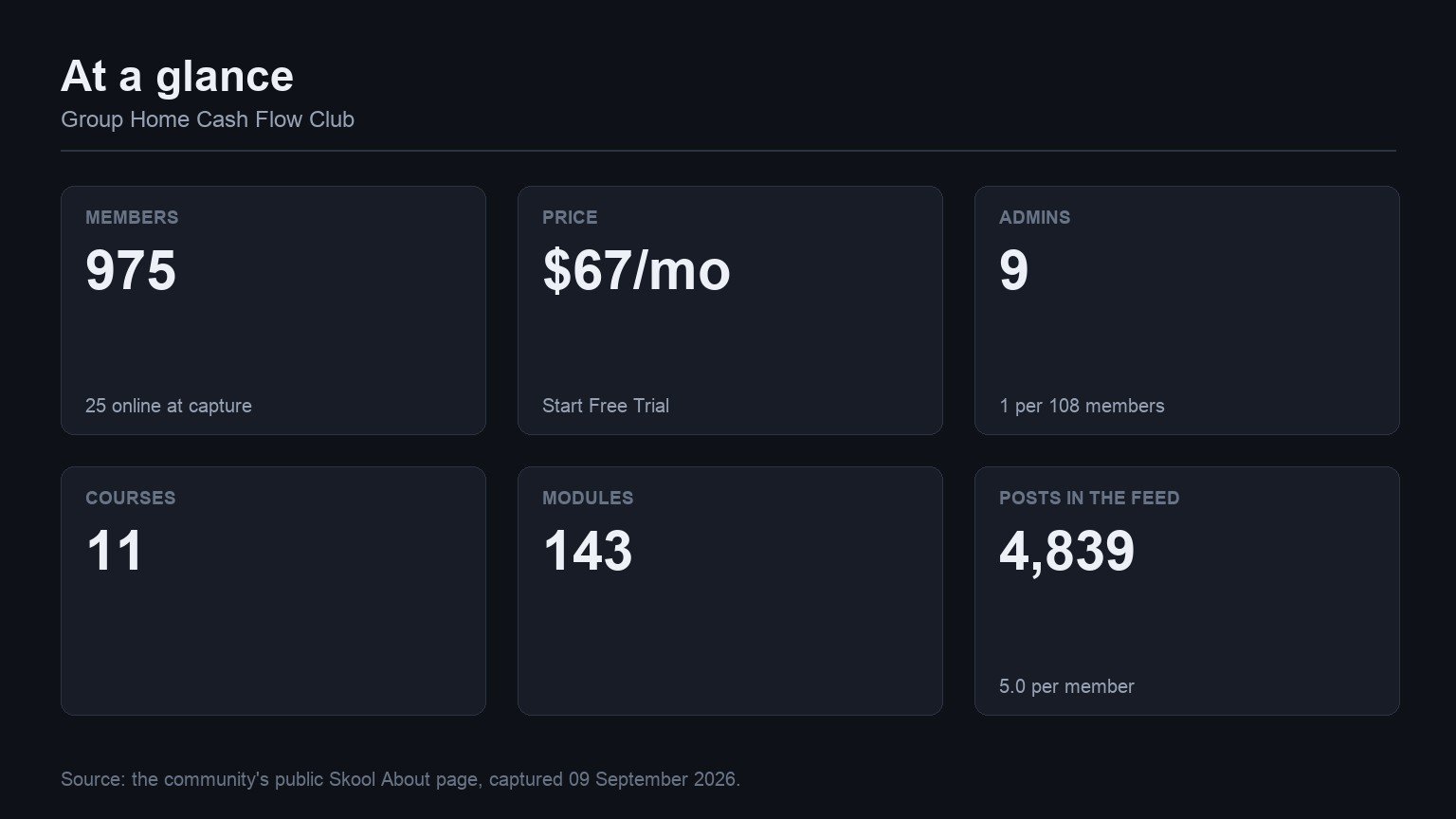
| Members | 975 |
| Members online at capture | 25 |
| Admins | 9 |
| Courses | 11 |
| Modules | 143 |
| Posts in the feed | 4,839 |
One hundred and forty-three modules across 11 courses averages 13 modules per course. At $67 a month that is about 47 cents per module per month, which is reasonable value by the standards of this category.
Nine admins for 975 members is the number that stands out. One staff seat per 108 people is better staffing than communities charging three times as much routinely provide.
The feed carries 4,839 posts, roughly five per member, with 25 people online at capture. This is an active room rather than a parked library.
What the seller says is inside
The page lists documents and resources, a virtual office, virtual networking events, an event schedule, new trainings each month with replays, guest speakers and Q&A sessions, ebooks and a book club, state and government contract training, real estate investing content and business credit building.
That is the seller’s own list, and it is broad. Breadth cuts both ways at 143 modules. Eleven topics split across that many lessons means roughly 13 lessons each, which is an introduction rather than a deep specialisation.
The state and government contract line is the one worth asking about first, because contract placement is where group home revenue tends to become predictable.
Lynette Jones, And The Words In Her Own Bio
Lynette Jones has been on Skool since 12 August 2023, about three years and one month at capture. Long tenure, and it counts for something.
Her bio is specific in a way most Skool founders avoid. She states she has eight non licensed group homes in the Houston, Texas area, that she has coached for three years across the US, and she goes by The Group Home Mogul. Her location field reads Houston, TX. Three public links sit on her profile: Facebook, Instagram and a YouTube channel called Grouphomesfornewbies.
The YouTube channel is the cheapest test available. Watch it before you spend $67 and decide whether her teaching suits you.
Her account carries a crown badge, which marks a high-earning Skool owner and says nothing about member results.
The licensing question you have to answer yourself
Her bio describes her own eight homes as non licensed. Take that at face value: it is her own description of her own model, and she is more upfront about it than she needed to be.
What it means for you depends entirely on where you live. Some jurisdictions allow certain shared-living arrangements to operate without a care licence, and others do not. The line usually turns on who the residents are, what services you provide, how many people share the property, and how local zoning treats the use. Those rules sit with state agencies, and some cities add their own on top.
So do this before anything else. Find the agency that regulates residential care in your state, read what it says about your intended resident population, and if the answer is unclear, pay a local attorney for an hour of their time. That hour costs less than a year of membership and it is the part no community can do for you.
A training group teaches a business model. Compliance is yours.
Eighteen Reviews From 975 Members
The average is 5.0 from 18 reviews. Out of 975 members, that is a 1.8% response rate.
Skool only takes reviews from paying members, so nothing in that average can be bought outright. The blind spot is the familiar one: people who cancel rarely stop to write on the way out, and 18 voices cannot represent 975 people.
Both visible reviews praise the room rather than the results. One member says the community feels like family, that members learn from each other, and that questions get immediate and sound answers from the team (a member review on Skool, August 2026). Another gives it two lines and calls the group fire (a member review on Skool, September 2026).
What the reviews leave out
Neither review names a home opened, a resident placed, a contract secured or a dollar of revenue.
For a community with “Cash Flow” in its name, that is the gap a buyer notices. The praise is about access and atmosphere, both of which the 9 admins and 4,839 posts support. The financial outcome the name implies has no first-person account behind it in public.
None of that means members are failing. It means the listing gives you no way to check, and the free trial is the only inspection tool you get.
Skip It If
- You want the community to handle licensing. It cannot, and rules vary by state and city.
- You need documented outcomes. Eighteen reviews from 975 members is 1.8%, and none names a result.
- You trust the reviews you found elsewhere. A 30% affiliate rate pays $20.10 a month per referral.
- You are outside the United States. The state and government contract training assumes a US regulatory system.
My Verdict
I score Group Home Cash Flow Club 3.7 out of 5.
The operational side is genuinely good. One hundred and forty-three modules across 11 courses at $67 a month works out near 47 cents per module, 9 admins for 975 members is one seat per 108, and a 4,839-post feed means questions get seen. Lynette Jones publishes her city, a real bio and three public channels including YouTube, so you can judge her teaching for free first. The free trial lets you inspect before paying, which most of this category refuses.
The deductions are about evidence and regulation. Eighteen reviews from 975 members is a 1.8% sample, and neither visible review names a home, a resident or a dollar. The 30% affiliate rate means $20.10 a month rides on every referral, so outside praise needs checking. The trial length, the refund policy and any annual plan are all absent from the listing. And the founder’s own model is described in her bio as non licensed, which is a fact you must reconcile against your own state’s rules before you copy it.
Start with the free YouTube channel, then take the trial and ask two questions in the feed: how long the trial runs, and how members in your state handled licensing. For a comparison with a community that publishes more outcome detail, read our Affiliate Marketing Launchpad review, and the AI Profit Boardroom review shows what a higher-priced business community looks like. The listing itself is here.
Full pros & cons
- 143 modules across 11 courses for $67 a month, about 47 cents per module per month
- Nine admin accounts for 975 members, one staff seat per 108 people
- 4,839 posts in the feed, roughly 5 posts per member, so questions get answered
- Lynette Jones publishes her city, a full bio and three public channels including YouTube
- The join button offers a free trial, so you can look inside before paying anything
- The founder's own bio describes her 8 group homes as non licensed, and licensing rules vary by state
- Only 18 of 975 members have written a review, a response rate of 1.8%
- The affiliate rate is 30%, or $20.10 a month per referral, so third-party praise can be paid
- No refund policy, no trial length and no annual plan appear anywhere on the listing
- Neither visible review names a home opened, a resident placed or a contract won
Try it yourself
Ready to put it to the test?
We may earn a commission at no extra cost to you. Affiliate disclosure.
Frequently Asked Questions
How much does Group Home Cash Flow Club cost?
Does this community make you licensed to run a group home?
How active is the community?
What do the reviews say?
Does the community pay affiliates?
Reader feedback
Was this review helpful?
Your feedback helps us write better reviews.
Thanks for your feedback.
Ray Okafor is the analyst behind AI Insider Edge, covering AI tools, online courses, and paid communities in the make-money-online space. Hands-on reviews say so and state what was actually paid for access. Research reviews say that too, and are built from the seller’s own public pages, verified member reviews, and the founder’s public record. Either way the aim is a buyer’s-eye read, not a press release. Reviews are independent and may contain affiliate links, at no extra cost to you.
More reviews: Real estate

Is Wholesailors Worth $25/mo?
Wholesailors charges $25/mo for 758 modules and a 14,719-post feed. But only 36 of 3,795 members have reviewed it. The numbers, read honestly.

Is Creative Owners Club Worth $25/mo?
Creative Owners Club charges $25/month for a real estate mentorship with 10,024 members. The 4.8 rating and 6 admins deserve a closer look.

RAMP REI Skills Academy Skool Review (2026)
RAMP REI lists $9/mo, but says plans are priced for teams and solo pricing is by email. 601 modules, 564 members, 1 review. What to check before joining.

Is Reverse Selling Inner Circle Worth $1,600/mo?
Reverse Selling Inner Circle costs $1,600 a month, or $19,200 a year. It holds 1,108 modules, 13,148 posts and just 8 member reviews.

Programa Investir Imobiliário Skool Review (2026)
A Portuguese property mentorship at $3,000 a year, 1,235 members and 12 admins. The 5.0 rating rests on 33 reviews, none in English.
The Edge Briefing
One honest review, every Sunday.
One email a week: which AI tools, courses & communities passed the rubric — and which to skip. Built for people funding their own stack.